Imagine standing in Jerusalem and seeing the golden Dome of the Rock shining above the ancient city. For many Christians, the sight raises deep questions: What does the Dome of the Rock mean in the Bible? Why is it important? Is it mentioned in Scripture? Does it have a spiritual meaning?
The short answer is that the Bible does not mention the Dome of the Rock by name. The building was constructed centuries after the biblical period. However, the place where it stands is closely connected with important biblical history, especially the Temple Mount and Mount Moriah.
Understanding this difference helps us approach the subject with wisdom. The Bible gives us a rich history of Jerusalem, the temple, worship, sacrifice, God’s presence, and His promises. The Dome of the Rock stands today in a location connected to some of those biblical events, but Christians should not claim that Scripture gives the building itself a specific prophetic or spiritual meaning.
This article explores the Dome of the Rock meaning in the Bible, its connection to biblical Jerusalem, possible spiritual symbolism, dreams involving the structure, and the faith lessons Christians can take from this historic place.
What Is the Dome of the Rock?

The Dome of the Rock is a famous Islamic shrine located in Jerusalem on the Temple Mount, also known as Haram al-Sharif. Its large golden dome has become one of the most recognizable landmarks in the world.
The building was completed in the late seventh century, long after the events recorded in the Bible. Therefore, the Dome of the Rock itself is not a biblical building.
Its location, however, is deeply connected with biblical history.
The Temple Mount is associated with the ancient Jewish temple. Jerusalem was also the city where Jesus taught, worshiped, was crucified, and rose from the dead.
Because of this rich history, the location carries great meaning for Christians.
Still, it is important to separate biblical facts from later religious interpretations.
The Bible teaches us about:
- Jerusalem
- Mount Moriah
- Solomon’s Temple
- The temple in Jesus’ time
- Jesus’ death and resurrection
- God’s plan of redemption
It does not teach that the Dome of the Rock itself has a particular prophetic meaning.
Dome of the Rock Meaning in the Bible: What Does Scripture Say?
The Bible does not directly explain the Dome of the Rock because it did not exist when the biblical books were written.
However, the land on which it stands has strong biblical connections.
One important connection is Mount Moriah.
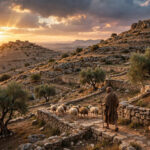
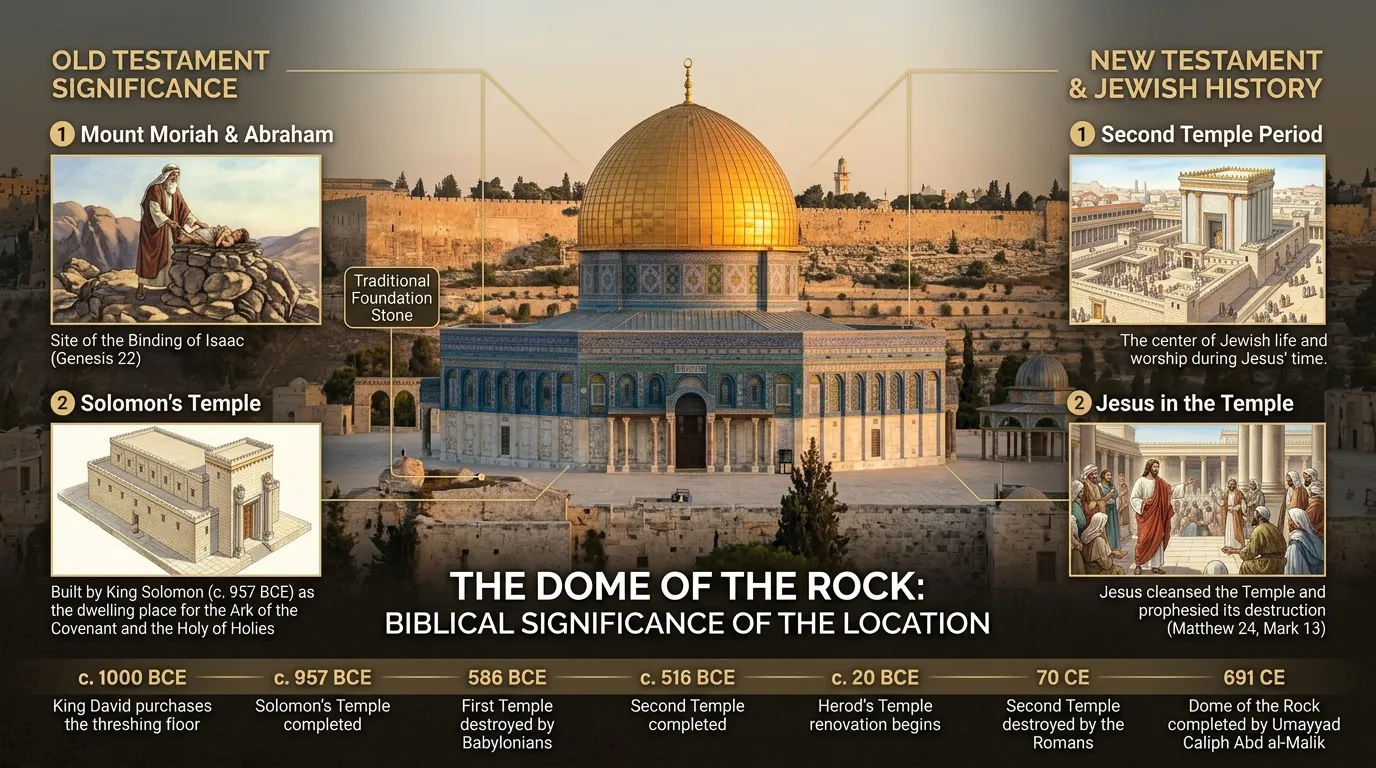
Genesis 22 describes Abraham taking Isaac to the land of Moriah. God tested Abraham’s faith and provided a ram instead of Isaac. This story points to themes of faith, obedience, sacrifice, and God’s provision.
Later, 2 Chronicles 3:1 says Solomon began building the temple in Jerusalem on Mount Moriah.
This creates an important biblical connection between the location and the story of God’s people.
The main lesson is not about a golden building. It is about God’s faithfulness and provision.
Abraham learned that God provides. Solomon’s temple became a center of worship. Centuries later, Jesus came to Jerusalem and fulfilled God’s redemptive plan through His death and resurrection.
The Biblical Connection to Mount Moriah

Mount Moriah is one of the most important geographical connections when studying the history behind the Dome of the Rock.
In Genesis 22, Abraham was told to offer Isaac. At the critical moment, God stopped him and provided a ram.
The story teaches that Abraham trusted God even when he did not understand everything.
Hebrews 11:17–19 later reflects on Abraham’s faith. The New Testament presents Abraham as an example of trusting God’s promises.
This gives Christians a powerful spiritual lesson:
Faith means trusting God’s character even when the path ahead is unclear.
The exact relationship between the biblical Mount Moriah and every part of today’s Temple Mount complex involves historical and archaeological questions. Christians should therefore avoid presenting uncertain details as absolute biblical facts.
What Scripture clearly gives us is the story of Abraham, Moriah, God’s provision, and the temple’s later connection with the same region.
Dome of the Rock Meaning in the Bible + Hebrew Meaning
The phrase “Dome of the Rock” does not have a Hebrew meaning given in the Bible because it is the English name of a later Islamic shrine.
In Arabic, the shrine is commonly called Qubbat as-Sakhrah, meaning “Dome of the Rock.” The name refers to the rock associated with the building’s central location.
The Hebrew name often used for the site is Kippat Ha-Sela, which also means “Dome of the Rock.”
It is important not to confuse the name of the building with the biblical Hebrew words connected with the area.
For example, the Hebrew word Moriah appears in Genesis 22:2 and 2 Chronicles 3:1. Moriah is associated with the location where Abraham was tested and where Solomon’s temple was later built.
So, from a biblical perspective, the most important words to study are not the name of the Dome of the Rock but the biblical concepts connected with the location:
- Moriah
- Jerusalem
- Temple
- Sacrifice
- Worship
- God’s presence
- Faith
- Redemption
These themes have much stronger biblical support.
What Does the Temple Mount Mean in the Bible?
The Temple Mount carries major biblical importance because it was associated with the temple in Jerusalem.
King Solomon built the first temple during his reign. When the temple was dedicated, Solomon prayed that God would hear the prayers of His people.
In 1 Kings 8, Solomon recognized something important: God cannot be contained by a physical building. Even though the temple was a holy place of worship, God is greater than any structure humans build.
This truth is still valuable today.
A Christian may visit a historic biblical location and feel deeply moved. But God’s presence is not limited to Jerusalem.
Jesus explained this in John 4:21–24 when He taught that true worshipers would worship the Father “in spirit and truth.”
Therefore, Christians should never think that God is more present in one building than another simply because of its history.
The Dome of the Rock and Jesus
The Dome of the Rock did not exist during Jesus’ earthly ministry.
Jesus, however, frequently visited the temple area in Jerusalem.
The Gospels describe Jesus teaching in the temple, challenging religious hypocrisy, and speaking about the temple’s future destruction.
In Matthew 24:1–2, Jesus told His disciples that the temple buildings would be destroyed. This prophecy was fulfilled when Jerusalem and the Second Temple were destroyed by the Romans in AD 70.
Jesus’ teaching also points Christians beyond physical buildings.
In John 2:19–21, Jesus spoke about raising the temple, and John explains that He was referring to His body.
This is a major Christian truth.
Jesus is the center of God’s redemptive work, not a particular monument or structure.
Does the Dome of the Rock Have a Spiritual Meaning?
Some Christians see spiritual symbolism in the Dome of the Rock because of its location and connection with Jerusalem. Others connect the Temple Mount with biblical prophecy.
These interpretations should be handled carefully.
The Bible does contain prophecies concerning Jerusalem, the temple, the end times, and God’s future kingdom. Christians have different views about how particular passages should be understood.
However, Scripture does not say that the Dome of the Rock itself represents a specific spiritual event.
Therefore, it is wise to distinguish between:
What the Bible says:
The Temple Mount is connected with important biblical events and the history of Jerusalem.
What Christians may interpret:
Some Christians see modern developments in Jerusalem as significant when considering biblical prophecy.
What Scripture does not establish:
The Bible does not identify the Dome of the Rock as a specific end-times sign.
This balanced approach protects believers from fear and speculation.
Spiritual Symbolism Christians May Reflect On
Although the Bible does not assign a direct spiritual meaning to the Dome of the Rock, the biblical history surrounding Jerusalem can inspire meaningful reflection.
God’s Faithfulness
Jerusalem reminds Christians of God’s long story of redemption.
From Abraham to David, from Solomon to the prophets, and finally to Jesus, Scripture shows that God works through history according to His purposes.
When life feels uncertain, remember:
God’s faithfulness does not depend on our ability to understand every detail of His plan.
God’s Provision
The story of Abraham and Isaac in Genesis 22 emphasizes God’s provision.
Abraham called the place “The LORD Will Provide” (Genesis 22:14).
This can encourage Christians facing financial pressure, family struggles, unanswered prayers, or difficult decisions.
God’s provision may not always look exactly as we expect, but His character remains trustworthy.
The Importance of True Worship
The temple was a place of worship, but Jesus taught that worship is not merely about geography.
True worship involves the heart.
A person can stand near a famous religious site and still have a distant heart. Another person can pray quietly in a small home and worship God sincerely.
God looks for worship that is genuine and rooted in truth.
What Does Seeing the Dome of the Rock Mean in a Dream?
Some people search for the Dome of the Rock dream meaning after seeing the building in a dream.
Dreams can feel powerful and deeply personal. However, Christians should be careful about automatically treating every dream as a message from God.
The Bible records times when God used dreams. Joseph received dreams in Genesis. Daniel received visions. Joseph, the husband of Mary, was also warned through dreams in Matthew 1 and 2.
But Scripture does not teach that every modern dream carries a divine message.
If you dream about the Dome of the Rock, consider the context of your life.
Ask yourself:
- What emotions did I feel in the dream?
- Have I recently been thinking about Jerusalem or the Bible?
- Am I facing a decision involving faith or trust?
- Did the dream make me feel peaceful, afraid, confused, or curious?
- Does the interpretation agree with Scripture?
Dreams should always be tested against God’s Word.
A dream should never be used to create a new doctrine, predict a certain future event, or replace prayer and biblical wisdom.
Common Christian Interpretations of the Dome of the Rock
Christians may interpret the symbolism differently depending on their theological background.
Some may view the structure primarily as a reminder of the history of Jerusalem.
Others may connect it with discussions about the biblical temple and end-times prophecy.
Some may see the location as a reminder of the conflict and brokenness found throughout human history.
Still others may simply see it as a historic landmark connected with a place that was central to biblical events.
None of these interpretations should be presented as a direct statement from Scripture.
Where the Bible is clear, Christians should be confident. Where Scripture is silent, Christians should be humble.
That principle is especially important when discussing prophecy.
Is the Dome of the Rock Mentioned in Bible Prophecy?
No. The Bible does not specifically mention the Dome of the Rock.
Some people connect modern Jerusalem with passages about the temple, the end times, or events described in Daniel, Matthew, 2 Thessalonians, and Revelation.
However, interpreting these passages requires care.
For example, Daniel contains visions involving kingdoms and future events. Jesus discusses future tribulation and His return in Matthew 24. Revelation uses powerful symbolic imagery concerning God’s final victory.
Christians disagree about how some prophetic passages relate to future events.
Therefore, it would be inaccurate to say, “The Bible predicts the Dome of the Rock.”
A more responsible statement is that modern Jerusalem is located in a region deeply connected with biblical history and remains important in Christian discussions about prophecy.
What Can Christians Learn From the Dome of the Rock?
Even though the building itself is not part of the Bible, the history surrounding its location can lead to several helpful spiritual lessons.
God Is Bigger Than Buildings
The temple was important, but Scripture repeatedly points God’s people toward a relationship with Him.
Today, Christians are described as God’s temple through the Holy Spirit in passages such as 1 Corinthians 6:19.
This reminds us that faith is not merely about visiting sacred places.
God’s Word Should Guide Our Understanding
Jerusalem can inspire strong emotions. So can dreams, current events, religious symbols, and discussions about prophecy.
But Christians need a steady foundation.
Let Scripture guide your interpretation rather than allowing fear or speculation to guide Scripture.
We Should Pray for Peace
Jerusalem has experienced centuries of conflict, suffering, and division.
Psalm 122:6 says, “Pray for the peace of Jerusalem.”
For Christians, this can become a simple call to pray for peace, mercy, justice, wisdom, and the well-being of people living in the region.
Jesus Is Our Hope
The greatest biblical connection to Jerusalem is not a building.
It is Jesus.
Jesus was crucified in Jerusalem. He rose again. His resurrection is the foundation of Christian hope.
Therefore, when thinking about Jerusalem, the temple, Mount Moriah, or any historic religious site, Christians can ultimately turn their hearts toward Christ and the gospel.
How Should Christians Respond When They Feel Drawn to Jerusalem?
Perhaps you saw the Dome of the Rock in a photograph. Maybe you dreamed about it. Maybe you are studying biblical prophecy and want to understand its significance.
Instead of immediately searching for hidden signs, begin with prayer and Scripture.
You might ask:
“Lord, what are You teaching me about faith, obedience, worship, and trust?”
Then study the relevant biblical passages in context.
You can begin with:
- Genesis 22 — Abraham and Mount Moriah
- 1 Kings 8 — Solomon dedicates the temple
- 2 Chronicles 3 — Solomon builds the temple on Mount Moriah
- Psalm 122 — Prayer for Jerusalem
- John 2 — Jesus and the temple
- John 4 — Worshiping in spirit and truth
- Matthew 24 — Jesus’ teaching about the future
- Hebrews 11 — Faith and Abraham’s example
The goal is not simply to discover a mysterious meaning.
The goal is to know God better and trust Him more deeply.
Frequently Asked Questions
Is the Dome of the Rock mentioned in the Bible?
No. The Dome of the Rock was built centuries after the biblical books were written. The Bible does, however, discuss Jerusalem, Mount Moriah, the temple, and events connected with the Temple Mount.
What biblical place is connected with the Dome of the Rock?
The location is associated with the Temple Mount in Jerusalem. Mount Moriah is also important in biblical history because Genesis 22 connects it with Abraham and Isaac, while 2 Chronicles 3:1 connects Mount Moriah with Solomon’s temple.
Does the Dome of the Rock have an end-times meaning?
The Bible does not specifically identify the Dome of the Rock as an end-times sign. Christians have different interpretations of biblical prophecy concerning Jerusalem and the temple, so such claims should be made carefully.
What does the rock represent in the Bible?
There are several important rocks and rock images in Scripture. God is sometimes described as a Rock, emphasizing His strength, protection, and faithfulness. However, the Bible does not say that the particular rock beneath the Dome of the Rock has a universal Christian symbolic meaning.
What does dreaming about the Dome of the Rock mean?
There is no single biblical interpretation. The dream may reflect thoughts about Jerusalem, faith, history, prophecy, worship, or personal emotions. Christians should test any spiritual interpretation against Scripture and avoid treating every dream as a divine message.
Should Christians be afraid of the Dome of the Rock?
There is no biblical reason for Christians to live in fear of the building. Christians are called to trust God, remain grounded in Scripture, pray for peace, and keep their hope centered on Jesus.
Final Thoughts
The Dome of the Rock meaning in the Bible becomes clearer when we separate the modern building from the biblical history of the land where it stands.
The Bible does not mention the Dome of the Rock itself. But Jerusalem, Mount Moriah, the temple, sacrifice, worship, and God’s promises all have important places in Scripture.
The story of Abraham reminds us of faith and God’s provision. The temple reminds us of worship and God’s holiness. Jesus’ ministry in Jerusalem points us toward redemption. His resurrection gives believers lasting hope.
So, if the Dome of the Rock catches your attention, let it lead you to something deeper than speculation.
Let it remind you to read Scripture carefully. Trust God’s Word. Pray for peace. Seek wisdom. And keep your eyes on Christ.
God’s plans do not depend on our ability to decode every symbol or understand every mystery. We can rest in the truth that God is faithful, Jesus is our hope, and God’s grace is sufficient for every season of life.
When you do not understand what God is doing, you can still trust who He is.