One of the strangest reds in the Bible fooled an entire army. During a campaign against Moab, the allied kings of Israel, Judah, and Edom were dying of thirst in the desert when God miraculously filled the valley with water. At sunrise, the Moabites looked across at it — and saw red. “The Moabites saw the water opposite them as red as blood. And they said, ‘This is blood; the kings have surely fought together'” (2 Kings 3:22–23). They charged in for the plunder and ran straight into an ambush. The water was not blood. The sunrise had painted it red, and a misread color led them to their deaths.
It is a perfect parable for red in Scripture: the most powerful color in the Bible, and the easiest to misread. Red saves and red warns. Red marks the forgiven and the doomed. The color never lies — but readers of the color often do. To understand red biblically is to learn to read it carefully, in context, the way the Moabites fatally did not.
Blood on the Doorposts
Red’s first and greatest sermon is blood — and blood’s first sermon is protection. On the night of the Exodus, God commanded each Israelite household to take a lamb “and put the blood on the two doorposts and the lintel of the houses” (Exodus 12:7). The promise: “when I see the blood, I will pass over you, and no plague will befall you to destroy you” (Exodus 12:13). Red became the color of a marked people — visibly claimed by God, visibly spared by God.
The logic behind it is stated once, definitively: “For the life of the flesh is in the blood, and I have given it for you on the altar to make atonement for your souls” (Leviticus 17:11). Blood is red because life is red; atonement is red because atonement costs life. The New Testament draws the line without blurring: “without the shedding of blood there is no forgiveness of sins” (Hebrews 9:22). And the blood in question is Christ’s — believers are sprinkled with “the blood of Jesus Christ” (1 Peter 1:2), ransomed “with the precious blood of Christ, like that of a lamb without blemish” (1 Peter 1:19). Every red in Scripture that speaks of sacrifice is whispering, or shouting, this name.
The Robe of Mockery
Red’s darkest biblical moment is also, paradoxically, its most redemptive. Before the crucifixion, Roman soldiers “stripped him and put a scarlet robe on him, and twisting together a crown of thorns, they put it on his head… And kneeling before him, they mocked him, saying, ‘Hail, King of the Jews!'” (Matthew 27:28–29). Scarlet — the color of kings — draped on a condemned man as a joke.
The mockery was more true than the mockers knew. He was the King; the robe was accidentally accurate. But the deeper truth is what the scarlet cost Him: within hours that robe would be exchanged for a cross, and the red of mockery would be joined by the red of His own blood. Isaiah had seen it centuries earlier: “He was pierced for our transgressions” (Isaiah 53:5). The scarlet robe is red’s sermon on humiliation willingly borne — glory wearing shame so that shame could one day wear glory.
Red as Warning
Turn the color and it blazes. The second horseman of the Apocalypse rides “a bright red horse,” and “its rider was permitted to take peace from the earth, so that people should slay one another” (Revelation 6:4). Here red is not atonement but bloodshed — the color of war, slaughter, and the removal of peace. Isaiah’s vision of the divine warrior comes “with his garments stained crimson” from Edom, having “trodden the winepress alone” in judgment (Isaiah 63:1–3). And Nahum pictures the shields of Nineveh’s attackers “red” and soldiers “clothed in scarlet” (Nahum 2:3) — red as the uniform of coming destruction.
Even nature preaches this red. The first plague turned the Nile to blood — “all the water in the Nile turned into blood” (Exodus 7:20) — red as the color of judgment on a defiant empire. The pattern is consistent: when red appears as inflicted blood rather than offered blood, it warns. Offered blood saves (the doorpost, the cross). Inflicted blood testifies to judgment (the Nile, the winepress). The Moabites’ error was confusing the two — reading a sunrise as a slaughter. Context is everything.
Red also names one of Scripture’s saddest bargains. Esau came in from the field famished and saw Jacob’s stew — “Let me eat some of that red stew, for I am exhausted!” (Genesis 25:30). The Hebrew doubles the red: ha’adom ha’adom, “the red, the red.” Esau sold his birthright for it, and the narrator stamps him with the color forever: “Therefore his name was called Edom” — Red (Genesis 25:30). Here red is appetite: the immediate, the visible, the steaming bowl that costs an inheritance. The sermon writes itself and Hebrews underlines it, warning against anyone “godless like Esau, who sold his birthright for a single meal” (Hebrews 12:16). Red as warning is not only about wars and dragons. Sometimes it is about lunch — the small red temptation that trades the eternal for the immediate. The Moabites misread red water and lost a battle. Esau correctly read red stew and lost far more.
Red in the Worship Tent
There is a quieter red woven through the tabernacle that ties the threads together. The tent’s outer covering included “tanned rams’ skins dyed red” (Exodus 26:14) — the worship structure itself wore red on its back, so to speak. And scarlet yarn ran through the curtains and the priestly garments (Exodus 26:1; 28:5). Every act of worship in Israel happened under and around red: the color of the sacrifice that made worship possible.
The design is deliberate. You could not approach God in Israel without passing red — because you cannot approach God anywhere without passing the blood. The tabernacle’s color scheme was a permanent visual sermon: access to the holy runs through atonement. Red was not decoration. It was doctrine you could see.
What Red Asks of the Heart
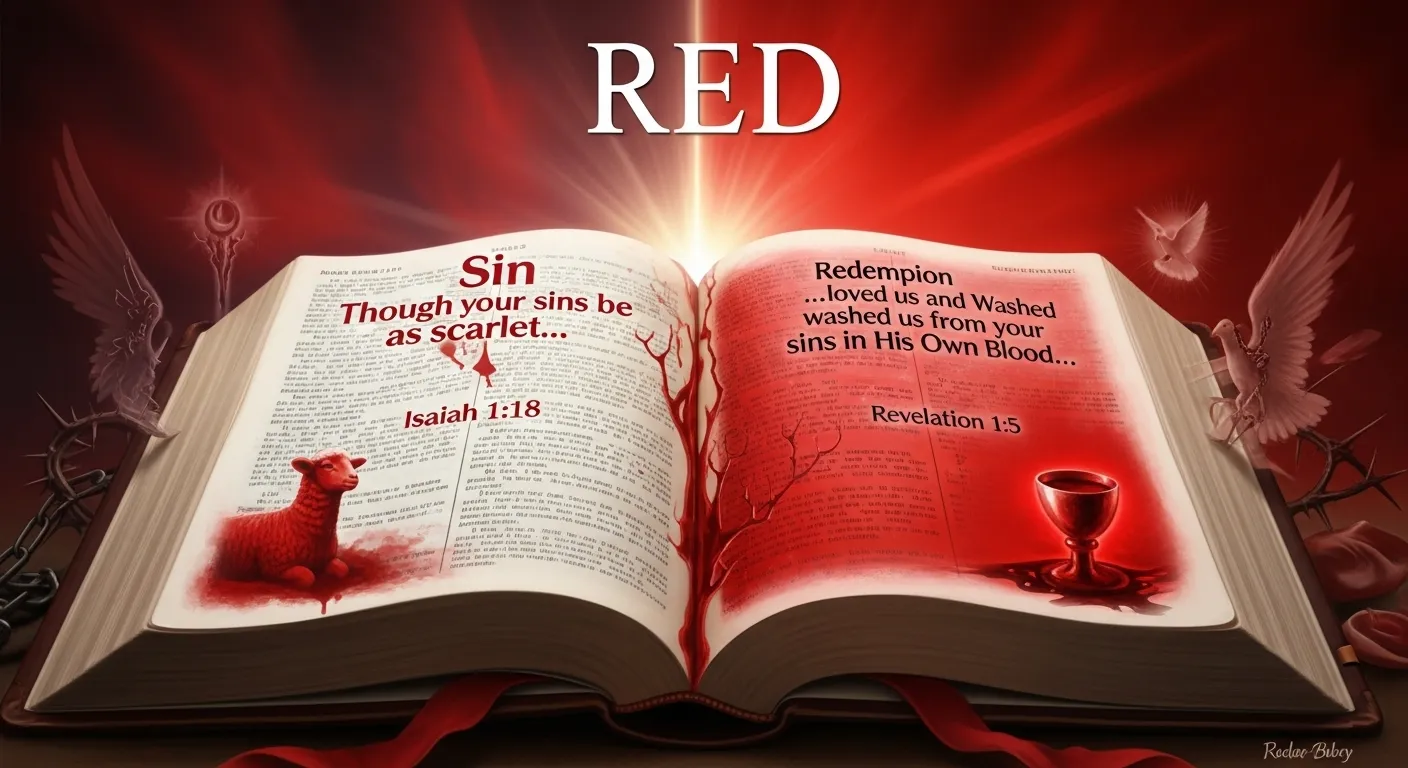
Gather the threads and red asks three things. First, gratitude: the red of the doorpost and the cross means someone’s blood stood between you and judgment. “In him we have redemption through his blood, the forgiveness of our trespasses” (Ephesians 1:7). Second, courage: red is the color of martyrs for a reason — the boldness to stand when standing costs. The early church’s red was not decorative; it was the blood of witnesses. Third, honesty: “though your sins are like scarlet, they shall be as white as snow” (Isaiah 1:18). Red names the stain before it announces the cleansing. Skip the naming and the cleansing means nothing.
Red Wine and the Coming King
Red has one more biblical register, and it flows from a cup. Jacob’s blessing over Judah — the Messianic tribe — pictures abundance in red: “Binding his foal to the vine and his donkey’s colt to the choice vine, he has washed his garments in wine and his vesture in the blood of grapes. His eyes are darker than wine” (Genesis 49:11–12). Wine-red as the color of the coming King’s plenty: so much wine that garments are washed in it. The image is extravagant on purpose — the Messiah’s reign will be a vintage beyond measure.
But wine’s red has a shadow, and Proverbs names it: “Do not look at wine when it is red, when it sparkles in the cup and goes down smoothly. In the end it bites like a serpent” (Proverbs 23:31–32). The same red that pictures kingdom abundance pictures addiction’s allure. The color does not change; the use does. Scripture’s honesty about red wine mirrors its honesty about red everywhere: the symbol is innocent, the heart decides.
And the thread resolves at the table. Jesus took the cup — the red wine of Passover, the color of the blood on the doorposts — and said, “This is my blood of the covenant, which is poured out for many for the forgiveness of sins” (Matthew 26:28). The red of Judah’s blessing, the red of the Exodus door, the red of the cross: one continuous stream. Every red in Scripture was flowing toward that cup.
Red, read rightly, is the gospel’s own color: the blood that warns (the Nile), the blood that marks (the doorpost), the blood that mocks-turned-to-majesty (the scarlet robe), and the blood that washes (the cross). Misread it and you charge like the Moabites into disaster. Read it in the light of Scripture and it points, every time, to the same place. The symbolism of red across cultures — power, passion, warning, lifeblood — finds its deepest anchor in the Bible’s own reds, where the color of life became, by God’s appointment, the color of forgiveness.










