She was a foreigner, a widow, and destitute, gleaning leftover grain in a field that was not hers so she and her mother-in-law would not starve. Nothing about Ruth’s situation looked like love. But when Boaz noticed her, protected her, and eventually redeemed her family’s land and married her, the Hebrew text describes his actions with a word that carries the weight of the whole Bible’s teaching on love: hesed. Steadfast, loyal, covenant love, love that shows up and does something. If you want to understand the love meaning in the Bible, do not start with feelings. Start with Ruth in the field, and watch what love does.
The Bible’s most famous sentence about love is “God is love” (1 John 4:8). But Scripture never leaves that sentence as an abstraction. It immediately translates it into action: “In this is love, not that we have loved God but that he loved us and sent his Son to be the propitiation for our sins” (1 John 4:10). Biblical love is not primarily something God feels. It is something God does, at infinite cost, for people who did not deserve it. Every discussion of love in Scripture flows from that center.
Hesed: Love That Keeps Its Promises
The Old Testament’s richest word for love is hesed, and English struggles to translate it. Bibles render it as steadfast love, lovingkindness, mercy, or loyalty, and all of those are true at once. Hesed is love bound by covenant, love that has made promises and keeps them when keeping them is costly. It is the love Exodus 34 describes when God proclaims His own name to Moses: “abounding in steadfast love and faithfulness” (Exodus 34:6). Before God describes His power or His justice, He describes His hesed. This is who He is.
Watch hesed in action. When Israel worshiped a golden calf at the foot of Sinai, days after God had rescued them from Egypt, God’s hesed did not evaporate. He disciplined them, yes, but He did not abandon the covenant (Exodus 32-34). When David had every political reason to eliminate Saul’s surviving family, he sought out Jonathan’s crippled son Mephibosheth and seated him at the king’s table for life, for Jonathan’s sake (2 Samuel 9). That is hesed: loyalty that outlives the person it was promised to. When Ruth clung to Naomi and said, “Where you go I will go… your God my God” (Ruth 1:16), she was speaking hesed, and God wove her into the lineage of the Messiah because of it (Matthew 1:5).
This reframes love entirely. In modern usage, love is mainly a feeling that comes and goes. In the Bible, love is mainly a loyalty that stays and acts. Feelings may accompany it, but they are not its foundation. The foundation is covenant, promise, and faithful action over time.
Hosea: Love That Chases the Unfaithful
No book displays covenant love more shockingly than Hosea. God commanded the prophet to marry Gomer, a woman who would be unfaithful to him, as a living parable of Israel’s unfaithfulness to God (Hosea 1:2). When Gomer left, God told Hosea to go love her again, to buy her back from the slave market where her choices had landed her (Hosea 3:1-3). The price Hosea paid for his own wife is one of the most heartbreaking verses in Scripture.
This is hesed pushed to its extreme: love that pursues the one who does not want it, pays for the one who cannot pay, and restores the one who ran. “How can I give you up, O Ephraim? … My heart recoils within me; my compassion grows warm and tender” (Hosea 11:8). God’s love is not the cool affection of a distant admirer. It is the anguished, pursuing love of a husband going after a runaway bride. Every believer who has wandered and been brought back knows this love firsthand.
The New Commandment: Love as Christ Loved
On the night before His death, Jesus gave His disciples a command that redefined love for all time: “A new commandment I give to you, that you love one another: just as I have loved you, you also are to love one another” (John 13:34). The command to love was not new. The standard was. Just as I have loved you. And within hours, they would watch what that meant: the Son of God washing feet, then stretching out His arms on a cross.
John, who leaned on Jesus’ chest that night, spent the rest of his life unpacking the standard. “By this we know love, that he laid down his life for us, and we ought to lay down our lives for the brothers” (1 John 3:16). Biblical love is measured in sacrifice. Not in intensity of feeling, not in eloquence of words, but in what you are willing to give up. “Little children, let us not love in word or talk but in deed and in truth” (1 John 3:18).
This is why Jesus said the world would identify His followers by their love (John 13:35). Not by their doctrine statements, their political alignment, or their worship style, though those matter, but by their visible, costly, self-giving love for one another. Love is the church’s uniform. Without it, everything else is camouflage.
1 Corinthians 13: Love Described by Its Actions
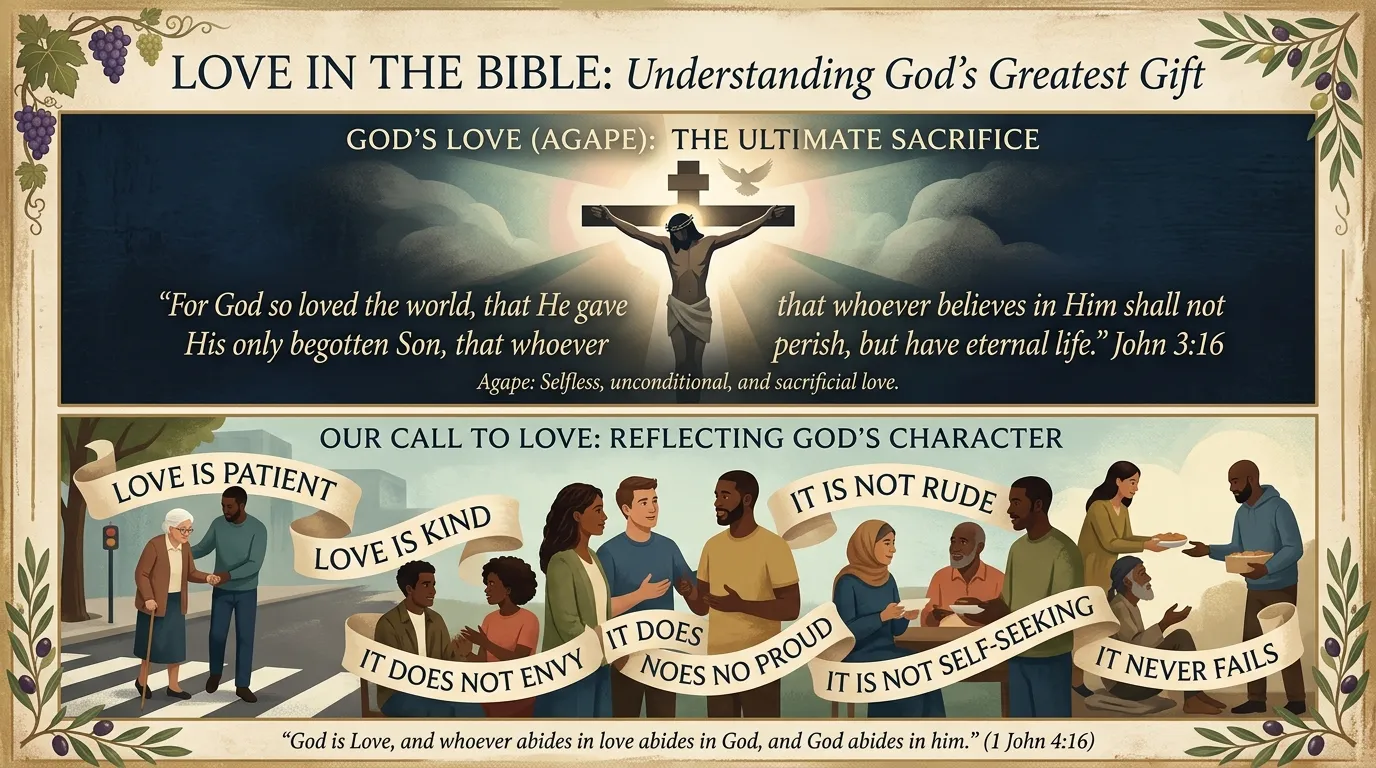
The most famous passage on love is striking for what it does not contain. Paul never describes what love feels like. Every line describes what love does. Love is patient, it waits without punishing. Love is kind, it acts for another’s good. It does not envy, it does not boast, it is not arrogant or rude. It does not insist on its own way. It is not irritable or resentful. It does not rejoice at wrongdoing but rejoices with the truth. It bears all things, believes all things, hopes all things, endures all things (1 Corinthians 13:4-7).
Read that list as a job description and it becomes deeply convicting. Patience with the difficult person is love in work clothes. Refusing to keep a record of wrongs is love doing accounting God’s way. Rejoicing in truth rather than in someone’s failure is love choosing its pleasures carefully. Paul wrote these words to a church torn by division, spiritual pride, and lawsuits, which means 1 Corinthians 13 was not wedding poetry. It was emergency surgery. Love, for Paul, is what the church does when it is hardest to do.
And the chapter ends with love’s permanence: “Love never ends” (1 Corinthians 13:8). Prophecies will pass, tongues will cease, knowledge will fade, but love remains, because love is the character of God Himself, and God does not end.
Loving Enemies: Love’s Final Frontier
Jesus pushed covenant love past every boundary His hearers recognized. “You have heard that it was said, ‘You shall love your neighbor and hate your enemy.’ But I say to you, Love your enemies and pray for those who persecute you” (Matthew 5:43-44). This is love as God loves, because God “makes his sun rise on the evil and on the good, and sends rain on the just and on the unjust” (Matthew 5:45).
Jesus did not merely teach this. He performed it. On the cross, with His executioners gambling for His clothes below, He prayed, “Father, forgive them, for they know not what they do” (Luke 23:34). Stephen, the first martyr, followed his Lord’s pattern, praying for his murderers as the stones fell (Acts 7:60). And Saul of Tarsus, who approved of Stephen’s killing, became Paul the apostle, living proof that enemy-love is not naive idealism. It is the strategy by which God conquers His enemies: He loves them into becoming family.
Paul turns this into direct instruction: “If your enemy is hungry, feed him; if he is thirsty, give him something to drink” (Romans 12:20). Love your enemy is not a feeling you wait for. It is a meal you serve.
Loving God Back: Obedience as Affection
Scripture also describes love flowing upward, from people to God, and here too love is action. Jesus said it plainly: “If you love me, you will keep my commandments” (John 14:15). John echoes: “For this is the love of God, that we keep his commandments” (1 John 5:3). Love for God is not measured by worship emotions, though emotions have their place. It is measured by obedience when obedience is costly.
The Shema, the central confession of Israel, commands love with totality: “You shall love the Lord your God with all your heart and with all your soul and with all your might” (Deuteronomy 6:5). Heart, soul, strength, the whole person, held back in nothing. Mary of Bethany pouring expensive perfume on Jesus’ feet (John 12:3) is what that looks like in a room. It looks wasteful to calculators and beautiful to heaven.
In the end, the love meaning in the Bible is gloriously simple and endlessly demanding: love is covenant loyalty expressed in costly action, first God’s toward us, then ours toward God and neighbor and even enemy. It began with Ruth in a field and Boaz keeping faith. It climaxed with Christ on a cross keeping the ultimate promise. And it continues every time an ordinary believer does the costly, loyal, unglamorous thing love requires. Those wanting a broader historical perspective on how this concept developed will find the Wikipedia article on love a useful starting point, but the Bible’s own definition remains unmatched: God loved, God gave, and God calls us to do the same.










