Assos appears in the Bible exactly once. In Acts 20:13–14, Luke records that Paul’s companions went ahead by ship to Assos, while Paul himself walked there on foot, and then they picked him up and sailed together to Mitylene. That is all. No sermon, no miracle, no church founded, no letter written. Assos is a footnote in the book of Acts, a single verse in a travel itinerary. And yet, that single verse contains a story worth telling, because it reveals something about Paul that the great speeches and miracles do not: the apostle who preached to thousands also walked alone, and the journey that mattered most sometimes happened on foot, in silence, with no audience at all.
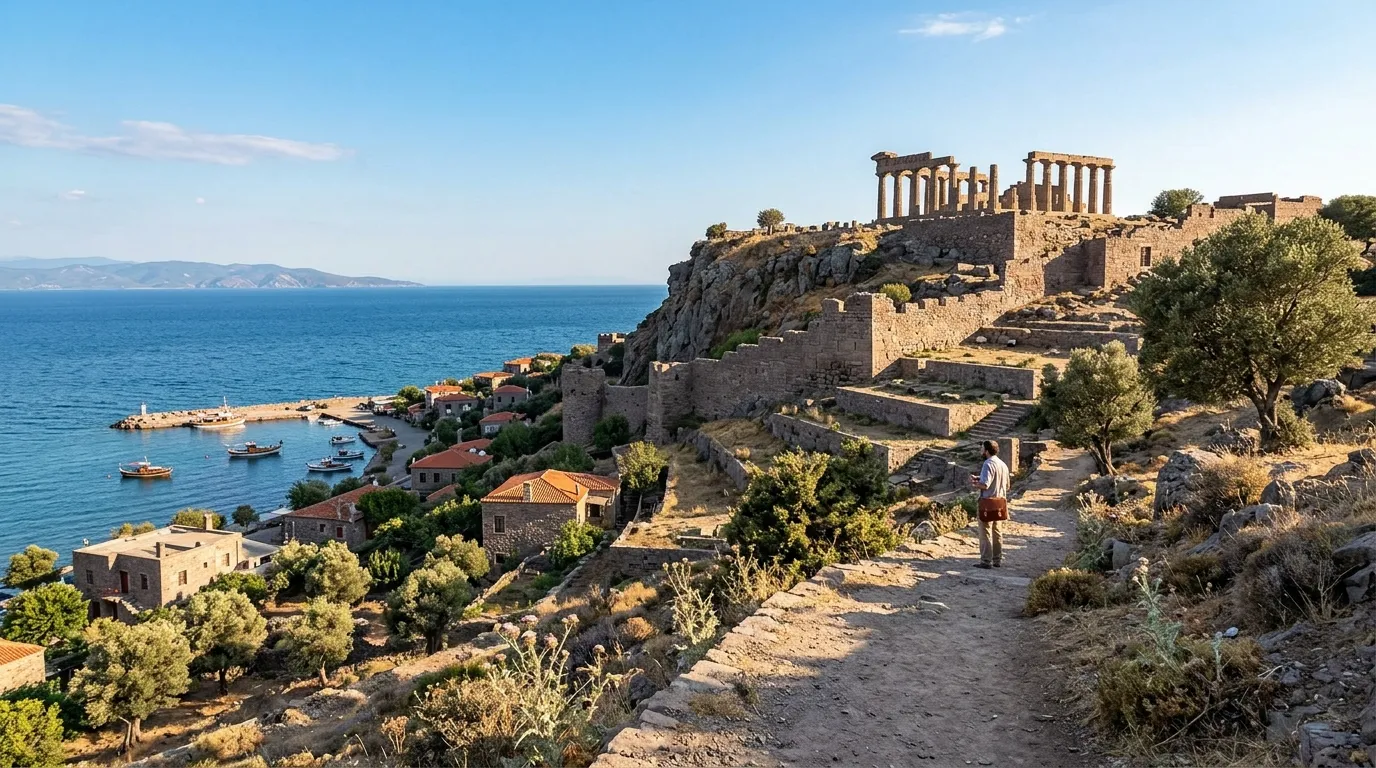
To understand Assos, it helps to know the geography. Assos was a seaport on the coast of Mysia, in the northwest corner of Asia Minor, overlooking the Aegean Sea. It stood on a high cliff, with a harbour below and a temple to Athena on the summit. The city was known for its philosophy — Aristotle had lived there for a time — and for its strategic position on the route between Troas and the islands of the Aegean. Paul was travelling from Troas to Miletus, on his way to Jerusalem, and the most direct route by sea would have taken him around the cape of Lectum. Instead, he chose to walk overland to Assos, a distance of about twenty miles, while his companions sailed.
Why Paul Walked
Luke does not say why Paul chose to walk, and the silence has invited speculation. The most common explanation is that Paul wanted time alone. He had just spent an intense period in Troas, where he had preached until midnight, raised a young man named Eutychus who had fallen from a window, and broken bread with the believers. He was on his way to Jerusalem, where he believed chains and hardships awaited him. He had told the Ephesian elders, whom he would soon meet at Miletus, that he was going to Jerusalem not knowing what would happen to him, except that the Holy Spirit had warned him in every city that prison and hardships were facing him. A man on such a journey might need a day alone to pray, to think, and to prepare.
Another possibility is that Paul was seasick, or that he wanted to avoid a difficult stretch of sailing around the cape. The waters around Lectum were notoriously rough, and a land journey, though longer, might have been safer or more comfortable. A third possibility is that Paul simply wanted to visit friends or believers in the towns along the road. The text does not say. What it does say is that Paul “had arranged this himself,” which suggests that the decision was deliberate and personal. It was not an accident of the itinerary. It was a choice.
Whatever the reason, the walk to Assos is a window into Paul’s humanity. The apostle who wrote half the New Testament, who debated philosophers in Athens and stood before kings, was also a man who sometimes needed to be alone. He was not a machine for ministry. He was a person who felt the weight of his calling, who grieved over the churches he had founded, and who faced his own future with a mixture of courage and uncertainty. The walk to Assos is the Bible’s quiet reminder that even the strongest servants of God need solitude.
The Road to Assos: What Paul Would Have Seen
The road from Troas to Assos wound through the hills and valleys of the Troad, the region around ancient Troy. Paul would have walked through farmland, past olive groves and vineyards, along roads built by the Romans, with the Aegean Sea visible to his left and the mountains of the interior to his right. The journey would have taken most of a day, on foot, in the heat of the Mediterranean spring or summer. It was not a leisurely stroll. It was a hard walk, over uneven terrain, carrying whatever he needed for the journey.
As he walked, Paul would have passed through a landscape steeped in history. The Troad was the region of the Trojan War, the setting of Homer’s Iliad. The ruins of Troy lay not far from the road. The cities he passed were old, layered with centuries of Greek and Roman civilisation. Paul, a man steeped in Scripture, would have seen in that landscape a picture of the world he was trying to reach: ancient, proud, beautiful, and lost. The walk to Assos was not only a journey through geography. It was a journey through the world the gospel had come to save.
The destination itself was striking. Assos stood on a volcanic cliff, 700 feet above the sea, with a harbour at the base and a temple on the summit. The city was built in tiers, rising from the water to the hilltop, and its walls and gates were visible from miles away. When Paul arrived, his companions were waiting with the ship, and they took him aboard and sailed on. The walk was over. The journey continued. But the day alone on the road had done its work, whatever that work was.
The Small Places in the Book of Acts
Assos belongs to a category of places in Acts that are easy to overlook: the small stops, the overnight stays, the towns where nothing dramatic happened. The book of Acts is full of them — Appii Forum and Three Taverns on the road to Rome, Fair Havens on Crete, Rhegium on the toe of Italy, and many others. These places are not the settings of great sermons or miracles. They are the settings of travel, of waiting, of walking. They remind readers that the mission of the church did not happen only in the great moments. It happened in the in-between spaces, in the journeys between the cities, in the ordinary days of travel and rest.
The small places also remind us that Luke was a careful historian. He recorded the itinerary of Paul’s journeys with the precision of a travel diary, noting the ports, the distances, the sailing times, and the companions. That precision is one of the reasons Acts is trusted as history. Luke did not invent a vague, mythical journey. He recorded a real trip, with real places, real ships, and real roads. Assos is part of that record, and its inclusion is evidence of the book’s reliability. A writer inventing a story would not bother with a footnote about a twenty-mile walk. A historian recording a journey would include it, because it happened.
There is a pastoral lesson in the small places as well. Most of life is lived in Assos, not in Athens. Most days are not the Areopagus. They are the walk, the waiting, the ordinary journey between the great events. The Bible’s inclusion of Assos is a reminder that God is present in those days too. The walk that no one preached about, the day that produced no sermon, the journey that left no record except a single verse — those days mattered. They were part of the mission. They were part of the life of the man God used to change the world.
The Companions Who Sailed Ahead
While Paul walked to Assos, his companions sailed ahead. Luke names them in Acts 20: Sopater, Aristarchus, Secundus, Gaius, Timothy, Tychicus, and Trophimus. They were a delegation from the churches Paul had founded, carrying a collection for the poor believers in Jerusalem. Their presence on the journey is a reminder that Paul did not travel alone. He travelled with a team, and the team carried the generosity of the Gentile churches to the Jewish church in Jerusalem.
The companions’ sailing ahead also shows the practical side of Paul’s ministry. The journey to Jerusalem was not only a spiritual pilgrimage. It was a logistical operation, involving ships, schedules, and the transport of funds. The walk to Assos was the quiet interlude in a journey that was otherwise busy with coordination, delegation, and planning. Paul’s ministry combined the contemplative and the administrative, the solitary walk and the team effort, and both were necessary.
What Assos Teaches About Solitude and Strength
The walk to Assos teaches that solitude is not a luxury for the servant of God. It is a necessity. Paul, who would soon face arrest, imprisonment, and eventually execution, took a day to walk alone before the storm. He did not explain it. He did not apologise for it. He arranged it himself, and he took it. The implication is that even the most dedicated workers need time to be alone with God, to pray, to reflect, and to gather strength for what lies ahead.
Assos also teaches that strength is not always public. The Paul of the Areopagus and the Paul of the walk to Assos are the same man. The public courage of the one depended on the private preparation of the other. The sermons that shook cities were born, at least in part, in the quiet hours of walking, praying, and thinking. The Bible does not record what Paul prayed about on the road to Assos, but it records that he took the road. That is enough. The walk is the lesson: before the next battle, take the time to be alone with God. The ancient city of Assos still stands in ruins on its cliff above the Aegean, and its single verse in Acts continues to remind readers that the quiet journeys matter as much as the public ones.










