Imagine standing in the ancient city of Jerusalem and seeing the great Temple rising above the city. For the people of Israel, this was not simply a beautiful building. It was a sacred place connected with worship, prayer, sacrifice, God’s presence, and covenant.
So, what is the Temple in Jerusalem meaning in the Bible?
The Temple holds a deep place in Scripture. It was a place where God’s people came to worship Him. It reminded Israel that God was near and that He had made a covenant with His people. The Temple was also connected with prayer, holiness, forgiveness, and hope.
The Bible speaks about the Temple from the days of King Solomon through the time of Jesus and the early church. Its story includes glory, destruction, restoration, warning, and spiritual transformation.
For Christians today, the Temple has an even deeper meaning. The New Testament teaches that God’s presence is not limited to a physical building. Through Christ and the Holy Spirit, believers themselves become a temple of God.
Understanding the Temple helps us understand God’s desire to live among His people. It also teaches us about holiness, prayer, faith, and the hope found in Jesus Christ.
Biblical Meaning of the Temple in Jerusalem
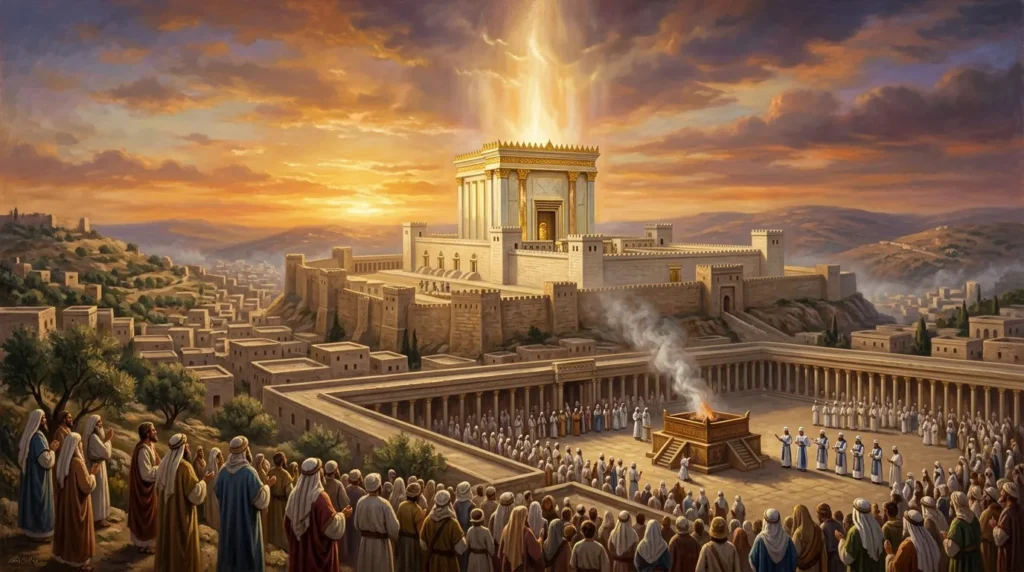
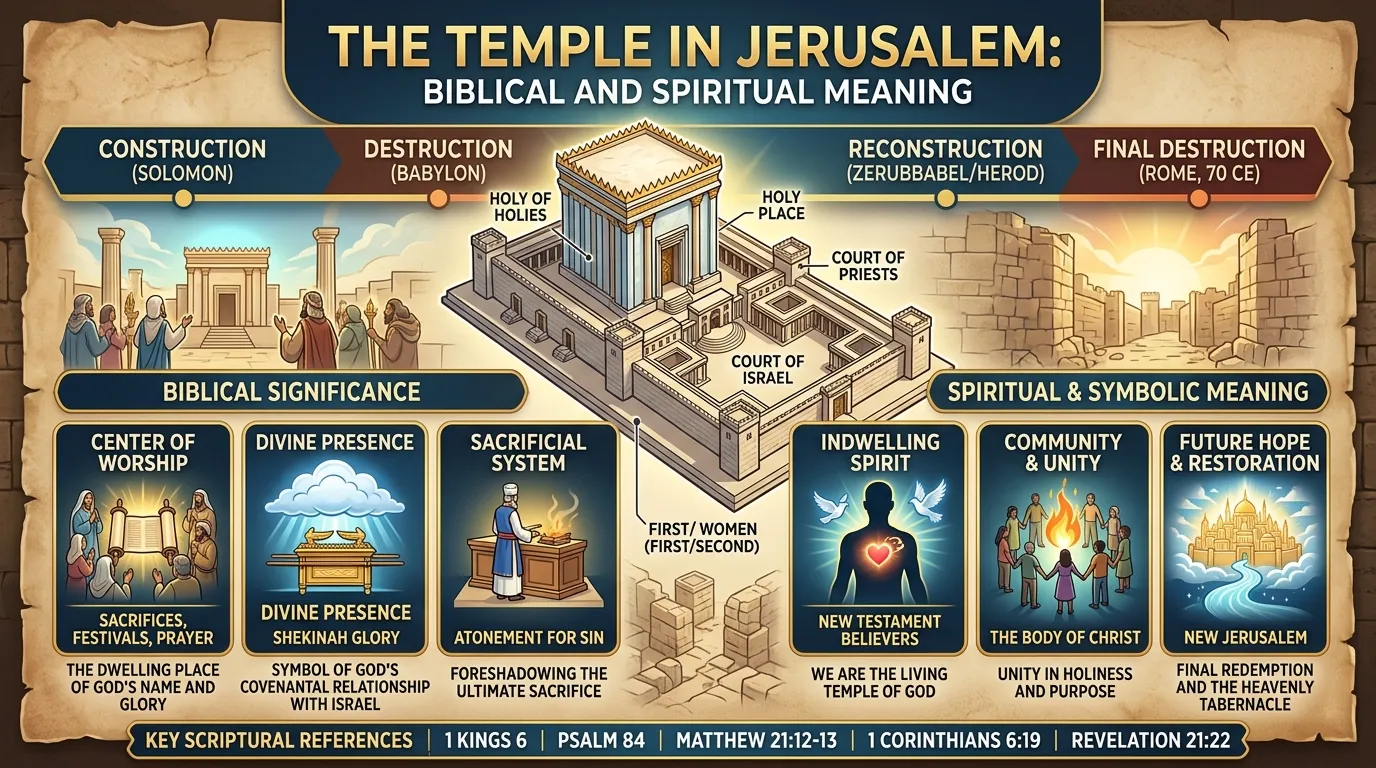
The Temple in Jerusalem in the Bible was the central place of worship for ancient Israel. It stood on Mount Moriah in Jerusalem and became the most important sacred place in the nation.
King Solomon built the first Temple. Before this, the Israelites worshiped God at the tabernacle, a movable sanctuary. When Israel became established in the land, David desired to build a permanent house for God. However, God chose David’s son Solomon to build it.
Solomon’s Temple was dedicated with great prayer and worship. In 1 Kings 8:27, Solomon recognized that even the highest heavens could not contain God. This is important because it shows that the Temple was never meant to limit God. Instead, it was a special place where His people could come before Him.
A Place of God’s Presence
One of the strongest meanings of the Temple is the presence of God.
When Solomon dedicated the Temple, God’s glory filled it. 1 Kings 8:10–11 describes how the priests could not continue their service because the glory of the Lord filled the house.
This showed Israel that God was with His people.
The Temple therefore became a powerful symbol of divine presence, holiness, and worship.
A Place of Prayer
The Temple was also a house of prayer.
In 1 Kings 8:29, Solomon asked God to keep His eyes on the Temple and to hear the prayers offered there. Jesus later quoted Isaiah 56:7, saying:
“My house shall be called a house of prayer.”
This teaches an important spiritual lesson. God’s people were not meant to approach Him only through rituals. They were called to seek Him, pray to Him, and trust Him.
A Place of Worship and Sacrifice
The Temple was connected with sacrifices and worship under the Old Covenant. The priests served there, and the people brought offerings according to God’s commands.
These sacrifices pointed to the seriousness of sin, repentance, forgiveness, and reconciliation with God.
For Christians, the Temple’s sacrificial system also points forward to Jesus. The New Testament presents Christ as the ultimate sacrifice for sin. Hebrews 10:11–14 explains that Christ offered one sacrifice for sins and accomplished what the repeated sacrifices could not fully accomplish.
A Place of Holiness
The Temple reminded God’s people that God is holy.
The Temple had areas with different levels of access. The Holy of Holies was the innermost place and represented the most sacred part of the sanctuary. Under the Old Covenant, the high priest entered this place on the Day of Atonement.
When Jesus died, Matthew 27:51 says that the curtain of the Temple was torn from top to bottom.
For Christians, this event has deep meaning. Through Jesus, the barrier between God and His people is removed. Believers can now approach God with confidence through Christ.
The Temple as a Warning
The Temple also carries a warning.
Although the Temple was holy, having the Temple did not automatically make the people faithful. Israel’s prophets repeatedly warned against empty worship and injustice.
The people could not use a sacred building as an excuse for sinful living.
In Jeremiah 7:4, the prophet warned the people not to place false confidence in the Temple while refusing to obey God.
This gives us an important lesson today:
Faith is not only about being near religious things. It is about having a heart that seeks God.
The first Temple was eventually destroyed by the Babylonians in 586 BC. Later, the Temple was rebuilt after the exile. Herod greatly expanded and renovated the Second Temple, which was the Temple known during much of Jesus’ earthly ministry. The Romans destroyed it in AD 70, fulfilling Jesus’ warning in passages such as Matthew 24:1–2.
The Temple’s history therefore includes both God’s presence and God’s warning about spiritual unfaithfulness.
Temple in Jerusalem Hebrew Meaning
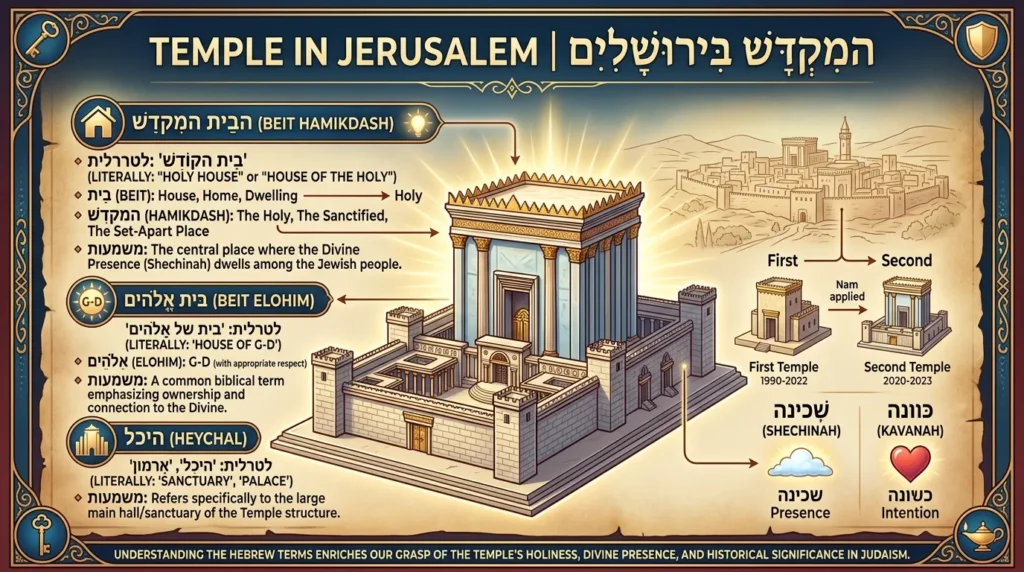
There is no single Hebrew word that literally means the entire phrase Temple in Jerusalem. Several Hebrew words are used in the Old Testament for the Temple and its sacred spaces.
One important word is מִקְדָּשׁ (miqdāsh). It means sanctuary, holy place, or sacred place. It comes from the Hebrew root קדשׁ (q-d-sh), which is connected with the idea of holiness or being set apart.
Another important word is הֵיכָל (heikhal). It can mean temple, palace, or great building. In the context of worship, it is often used for the Temple or sanctuary.
The Hebrew word בַּיִת (bayit) means house. It is often used in expressions referring to the house of God. For example, the Temple can be described as the house of the Lord.
Jerusalem itself is called יְרוּשָׁלַיִם (Yerushalayim) in Hebrew.
These words help us understand that the Temple was viewed as a holy house or sanctuary dedicated to God.
However, an important point must be remembered: God was never physically contained inside the Temple. Solomon himself understood this. In 1 Kings 8:27, he said that the heavens and even the highest heavens could not contain God.
The Temple was a special place of worship and God’s revealed presence, but God Himself is greater than any building.
Spiritual Significance and Symbolism of the Temple
The spiritual meaning of the Temple in Jerusalem reaches beyond its ancient history.
For Christians, the Temple can symbolize God’s presence, holiness, prayer, sacrifice, relationship, and spiritual transformation.
God’s Presence
The Temple reminds us that God desires to be near His people.
Life can sometimes feel lonely. You may pray and wonder whether God hears you. The Temple points back to the biblical truth that God is not distant from those who seek Him.
Psalm 84:1–2 expresses a deep desire to be near God’s dwelling place.
Today, Christians do not need to travel to Jerusalem to find God. Through Christ, we can come to God wherever we are.
Prayer
The Temple was called a house of prayer.
This reminds us that prayer is not merely a religious duty. It is a relationship with God.
You can pray when you are happy, afraid, confused, thankful, or tired. God invites His people to bring their hearts before Him.
Holiness
The Temple was set apart for God. This teaches believers to live with spiritual purpose.
Holiness does not mean pretending to be perfect. It means allowing God to shape your heart, choices, thoughts, and actions.
Transformation
The New Testament takes the Temple theme even further.
In 1 Corinthians 6:19, Paul teaches that the believer’s body is a temple of the Holy Spirit.
Similarly, 1 Corinthians 3:16 says that God’s Spirit dwells among His people.
This means that the Christian life is not simply about visiting a holy place. God’s Spirit lives in His people.
That is a powerful picture of spiritual transformation.
Biblical Interpretations of the Temple in Dreams or Real Life
If you see the Temple in Jerusalem in a dream, Scripture does not give one universal dream interpretation. The Bible contains dreams, but it does not teach that every modern dream has a fixed spiritual meaning.
A Temple in a dream may personally remind someone of prayer, God’s presence, worship, holiness, or a desire to draw closer to God. But such an interpretation should be tested carefully against Scripture.
For example, seeing a beautiful Temple might lead you to reflect on God’s holiness and your relationship with Him.
Seeing a damaged or destroyed Temple might remind you of the biblical warnings about spiritual decline, loss, repentance, or the temporary nature of earthly things.
Dreaming about praying in a Temple may encourage personal reflection about your prayer life.
These are personal spiritual reflections, not guaranteed messages from God.
If you experience such a dream, pray for wisdom and compare your thoughts with Scripture. James 1:5 encourages believers to ask God for wisdom.
The safest foundation for Christian guidance is always God’s Word, not a dream by itself.
The Temple and Jesus Christ
The Temple becomes even more meaningful when we look at Jesus.
Jesus taught in the Temple, worshiped there, and spoke about its future. In John 2:19–21, Jesus used the Temple as a picture of His body. John explains that Jesus was speaking about His resurrection.
This is a major turning point in biblical understanding.
The physical Temple pointed toward something greater.
Through Jesus, God’s presence comes near in a unique way. Jesus is described as the Word who “became flesh and dwelt among us” in John 1:14.
His death and resurrection also changed the way believers understand access to God.
The Temple curtain was torn when Jesus died. This points to the new access believers have to God through Christ.
The Temple therefore helps Christians understand the gospel:
God desires to dwell with His people, sin separates people from God, and Jesus provides the way of reconciliation.
The Temple and the Believer Today
The New Testament gives the Temple image a personal meaning.
Paul says in 1 Corinthians 6:19 that the believer’s body is a temple of the Holy Spirit.
This changes how we think about Christian faith.
Your life matters to God.
Your body matters.
Your choices matter.
Your thoughts, words, relationships, and actions can become part of your worship.
The Bible also uses the Temple image for the community of believers. Ephesians 2:21–22 describes God’s people as being built together into a dwelling place for God by the Spirit.
So the Christian is not called merely to admire the ancient Temple. Christians are called to become people whose lives reflect God’s presence, love, holiness, and grace.
Practical Lessons and Faith Insights
The Temple in Jerusalem gives us several simple lessons.
Seek God’s presence. Make time for prayer and Scripture.
Respect holiness. Let your choices reflect your faith.
Do not depend only on outward religion. God looks at the heart.
Trust Jesus. He is central to the Christian understanding of reconciliation with God.
Remember that God is greater than any building or place. You can seek Him wherever you are.
When life feels uncertain, return to Scripture. Pray honestly. Ask God for wisdom. Trust His timing and allow your faith to grow one step at a time.
Conclusion
The Temple in Jerusalem meaning in the Bible is deeply connected with God’s presence, worship, prayer, holiness, sacrifice, and covenant. Its history also teaches important lessons about obedience and the danger of empty religion.
For Christians, the Temple points toward Jesus and the greater truth that God now dwells with His people through the Holy Spirit.
The message is one of hope and transformation. God invites you to draw near to Him through Christ, seek Him in prayer, and allow His presence to shape your life. When you feel lost or uncertain, return to Scripture. God’s guidance is still available to those who seek Him with a sincere heart.