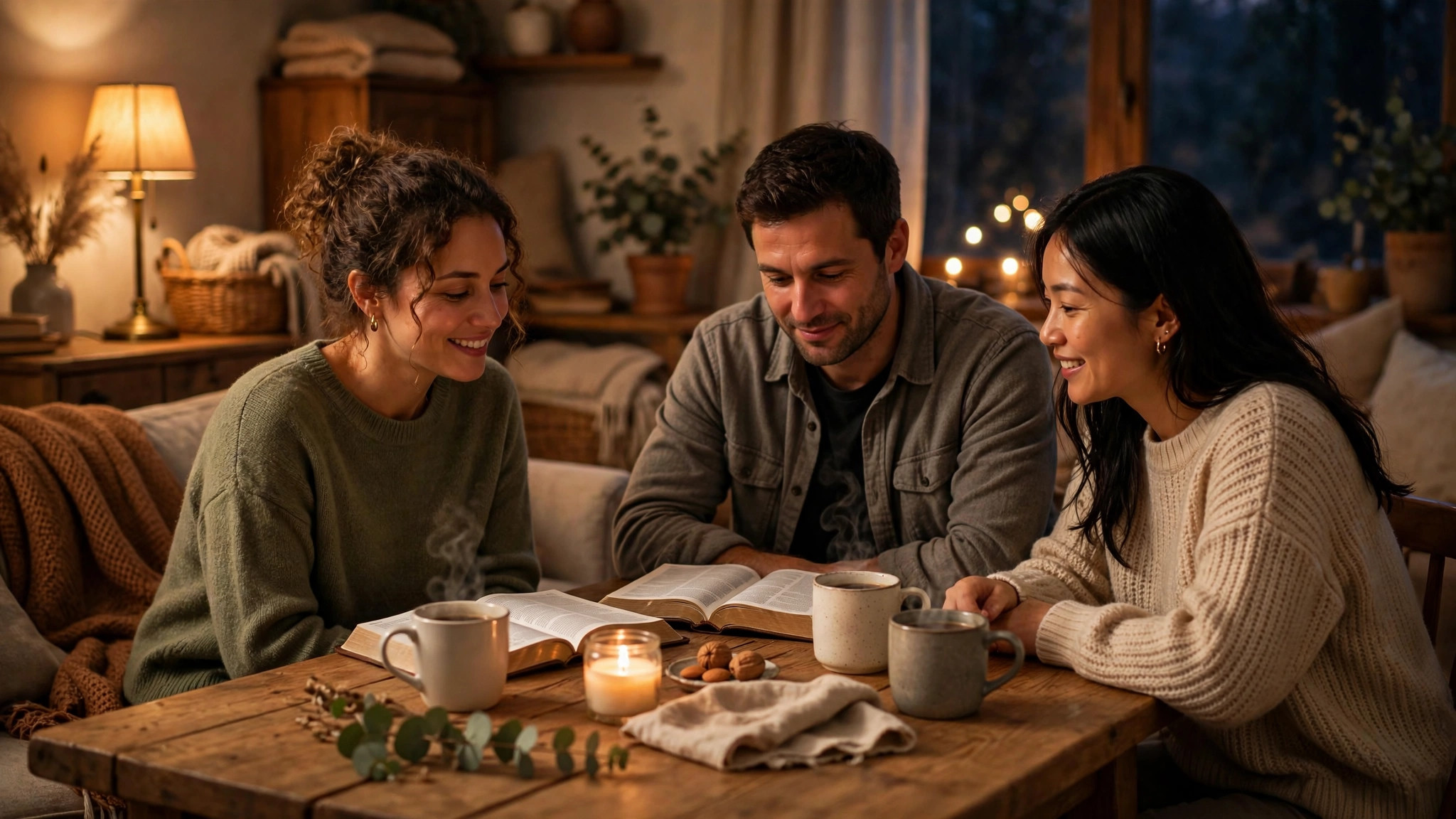
Tuesday night. The dishes are still in the sink, and nine people are crowded around your table — a widow from two streets over, a college student far from home, a couple facing a hard decision, a brand-new believer who keeps asking questions about prayer. Someone reads a psalm. Someone else prays, haltingly and honestly. Toys litter the floor, but something sacred is happening in the middle of the mess. This is not a modern invention. It is the church in its most ancient form.
Long before cathedral blueprints, God’s people were meeting around tables. Scripture keeps returning to the home — not as a backup plan, but as the stage where the gospel took root. Your own front door may be a greater ministry tool than you think.
The First Church Had No Building
The church’s first prayer meeting happened in someone’s house: after the ascension, the 120 went up to the upper room and “joined together constantly in prayer” (Acts 1:13–14). The church was born in a living room.
After Pentecost added three thousand, the newborn church skipped the building campaign entirely. Their rhythm, per Acts 2:42–47: devotion to the apostles’ teaching, to fellowship, to the breaking of bread, and to prayer — meeting in the temple courts and breaking bread in their homes “with glad and sincere hearts” (Acts 2:46). Public witness in the courts; intimate life in the homes.
Paul carried the same pattern everywhere: he “taught you publicly and from house to house” (Acts 20:20). Living rooms were his lecture halls; kitchens his classrooms — transformation happens face to face, where honest questions get honest answers. And Hebrews urges us on: “not giving up meeting together… but encouraging one another” (Hebrews 10:24–25).
Five Homes That Carried the Gospel
Scripture does not speak of home fellowships in the abstract — it names the addresses.
Priscilla and Aquila. This married couple hosted “the church that meets in their house” in Rome (Romans 16:5) and Ephesus (1 Corinthians 16:19), and instructed Apollos in their home. Their marriage was a ministry; their living room trained preachers.
Nympha’s house. Paul greets “Nympha and the church in her house” (Colossians 4:15) — nothing else is recorded about her, yet her quiet hospitality put her in Scripture forever.
Philemon’s house. Paul writes to “the church that meets in your home” (Philemon 1:2) — and asks that community to receive back the runaway Onesimus, no longer as a slave, but as a brother.
Mary’s house. While Peter sat chained between soldiers, “many people had gathered and were praying” in the house of Mary, mother of John Mark (Acts 12:12). When the freed Peter knocked, the servant Rhoda recognized his voice and ran back inside, too stunned to open the gate. Heaven answered a home prayer meeting.
Lydia’s house. In Philippi, a dealer in purple cloth heard Paul, “the Lord opened her heart,” and she was baptized with her household (Acts 16:14–15). She insisted — “come to my house and stay there” — and her home became the believers’ base in that city; after prison, Paul and Silas returned there to encourage the saints (Acts 16:40). One open door gave a newborn church its first headquarters.
Koinonia: The Word That Changes Everything
The engine of home fellowship is one Greek word: koinonia (koy-noh-NEE-ah). “Fellowship” can sound like coffee and polite chat; koinonia means partnership, participation, shared life — meals, possessions, joys, and sorrows held in common. Acts 2:42’s “fellowship” means the believers stopped being spectators of each other’s lives and became participants in them.
The Hebrew roots run deep. Mishpachah (family, clan) pictures God’s people as extended family, not an audience. The Passover was celebrated in homes (Exodus 12), with each household a place of worship — Israel’s living room was its first sanctuary. And the word for “house” in “house church” — oikos (OY-koss) — means not just a building but a household: family, servants, guests, everyone under one roof. An oikos living out koinonia is the biblical picture of a home fellowship.
Even hospitality has a name: philoxenia, love of strangers. “Share with the Lord’s people who are in need. Practice hospitality” (Romans 12:13). And Hebrews 13:2 gives the promise: “Do not forget to show hospitality to strangers, for by so doing some people have shown hospitality to angels without knowing it.” Opening your home is not a personality trait. In the Bible, it is a spiritual discipline.
What Home Fellowship Is Not
The warmth can be twisted, so Scripture draws boundaries.
Not a replacement for the church. Believers met in temple courts, synagogues, a lecture hall (Acts 19:9), and homes — sometimes on the same day. A home group expresses church life; it does not replace the gathered church with its teaching, leadership, and ordinances.
Not automatically holier than a larger gathering. Scripture ranks no venue. The issue is never the size of the room but the depth of the sharing — a megachurch with real small-group life can hold more true koinonia than a home group simmering with gossip.
Not leaderless. Warm and informal does not mean unstructured. New Testament house churches stood under recognized shepherds — elders in every town (Titus 1:5), overseers meeting God’s standards (1 Timothy 3). Family warmth, plus flock accountability.
Not a social club. The four marks of Acts 2:42 — teaching, fellowship, breaking of bread, prayer — keep the gathering from drifting into mere food and small talk (though food and laughter matter). When Scripture opens and prayers are prayed, the living room becomes what Jesus promised: “Where two or three gather in my name, there am I with them” (Matthew 18:20).
Opening Your Door This Week
Start before the house is ready. The first believers met in ordinary, probably crowded homes. Hospitality is about the heart, not the house. Invite one person or one family for a simple meal this month — paper plates are fine.
Keep Jesus at the center. Share a meal, read a short passage, ask “what is God teaching you?”, and pray for one another. Let the new believer ask the awkward question. Koinonia grows where honesty is safe.
Stay under the church’s covering. Begin with your pastor’s or elders’ blessing, not apart from them. Let your small group be a hearth within the larger house of the church — feeding people back into worship, serving, and giving.
Treat your household as a mission base. Your oikos — family, roommates, close friends — is your first mission field. Pray for them by name. Share Christ naturally. The gospel spread in the first century from household to household, and it still does, one open door at a time.
Here are the questions people ask most about home fellowships.
Are home fellowships really biblical?
Yes — emphatically. The New Testament repeatedly names churches meeting in homes (Romans 16:5; 1 Corinthians 16:19; Colossians 4:15; Philemon 1:2), shows believers praying in homes (Acts 12:12), and describes daily home gatherings as the church’s normal life (Acts 2:46).
What should happen in a home fellowship?
Follow the Acts 2:42 pattern: teaching from Scripture, koinonia (honest sharing of life), the breaking of bread (shared meals, and where appropriate communion), and prayer. Add worship, encouragement, and practical care for one another’s needs.
Do I need my pastor’s permission to start one?
Scripture shows home gatherings under spiritual oversight (Titus 1:5; 1 Timothy 3). The wise and biblical path is to start with your church’s blessing and accountability — talk to your pastor or elders first — rather than launching an independent group. Oversight protects the flock and strengthens the fellowship.
Can a home fellowship replace church for me?
No. The New Testament never treats home groups as replacements for the gathered church with its appointed leadership, public teaching, and ordinances. Home fellowship is a vital expression of church life — the hearth — not a substitute for the whole house. Keep both.
Your Home Can Be Holy Ground
The remarkable thing about the five homes is how unremarkable they were — no cathedrals, no stages, just tables, lamps, and people who kept their doors open. In those ordinary rooms the Spirit fell, prisoners’ chains loosened, preachers were trained, a runaway slave became a brother, and a city received its first church.
So look at your home again — not with frustration at the clutter, but with faith at the possibility. Your dining table can be where a lonely person finds family. Your couch can be where a new believer asks the question that changes everything. The same Jesus who filled upper rooms and crowded houses in the first century still shows up wherever two or three gather in His name. Light a lamp. Open the Word. Set one more plate. Then watch what God does with an open door.
Pray with me: “Lord, make my home a place of Your presence. Give me the courage to open my door and the grace to love whoever walks through it.” Then take one small step this week — one invitation, one meal, one open door. Your home was always meant for more than just living in. To read more about the history of churches meeting in homes, see the Wikipedia article on the house church.










