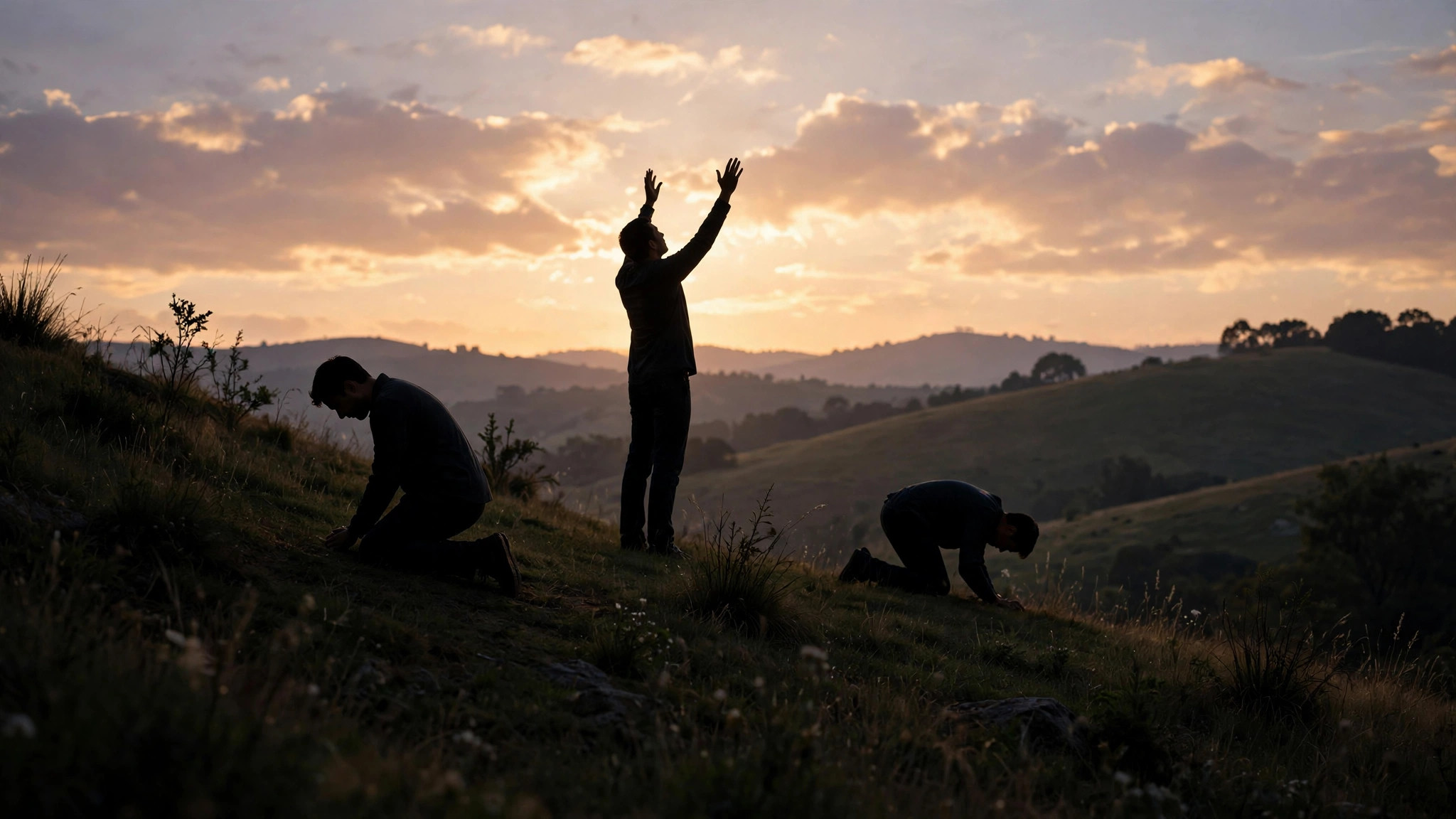
Night in Gethsemane, and the Son of God is on the ground — face to the earth, crying out, “My Father, if it is possible, may this cup be taken from me” (Matthew 26:39). Centuries earlier, Daniel goes to his room, throws the window open toward Jerusalem in defiance of the king’s decree, drops to his knees, and prays as he always has — three times a day (Daniel 6:10). And in Jesus’ own parable, a tax collector stands at the back of the temple, unable to lift his eyes, beating his chest and pleading, “God, have mercy on me, a sinner” (Luke 18:13).
Three people, three positions, one Lord. In Scripture, what we do with our bodies often says what our hearts are trying to tell God. So what does each prayer posture mean — and does God care how we position ourselves when we pray?
Postures of Humility: Kneeling, Bowing, Lying Face-Down
Stephen knelt on the stones of his own execution and cried, “Lord, do not hold this sin against them” (Acts 7:60). Paul knelt on the beach with the Ephesian elders at their tearful farewell (Acts 20:36). And Jesus Himself knelt in Gethsemane (Luke 22:41). The invitation still stands: “Come, let us bow down in worship, let us kneel before the Lord our Maker” (Psalm 95:6).
To kneel is to confess with the body what the heart already knows — He is high, and we are not. Bowing the head belongs to the same family: Abraham’s servant “bowed down and worshiped the Lord” (Genesis 24:26), and the Israelites “bowed down and worshiped” at the news of deliverance (Exodus 4:31). The bowed head shuts out distraction and tells our own heart we are stepping into God’s presence.
Then there is the deepest bow of all: lying face-down, fully prostrate. When God made His covenant with Abraham, Abraham “fell facedown” as God spoke (Genesis 17:3). Joshua fell facedown before the commander of the Lord’s army (Joshua 5:14). Ezekiel fell facedown when he saw the glory of God (Ezekiel 1:28). Moses and Aaron fell facedown in moments of crisis (Numbers 16:22). And Jesus “fell with his face to the ground” in Gethsemane (Matthew 26:39).
Prostration is the body’s final argument: “I am nothing; You are everything.” It surfaces in covenant, overwhelming awe, and desperate grief. Ezra fell to his knees, confessing his people’s sins with hands spread out (Ezra 9:5). Most of us rarely pray this way — but some of Scripture’s greatest prayers rose from the ground.
Postures of Boldness: Standing and Lifting Hands
Humility is not the only honest posture before God. Standing was a completely normal prayer stance in biblical times, speaking of confidence, readiness, and expectation. In Jesus’ parable, the Pharisee “stood by himself and prayed” (Luke 18:11) — and the tax collector stood too, but “at a distance.” Two men, the same posture, entirely different hearts: posture alone never decides the worth of a prayer.
Jesus assumed His hearers would pray standing: “When you stand praying, if you hold anything against anyone, forgive them” (Mark 11:25). Solomon stood before the altar at the temple dedication, spreading his hands toward heaven (1 Kings 8:22). It is the posture of a servant awaiting instruction and a child with access to the throne: “Let us then approach God’s throne of grace with confidence” (Hebrews 4:16).
Then there are lifted hands. Moses raised his hands over the battle with Amalek, and Israel prevailed as long as they stayed up (Exodus 17:11-12). Solomon knelt and spread his hands toward heaven at the temple (1 Kings 8:54). David wrote, “I spread out my hands to you” (Psalm 143:6), and “May the lifting up of my hands be like the evening sacrifice” (Psalm 141:2). Paul instructed, “I want the men everywhere to pray, lifting up holy hands” (1 Timothy 2:8). Elijah pressed his face between his knees on Mount Carmel as he prayed for rain (1 Kings 18:42) — a man putting his whole body into his request. Open, lifted hands say: “I hide nothing. I surrender everything.”
Postures of Rest: Sitting With God
Not every prayer is a battle stance. Some are simply conversation — and the Bible gives us permission to sit. After God made His covenant promise, David “went in and sat before the Lord” and prayed (2 Samuel 7:18). The man after God’s own heart did not always kneel; sometimes he simply sat down in God’s presence and talked.
Sitting is the posture of rest and intimacy — the child on the father’s knee, the friend at the kitchen table. Nehemiah’s prayer began seated: he “sat down and wept” when he heard Jerusalem’s walls were broken (Nehemiah 1:4). Never feel guilty for praying seated — what matters is not the position of the body but the direction of the heart.
The Words Behind the Postures
The Hebrew language itself shows that prayer in Israel was a whole-body act. The most common word for prayer is tefillah (teh-feel-LAH), from the root palal (pah-LAHL) — “to pray,” “to intercede.” Strikingly, palal also carries the sense of judging oneself: prayer begins with honest self-examination before God.
The word for bowing or kneeling is kara (kah-RAH), the verb behind Psalm 95:6’s call to kneel before our Maker. A related word, shachah (shah-KHAH), means “to bow down, to worship” — often full prostration, face to the ground. Standing in prayer uses amad (ah-MAHD) — “to stand,” and also “to stand firm,” as when Hannah stood before the Lord in the temple pouring out her soul (1 Samuel 1:26). And lifting the hands is nasa (nah-SAH), “to lift up” — the raised hands of Psalm 141:2, offered like the evening sacrifice.
Does Posture Change Whether God Hears?
Here is the biblical balance: posture expresses the heart, but it does not earn God’s attention. God hears the kneeling saint and the standing sinner, the prostrate prophet and the seated supplicant. The Pharisee stood in pride and went home condemned; the tax collector stood in humility and went home justified (Luke 18:9-14). Same posture, opposite results — because “the Lord does not look at the things people look at… the Lord looks at the heart” (1 Samuel 16:7).
Yet bodies and hearts are connected. Kneeling can cultivate humility when pride creeps in; lifting hands can stir surrender when the heart feels clenched; lying prostrate can deepen awe when God feels small. We do not move our bodies to impress God — we do it to engage our whole selves in worship.
Trying Them This Week
Here are hands-on ways to bring biblical prayer postures into your week — one for each day:
- Morning kneeling. Begin one day on your knees, like Daniel, surrendering the hours ahead to God.
- Standing in worship. At church, stand with intention during the songs, remembering you stand before the King.
- Raised hands in private. When alone, try Psalm 141:2 — lift your hands as an evening offering.
- Bowed head at a meal. Use mealtime prayer to practice gratitude and reverence as a family.
- Prostrate in crisis. When overwhelmed, fall on your face before God, as Jesus did in Gethsemane.
- Sitting in reflection. Take a quiet chair, open your Bible, and sit with God the way David did.
Two common questions about prayer posture:
Is kneeling required for God to answer prayer?
No. Kneeling expresses humility and can focus the heart, but Scripture shows God answering prayers in every posture — David seated (2 Samuel 7:18), Solomon standing (1 Kings 8:22), Moses’ lifted hands (Exodus 17:11-12). What God requires is a sincere heart (1 Samuel 16:7), not a particular position of the body.
Why do Christians bow their heads and close their eyes to pray?
Bowing the head is a biblical gesture of reverence — Abraham’s servant bowed to worship (Genesis 24:26), and the Israelites bowed at the news of deliverance (Exodus 4:31). It helps shut out distractions and signals that we are entering God’s presence — a helpful habit, not a command.
Pray With Your Whole Self
From Gethsemane’s garden to Daniel’s open window, from the temple courts to a quiet kitchen chair, the Bible’s praying people brought their bodies with them into God’s presence. Knees bent, heads bowed, faces on the ground, hands lifted — each posture told the truth about the heart behind it.
So try them. Kneel in humility when pride tightens its grip. Stand in confidence when you need to remember your access to the throne. Lie face-down when awe or grief leaves you wordless. Lift your hands when surrender is the only prayer left. Your body is not an obstacle to prayer — it is an instrument of it.
And whatever posture you choose, pray. Your Father listens to the kneeling saint and the standing sinner alike, because He is listening for the heart. Bring Him the whole of yourself — and find, like David, like Daniel, like the tax collector, that He is already leaning close to hear. For background on the physical postures of worship, see the Wikipedia article on prostration.










