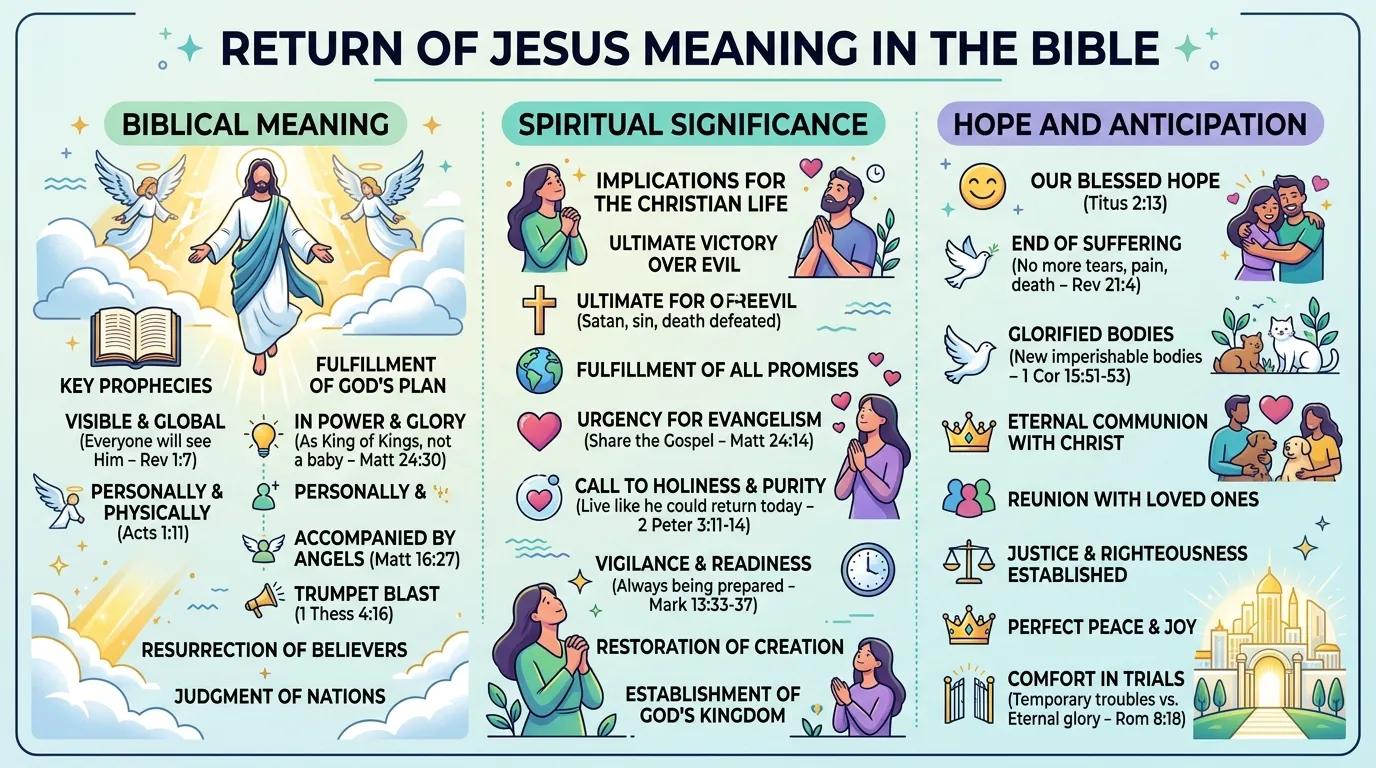
Jesus promised to return. That promise is one of the most repeated in the New Testament — mentioned in every major section, from the Gospels to the letters to Revelation. Yet it is also one of the most misunderstood. Some treat it as a code to crack, a timetable to calculate. Others treat it as a threat to fear. But the Bible presents Christ’s return as something else: a promise meant to produce hope, faithfulness, and joy. This article listens first to what Jesus Himself said about His return, then to what the apostles added, and finally to what it all asks of us.
What Jesus Himself Said
Jesus spoke about His return most fully in the Olivet Discourse — the teaching He gave on the Mount of Olives shortly before His crucifixion (Matthew 24–25; Mark 13; Luke 21). His disciples had asked a compound question: When will the temple be destroyed, and what will be the sign of His coming and of the end of the age? Jesus’s answer is both a warning and a promise.
The warning is against deception and date-setting. “Watch out that no one deceives you,” Jesus says. “Many will come in my name, claiming, ‘I am the Messiah,’ and will deceive many” (Matthew 24:4–5). He describes wars, famines, earthquakes, and persecutions — but He says these are “the beginning of birth pains,” not the end itself. The end will come, but its timing is not given. “But about that day or hour no one knows, not even the angels in heaven, nor the Son, but only the Father” (Matthew 24:36). That verse alone should end every attempt to set a date for Christ’s return. If Jesus Himself said the timing was known only to the Father, then anyone who claims to know it is claiming more than Jesus claimed.
The promise is that His return will be unmistakable. “For as lightning that comes from the east is visible even in the west, so will be the coming of the Son of Man” (Matthew 24:27). It will not be secret, hidden, or ambiguous. “They will see the Son of Man coming on the clouds of heaven, with power and great glory. And he will send his angels with a loud trumpet call, and they will gather his elect from the four winds” (Matthew 24:30–31). The return of Jesus will be public, glorious, and final.
Parables of Readiness
Jesus did not only teach about His return in prophecy. He taught about it in parables — stories designed to shape how His followers live while they wait. The parable of the ten virgins (Matthew 25:1–13) warns against unpreparedness: five were ready, five were not, and when the bridegroom arrived, the door was shut. The parable of the talents (Matthew 25:14–30) teaches that waiting is not idleness: the servants who invested their master’s money were rewarded, and the one who buried his was rebuked. The parable of the sheep and the goats (Matthew 25:31–46) teaches that readiness is measured by love: feeding the hungry, welcoming the stranger, clothing the naked, visiting the prisoner.
Read together, the parables give a balanced picture of waiting. Be prepared, like the wise virgins. Be productive, like the faithful servants. Be compassionate, like the sheep who served “the least of these.” Waiting for Christ is not passive. It is active, fruitful, loving faithfulness in the ordinary days between promise and fulfillment.
Jesus also gave the promise personally, in His farewell words to the disciples: “My Father’s house has many rooms… I am going there to prepare a place for you. And if I go and prepare a place for you, I will come back and take you to be with me that you also may be where I am” (John 14:2–3). The return of Jesus is, at its heart, a reunion. The Bridegroom is coming for His bride. The Shepherd is coming for His sheep. The Lord is coming for His people.
What the Apostles Added
The apostles picked up Jesus’s teaching and applied it to the churches. Paul, writing to the Thessalonians, described the Lord descending from heaven “with a loud command, with the voice of the archangel and with the trumpet call of God,” and the dead in Christ rising first (1 Thessalonians 4:16). His purpose was pastoral: to comfort grieving believers with the assurance that those who died in Christ would not be left behind. The doctrine of the return was given as medicine for grief.
Peter warned that scoffers would mock the promise — “Where is this ‘coming’ he promised?” — and answered that God’s apparent delay is patience, not indifference: “The Lord is not slow in keeping his promise, as some understand slowness. Instead he is patient with you, not wanting anyone to perish, but everyone to come to repentance” (2 Peter 3:9). The delay is mercy. Every day that passes is another day for someone to turn to God.
John, in Revelation, gives the promise its final form: “Look, he is coming with the clouds, and every eye will see him” (Revelation 1:7), and “Behold, I am coming soon!” (Revelation 22:12). The Bible’s last prayer is a response to that promise: “Amen. Come, Lord Jesus” (Revelation 22:20). The book that begins with creation ends with a longing for Christ’s return.
The Return in the Old Testament Promise
Long before Jesus spoke of His return, the Old Testament pointed toward a coming Day when God would act decisively. Daniel saw “one like a son of man, coming with the clouds of heaven” who would receive “authority, glory and sovereign power” and whose kingdom “will never be destroyed” (Daniel 7:13–14). Jesus took that title — Son of Man — as His own, and applied Daniel’s vision to Himself. When He spoke of coming on the clouds, His hearers would have recognized the reference. The return of Jesus is the fulfillment of Daniel’s vision: the Son of Man receiving the kingdom.
Zechariah added another thread: “Then the Lord my God will come, and all the holy ones with him” (Zechariah 14:5), and “they will look on me, the one they have pierced” (Zechariah 12:10). The Old Testament held together two pictures that seemed impossible to reconcile: a suffering servant, pierced and rejected, and a glorious king, coming with the clouds. The New Testament’s answer is that they are the same person, in two comings. The first coming was the servant, pierced for our sins. The second coming is the King, returning in glory. The return of Jesus completes what the cross began.
That is why the promise of His return is woven into the whole Bible, not only the New Testament. From Eden’s promise of a seed who would crush the serpent, to the prophets’ visions of a coming King, to the angels’ words at the ascension — “This same Jesus, who has been taken from you into heaven, will come back in the same way you have seen him go into heaven” (Acts 1:11) — the whole story points forward to the day when Christ returns and makes all things new.
What Christians Disagree About
Honest readers should know that Christians disagree about the details. The timing and sequence of events — the tribulation, the millennium, the rapture, the final judgment — are understood differently by sincere, Bible-believing Christians. The major views — premillennialism, amillennialism, and postmillennialism — each have long histories and thoughtful defenders. This article does not settle those debates, and readers should be wary of anyone who claims they are simple.
What all orthodox Christians agree on is the core: Jesus Christ will return personally, visibly, and gloriously; the dead will be raised; the living will be transformed; judgment will come; and God’s kingdom will be fully established. The details are debated. The promise is not. A wise approach is to hold the core with conviction and the details with humility — and to refuse to divide the church over questions the Bible leaves open.
How to Live While You Wait
The Bible’s teaching on Christ’s return is meant to produce three things in us. First, hope. The return of Jesus means that suffering is not the end, that death is not final, and that the world’s brokenness will be healed. Hope is not wishful thinking. It is confident expectation anchored in the resurrection.
Second, holiness. “Everyone who has this hope in him purifies himself, just as he is pure” (1 John 3:3). The knowledge that Christ will return — and that we will see Him — is a motive for purity, integrity, and love. We live now in the light of that coming day.
Third, mission. The return of Jesus gives our witness urgency. If the day is coming when every knee will bow, then every conversation, every act of kindness, every prayer for the lost matters. The church’s mission is not to predict the end but to prepare people for it — by proclaiming the gospel that saves them.
Jesus is coming again. That is not a puzzle to solve or a threat to dread. It is a promise to trust, a hope to hold, and a call to live faithfully until He comes. “Look, I am coming soon! My reward is with me, and I will give to each person according to what they have done” (Revelation 22:12). Maranatha — come, Lord Jesus. For the broader Christian teaching on this promise, see the Wikipedia article on the Second Coming.










