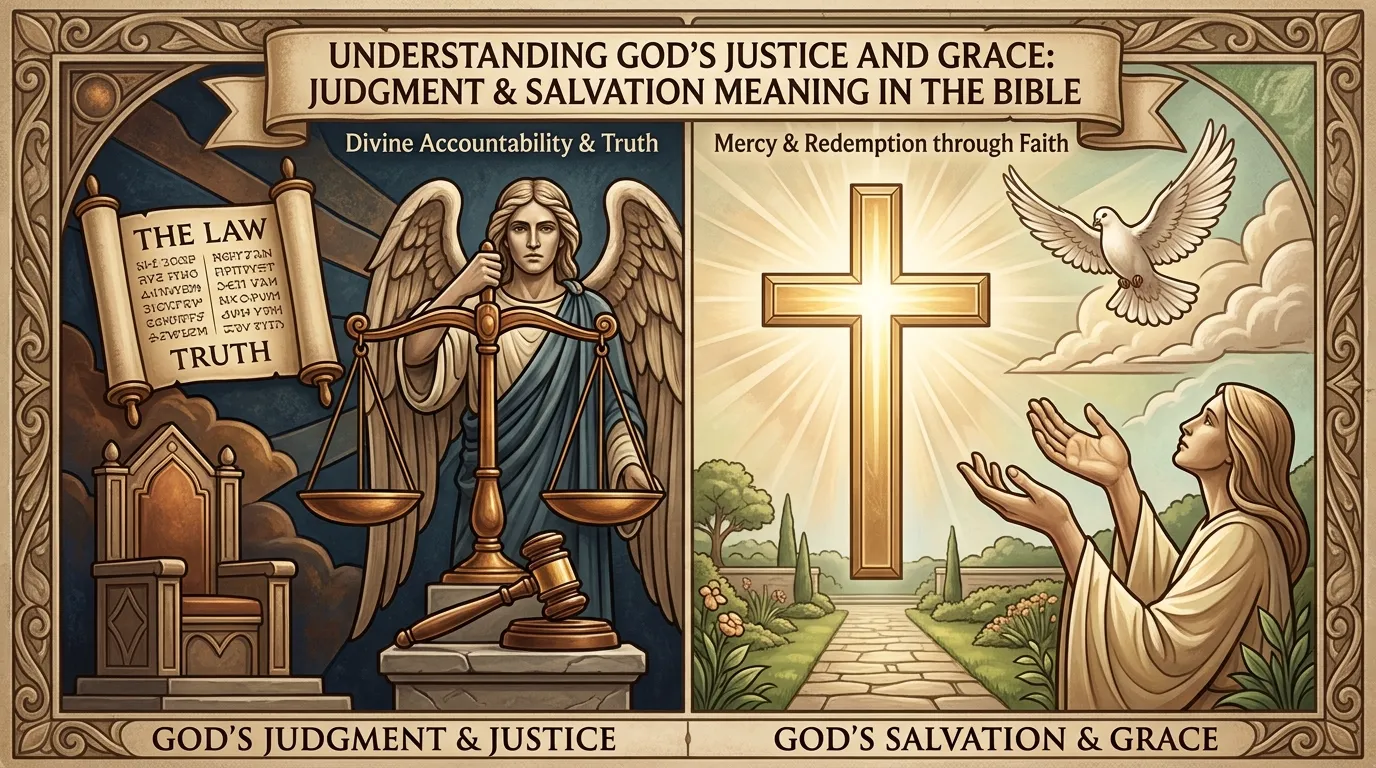
Judgment and salvation sound like opposites. Judgment is God saying what is wrong. Salvation is God making it right. Judgment feels like a courtroom; salvation feels like a rescue. Many people imagine them as two competing ideas in the Bible — as if God must choose between being just and being loving. But Scripture presents them as two sides of one story. Judgment and salvation belong together, and neither makes full sense without the other. To understand either, we must understand both.
This article follows the thread of judgment and salvation from the Old Testament to the cross to the final judgment, showing how they form a single story of God’s justice and grace.
The Pattern in Israel’s Story
The pattern begins early. In the Exodus, judgment and salvation arrive together. The plagues are God’s judgment on Pharaoh and on Egypt’s gods. The Passover is God’s salvation for Israel — the blood of the lamb on the doorposts, so that judgment passes over the house. The same night that brings destruction to Egypt brings deliverance to Israel. The two are not in tension. The judgment on Egypt is the salvation of Israel. God does not choose between justice and mercy. He accomplishes both in one act.
The pattern repeats through Israel’s history. When Israel turns to idolatry, the prophets announce judgment — exile, invasion, loss. But the same prophets, often in the same breath, announce salvation: a remnant will return, a new covenant will be made, a shepherd-king will come. Isaiah’s vision is the clearest example. Isaiah 1 opens with judgment on a rebellious people. Isaiah 53 describes a suffering servant who bears the punishment of others. Isaiah 65 ends with new heavens and a new earth. The prophet who sees judgment most clearly also sees salvation most gloriously.
The Psalms hold the two together in prayer. “The Lord is a God who avenges,” says Psalm 94. “Come, let us sing for joy to the Lord,” says Psalm 95. The same God who judges is the God who saves, and the psalmist worships Him for both. Judgment without salvation would be despair. Salvation without judgment would be sentiment. Together, they are the gospel.
Judgment at the Cross
The cross is where judgment and salvation meet most completely. At the cross, God does not set aside His justice to save us. He satisfies it. The New Testament is explicit: “God presented Christ as a sacrifice of atonement, through the shedding of his blood — to be received by faith. He did this to demonstrate his righteousness, because in his forbearance he had left the sins committed beforehand unpunished” (Romans 3:25). The cross is God’s answer to the hardest question in theology: How can a holy God forgive sin without pretending it does not matter?
On the cross, judgment fell — not on us, but on Christ. He bore the penalty our sin deserved. “God made him who had no sin to be sin for us, so that in him we might become the righteousness of God” (2 Corinthians 5:21). That is why the cross is both terrible and beautiful. It is terrible because it shows what sin costs. It is beautiful because it shows what love gives. The judgment we deserved was absorbed by the Savior who loved us, and the salvation we could not earn was given freely.
This is why Christians can face judgment without terror. “There is now no condemnation for those who are in Christ Jesus” (Romans 8:1). The judgment has already happened — at the cross, for those who trust in Christ. What remains is not a trial to determine whether we are guilty. It is a reckoning of a life already covered by grace. The verdict for the believer was rendered on a Friday afternoon outside Jerusalem, and it was “not guilty” — paid in full.
Salvation: More Than Escape
Salvation in the Bible is larger than escape from punishment. It is rescue from sin and for a new life. The Hebrew and Greek words for salvation carry the sense of being delivered, healed, made whole, and brought to safety. When the New Testament says “believe in the Lord Jesus, and you will be saved” (Acts 16:31), it means more than “you will go to heaven when you die.” It means: you will be rescued from the power of sin now, restored to relationship with God now, and brought into a new life that begins today and lasts forever.
Salvation has three tenses in Scripture. We have been saved — justified by faith, once for all (Ephesians 2:8). We are being saved — sanctified, transformed, made holy day by day (1 Corinthians 1:18). And we will be saved — glorified, raised, brought into the fullness of God’s kingdom (Romans 13:11). A Christian who understands only the first tense will miss the daily transformation. A Christian who understands only the second will miss the assurance. The full picture holds all three together: past, present, and future.
The Final Judgment
The Bible also speaks of a final judgment — a day when God will judge the world in righteousness. Revelation pictures it as a great white throne, with books opened and the dead judged according to what they had done (Revelation 20:11–15). Jesus spoke of it repeatedly: the sheep and the goats, the wheat and the weeds, the wise and foolish builders. The message is consistent: history is heading toward a reckoning, and no one will escape it.
That sounds frightening, and it should be taken seriously. But for the believer, the final judgment is not a threat. It is a vindication. Paul writes that we will all stand before God’s judgment seat — and in the same breath, he urges believers not to judge one another, because the Judge is God (Romans 14:10–12). The final judgment is the moment when every wrong is set right, every hidden thing is revealed, and every tear is wiped away. It is the day when justice is fully done — and for those in Christ, it is the day when salvation is fully revealed.
It is also the day that gives our lives urgency. The knowledge that judgment is coming does not make Christians fearful; it makes them earnest. It makes evangelism matter. It makes holiness matter. It makes the choices of today carry eternal weight. The final judgment is not a doctrine for speculation. It is a doctrine for action.
The Judgment Seat and the Believer’s Works
One question troubles many Christians: If there is no condemnation for those in Christ, what about the passages that say believers will be judged for their works? Paul writes that “we will all stand before God’s judgment seat” (Romans 14:10) and that “we must all appear before the judgment seat of Christ, so that each of us may receive what is due us for the things done while in the body, whether good or bad” (2 Corinthians 5:10). How does that fit with “no condemnation”?
The answer lies in distinguishing two judgments. The first is the judgment of our standing before God — guilty or forgiven. For the believer, that judgment was settled at the cross: Christ bore the penalty, and faith receives the verdict of “righteous.” The second is the judgment of our works — an assessment of how we lived, what we built, and how faithfully we served. Paul describes it in 1 Corinthians 3 as a fire that tests the quality of each person’s work. Some works will survive; some will burn. The builder whose work burns “will suffer loss” but “will be saved — even though only as one escaping through the flames” (1 Corinthians 3:15).
That distinction matters. The believer’s judgment is not a trial to determine heaven or hell. It is a review of a life — with loss and reward, with grief over wasted years and joy over faithful ones, but always within the security of salvation. It means our choices matter eternally, without making our eternity depend on our choices. Grace secures us; works reveal us. Both are true, and both should shape how we live today.
Judgment and Salvation in Your Life
So what do judgment and salvation mean for you, today? They mean three things. First, take sin seriously. Sin is not a mistake or a quirk. It is rebellion against a holy God, and it carries real consequences. Judgment is God’s honest answer to sin, and we should not minimize it.
Second, take grace seriously. God did not leave us under judgment. He entered the judgment Himself, in Christ, and bore it for us. Salvation is not something we achieve. It is something we receive, by faith, as a gift. “For it is by grace you have been saved, through faith — and this is not from yourselves, it is the gift of God” (Ephesians 2:8).
Third, live in light of both. The Christian life is lived between the cross and the final judgment — between the salvation already accomplished and the judgment still to come. That in-between life is marked by gratitude, holiness, mercy, and mission. We forgive because we have been forgiven. We show mercy because mercy was shown to us. We tell others because the rescue we received is meant for them too.
Judgment and salvation are not opposites. They are the two great acts of God’s love: His justice that tells the truth about sin, and His grace that provides the way out. At the cross, they met. In your life, they can meet too. For the wider Christian teaching on the final reckoning, see the Wikipedia article on the Last Judgment.










