Imagine opening the Bible and finding a letter that speaks deeply about Jesus, faith, suffering, hope, and God’s promises, yet the writer never gives his name. That is the mystery of Hebrews.
Many Christians ask, Did Paul write Hebrews meaning in the Bible? The question has been discussed for centuries. Hebrews contains ideas that are close to Paul’s teaching, but the Bible itself never says that Paul wrote it.
So, what can we know with confidence?
The safest answer is this: the author of Hebrews is unknown. Early Christians suggested several names, including Paul, Barnabas, Luke, Apollos, and others. However, the letter itself does not identify its writer.
What matters most is that Hebrews points us to Jesus Christ as our perfect Savior, High Priest, and source of hope. Its message calls believers to remain faithful, trust God, and hold firmly to Christ.
This article explores the authorship of Hebrews, its biblical meaning, its Hebrew background, important verses, spiritual lessons, and what Christians can learn when questions remain unanswered.
Did Paul Write Hebrews?
The Bible does not explicitly say that Paul wrote Hebrews.
Paul identifies himself by name in many of his letters. For example, Romans begins with, “Paul, a servant of Jesus Christ” (Romans 1:1). Galatians, Ephesians, Philippians, Colossians, and several other New Testament letters also identify Paul as their writer.
Hebrews is different.
The opening does not say, “Paul, an apostle of Christ Jesus.” Instead, it begins by focusing immediately on God’s revelation through His Son:
“God, who at various times and in various ways spoke in time past to the fathers by the prophets, has in these last days spoken to us by His Son.”
Hebrews 1:1–2
This makes the identity of the human author uncertain.
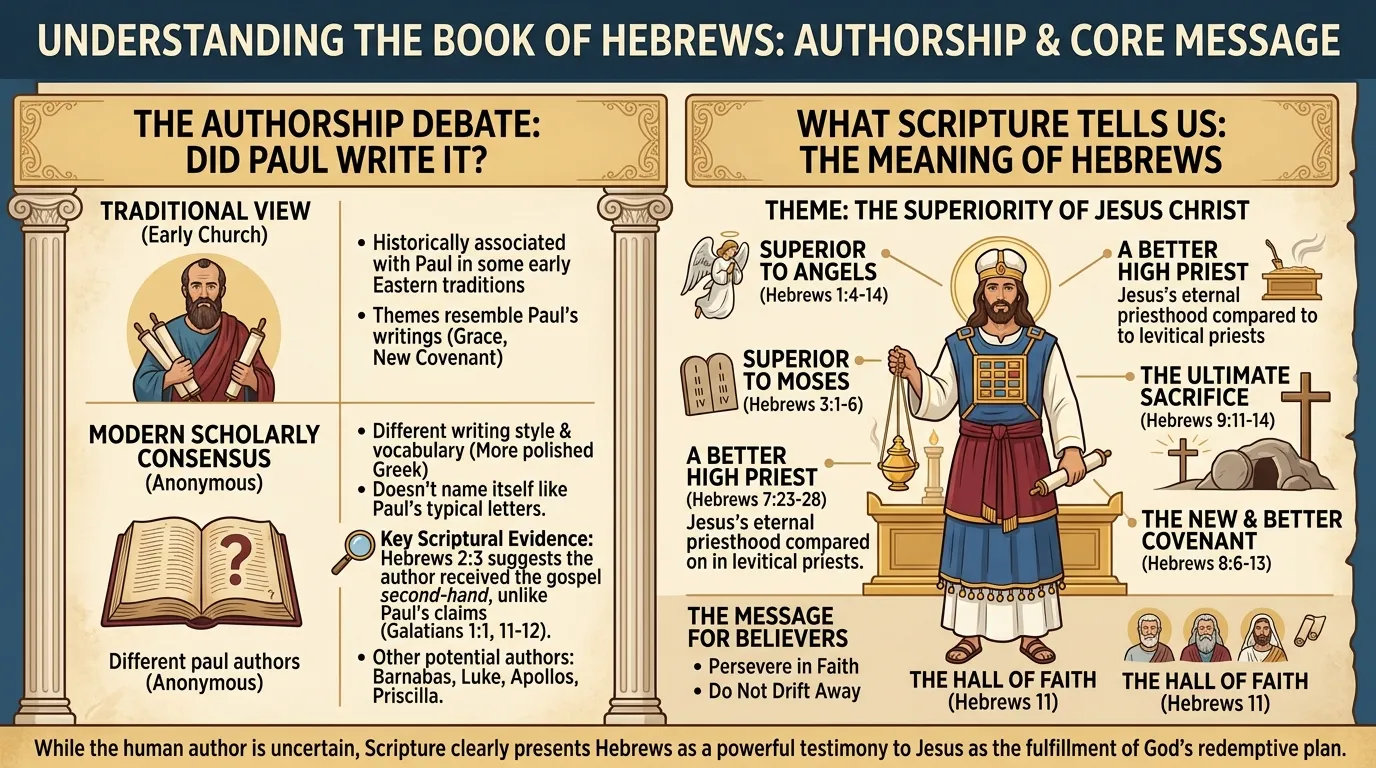
Why Do Some Christians Think Paul Wrote Hebrews?
There are several reasons Paul has traditionally been connected with Hebrews.
First, Hebrews contains strong teaching about faith, grace, Christ’s sacrifice, God’s promises, and perseverance. These subjects are also important in Paul’s letters.
For example, Paul teaches that believers are justified by faith in Romans 3:28. Hebrews also strongly emphasizes faith, especially in Hebrews 11.
Second, some early Christian traditions associated Hebrews with Paul.
Third, Hebrews has a strong understanding of the Old Testament and explains how the Old Testament points toward Christ. Paul also frequently uses Old Testament Scripture to explain the gospel.
However, these similarities do not prove Pauline authorship.
Why We Cannot Say Paul Definitely Wrote Hebrews
There are also important reasons to be cautious.
Hebrews has a different writing style from Paul’s known letters. Its Greek is polished and carefully structured. The author also uses Scripture in a distinctive way.
Hebrews 2:3 says:
“How shall we escape if we neglect so great a salvation?”
The writer then says that this salvation was confirmed to the original hearers by those who heard the Lord.
Some readers see this wording as different from Paul’s usual claim of receiving the gospel directly through Christ.
Most importantly, Hebrews never names Paul as its author.
Therefore, saying “Paul definitely wrote Hebrews” goes beyond what Scripture tells us.
A trustworthy Bible study should allow Scripture to speak clearly while also admitting when Scripture does not give us an answer.
Who Wrote Hebrews?
The honest answer is we do not know.
Throughout church history, different people have been suggested as the author. Paul is one possibility. Barnabas, Apollos, Luke, and other early Christian leaders have also been suggested.
Apollos is sometimes mentioned because Acts 18:24 describes him as an eloquent and knowledgeable teacher who was “mighty in the Scriptures.” Hebrews certainly shows deep knowledge of the Old Testament.
But again, this is a possibility, not a biblical fact.
What We Know About the Author
Although we do not know the author’s name, Hebrews tells us something about his Christian community and message.
The writer knew the Old Testament deeply. He understood the importance of the priesthood, sacrifices, covenant, tabernacle, and promises of God.
He also cared deeply about believers who were facing pressure and needed encouragement.
Hebrews repeatedly urges Christians to remain faithful to Jesus.
That message remains powerful today.
What Is the Main Meaning of Hebrews in the Bible?
The central message of Hebrews is that Jesus is greater and better than everything that came before Him.
Hebrews presents Jesus as greater than angels, greater than Moses, and greater than the Old Testament priesthood. It explains that Jesus brings the fulfillment of God’s saving plan.
Hebrews 1:3 describes Christ as the brightness of God’s glory and the exact representation of His being.
Hebrews 4:14 calls Jesus the great High Priest.
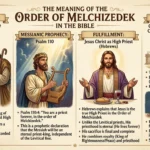
Hebrews 7 explains that Jesus has a permanent priesthood.
Hebrews 9 teaches that Christ entered the heavenly presence with His own blood, providing redemption.
The message is not simply, “Who wrote this book?”
The deeper message is:
Look to Jesus. Trust Jesus. Hold firmly to Jesus.
Jesus Is the Center of Hebrews
Hebrews gives Christians a beautiful picture of Christ.
Jesus is presented as:
- The Son of God — Hebrews 1:1–5
- The Creator and Sustainer — Hebrews 1:2–3
- The perfect High Priest — Hebrews 4:14–16
- The mediator of a better covenant — Hebrews 8:6
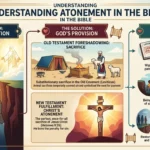
- The perfect sacrifice for sin — Hebrews 9:11–14
- The author and finisher of faith — Hebrews 12:2
- The same yesterday, today, and forever — Hebrews 13:8
This gives Hebrews its powerful spiritual meaning.
When life feels uncertain, Jesus remains certain.
Did Paul Write Hebrews Meaning in the Bible? A Biblical Perspective
If someone asks, “Did Paul write Hebrews?” a careful Christian answer is:
The Bible does not tell us that Paul wrote Hebrews, so we should not treat Pauline authorship as established fact.
At the same time, Hebrews agrees with many truths taught elsewhere in the New Testament.
The authorship question is interesting, but it should never become more important than the message of the book.
God has preserved the message of Hebrews for His people even though He did not preserve the author’s name.
That itself can teach us something important: God’s truth does not depend on human fame.
The unknown writer points away from himself and toward Christ.
Did Paul Write Hebrews? What Early Christians Believed
Some early Christians believed Paul was connected to Hebrews, while others were uncertain.
Even early Christian writers did not always agree about the identity of the author. This is one reason modern Christians should avoid making an uncertain historical claim sound like a clear biblical fact.
The important distinction is:
Biblical fact: Hebrews is part of the New Testament and teaches the supremacy of Christ.
Historical tradition: Some Christians believed Paul wrote it.
What remains uncertain: The exact identity of the human author.
This distinction helps us study the Bible honestly.
Focus Keyword + Hebrew Meaning
The word Hebrews has an interesting Hebrew background.
The Hebrew word commonly translated as “Hebrew” is Ivri or ʿIvri (עִבְרִי). Its plural form is Ivrim (עִבְרִים), meaning “Hebrews.”
The exact origin of the word has been discussed by scholars. It is commonly connected with the Hebrew root ʿ-b-r (עבר), which carries the idea of crossing over or passing through. However, the precise historical development of the term is not completely certain.
In the Old Testament, Abraham is called a Hebrew in Genesis 14:13. The term is also used for the Israelites in places such as Exodus 1:15–19.
The New Testament book called Hebrews is traditionally understood as being addressed to Christians with a strong knowledge of the Jewish Scriptures and religious background.
The Hebrew meaning does not prove who wrote the book.
Instead, it helps us understand why Hebrews spends so much time explaining Old Testament themes and showing how they find their fulfillment in Christ.
Important Verses in Hebrews About Jesus
Hebrews contains some of the strongest teachings about Jesus in the entire Bible.
Hebrews 1:1–2 — God Speaks Through His Son
God spoke through prophets in earlier times, but Hebrews says that God has spoken to us through His Son.
This points to Jesus as the supreme revelation of God.
Hebrews 4:14–16 — Jesus Is Our High Priest
The writer encourages believers to hold firmly to their confession because Jesus is the great High Priest.
Then comes a beautiful invitation:
“Let us therefore come boldly to the throne of grace.”
Hebrews 4:16
This means Christians do not need to hide from God in fear when they need mercy and help.
Because of Christ, we can approach God with confidence.
Hebrews 7:25 — Jesus Saves Completely
Hebrews 7:25 teaches that Jesus is able to save completely those who come to God through Him.
This gives hope to believers who feel weak or discouraged.
Our salvation rests in Christ, not in our ability to make ourselves perfect.
Hebrews 9:28 — Christ Will Appear Again
Hebrews 9:28 points believers toward Christ’s return.
Jesus came once to deal with sin, and Christians look forward to His appearing again.
This creates a strong connection between redemption, hope, and the future.
Hebrews 10:23 — Hold on to Hope
Hebrews 10:23 says:
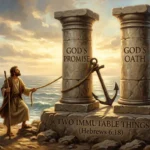
“Let us hold fast the confession of our hope without wavering, for He who promised is faithful.”
Notice where the writer places the reason for our hope.
It is not, “because life will always be easy.”
It is because God is faithful.
Hebrews 11 and the Meaning of Faith
Hebrews 11 is often called the great chapter of faith.
It describes people such as Abel, Noah, Abraham, Sarah, Moses, and others who trusted God.
Hebrews 11:1 describes faith as confidence in what we hope for and assurance concerning things not seen.
But faith in Hebrews is not blind optimism.
These people trusted God and His promises.
Some received wonderful answers. Others suffered greatly. Hebrews 11:39 says that many of them did not receive the fullness of what had been promised during their earthly lives.
This is important for Christians today.
Faith does not mean God will always give us exactly what we want.
Faith means we continue trusting God even when we cannot see the whole picture.
Hebrews 12:1–2 and Spiritual Encouragement
After describing faithful people in Hebrews 11, the writer says:
“Let us run with endurance the race that is set before us.”
Hebrews 12:1
Then believers are told to look to Jesus.
This gives Hebrews a practical message.
Christian life can feel like a long race. There may be seasons of waiting, disappointment, grief, temptation, or uncertainty.
Yet Hebrews says:
Keep going. Keep your eyes on Jesus.
Jesus is described as the author and finisher of faith in Hebrews 12:2.
That means our attention should not become trapped by fear about the future.
What Does Hebrews Teach About Suffering?
Hebrews does not promise Christians a life without hardship.
Instead, it teaches believers to endure.
Hebrews 12:5–11 discusses God’s loving discipline. The passage should not be used to say that every painful event is a direct punishment from God. Scripture does not give us permission to make that assumption.
Rather, the passage teaches that God can use correction and hardship to produce growth and holiness.
This offers a balanced Christian response to suffering.
When you are hurting, you can pray:
“Lord, help me understand what I can learn, help me remain faithful, and give me strength to trust You.”
Can Hebrews Help Us Understand Dreams?
Some Christians wonder whether dreaming about Paul, Hebrews, a Bible, a priest, a temple, or Jesus has a special spiritual meaning.
The Bible does show that God sometimes used dreams in particular situations. For example, Joseph received dreams in Genesis 37, and Joseph in Matthew 1 received divine guidance through dreams.
However, not every dream is a message from God.
Ecclesiastes 5:3 connects dreams with the many concerns of life. Scripture also teaches believers to test spiritual claims rather than accepting every experience automatically.
Therefore, if you dream about Hebrews or Paul, do not assume that the dream is a prophecy.
Instead:
- Test the message against Scripture.
- Do not build doctrine on a dream.
- Pray for wisdom.
- Look at the fruit the interpretation produces.
- Seek wise Christian counsel when necessary.
- Keep Jesus and Scripture at the center.
A dream may cause you to reflect on faith, perseverance, or God’s promises, but the dream itself does not establish biblical truth.
Spiritual Meaning of Not Knowing Who Wrote Hebrews
There is a gentle spiritual lesson in the mystery.
We often want every answer.
We want to know who wrote the book, why something happened, when an answer will come, and what God is doing behind the scenes.
But sometimes Scripture gives us the truth we need without satisfying every curiosity.
Hebrews teaches us to focus on what God has clearly revealed.
We may not know the author’s name, but we know the message points to Christ.
This is a helpful lesson for everyday faith.
You may not know why a prayer has not been answered.
You may not know why a door closed.
You may not know what the next season will bring.
But you can still know God’s character.
What Christians Can Learn From Hebrews Today
The message of Hebrews applies to ordinary life.
When You Feel Spiritually Tired
Hebrews 4:16 reminds you that you can come to God’s throne for mercy and grace.
You do not have to pretend that you are strong.
When You Are Tempted to Give Up
Hebrews 10:23 calls you to hold firmly to hope because God is faithful.
Your circumstances may change, but God’s faithfulness does not.
When You Feel Afraid About the Future
Hebrews 13:5 reminds believers that God will not abandon His people.
You can take the next faithful step without knowing every detail of tomorrow.
When Your Faith Feels Small
Hebrews 11 shows that faith has always involved trusting God without seeing everything clearly.
You can bring even a struggling faith to God in prayer.
When You Are Distracted
Hebrews 12:2 tells believers to look to Jesus.
Sometimes spiritual strength begins by turning our attention away from fear and back toward Christ.
Is Hebrews Still Relevant If We Do Not Know Its Author?
Absolutely.
The uncertainty about authorship does not make the book less valuable.
The church has received Hebrews as part of the New Testament canon, and its teaching fits within the central Christian message of Scripture.
The book calls believers to trust Christ, understand His sacrifice, persevere in faith, and draw near to God.
In other words, Hebrews does not need Paul’s name on the first page to speak powerfully to God’s people.
Its message stands on its own.
Frequently Asked Questions
Did Paul write Hebrews according to the Bible?
The Bible does not say that Paul wrote Hebrews. Pauline authorship is an old Christian tradition, but it cannot be stated as a biblical certainty.
Why do people think Paul wrote Hebrews?
People connect Hebrews with Paul because of similarities in theology, its strong use of the Old Testament, and early Christian tradition. However, similarities do not prove authorship.
Who is the most likely author of Hebrews?
No author can be identified with certainty from Scripture. Paul, Barnabas, Apollos, Luke, and other early Christian leaders have been proposed, but the Bible does not name the writer.
What is the main message of Hebrews?
The central message is that Jesus Christ is supreme, sufficient, and worthy of our faith and perseverance.
What does Hebrews say about faith?
Hebrews 11 teaches that faith involves trusting God and His promises even when we cannot see the outcome. The chapter shows that faithful people continued to trust God through both victories and suffering.
What is the most important verse in Hebrews?
There is no single verse that every Christian must call the most important. However, Hebrews 12:2 is especially central because it directs believers to look to Jesus, while Hebrews 4:16 offers powerful encouragement to approach God for grace and mercy.
Does the word Hebrews mean Israelites?
The term “Hebrew” is used in the Bible for members of the people of Israel, but its history and exact origin are more complex. The Hebrew term Ivri is commonly translated “Hebrew.”
Final Thoughts
The question Did Paul write Hebrews meaning in the Bible leads us into an important lesson about biblical study.
We can honestly say that Scripture does not identify the author of Hebrews. Paul may have been suggested by early Christian tradition, but his authorship cannot be proven from the biblical text.
What Scripture makes clear is far more important.
Jesus is greater than the old covenant shadows. Jesus is our perfect High Priest. Jesus offered Himself for our salvation. Jesus is faithful.
Hebrews calls us to keep our eyes on Him.
When you face unanswered questions, you do not need to have every answer before you can have faith. You can trust the God who has already revealed His character through His Word and His Son.
Take time to read Hebrews slowly. Pray over its promises. Think about the faith of those who came before you. Then, as Hebrews 12 encourages us, look to Jesus and keep running your race with endurance.
God’s guidance may not always come in the way we expect. Yet His faithfulness gives us a firm place to stand.
When you do not know everything, trust the One who does. When you cannot see the road ahead, keep your eyes on Christ. And when your faith feels weak, draw near to the throne of grace.