The virgin birth is the claim that Jesus Christ was conceived by the Holy Spirit and born of the virgin Mary — that He had no human father, and that His birth was a miracle, not a natural event. It is one of the most distinctive doctrines of Christianity, confessed in the Apostles’ Creed and the Nicene Creed, and recorded in the Gospels of Matthew and Luke. It is also one of the most contested. To some, it is a stumbling block. To others, it is the keystone. The Bible presents it not as a legend but as the explanation of who Jesus is: the Son of God, come in the flesh, to save His people from their sins.
This article examines the biblical accounts of the virgin birth, its Old Testament roots, its theological meaning, and the objections commonly raised against it. The focus is doctrinal rather than biographical: not the story of Mary and Joseph’s marriage, but the miracle itself and what it means.
The Two Accounts: Matthew and Luke
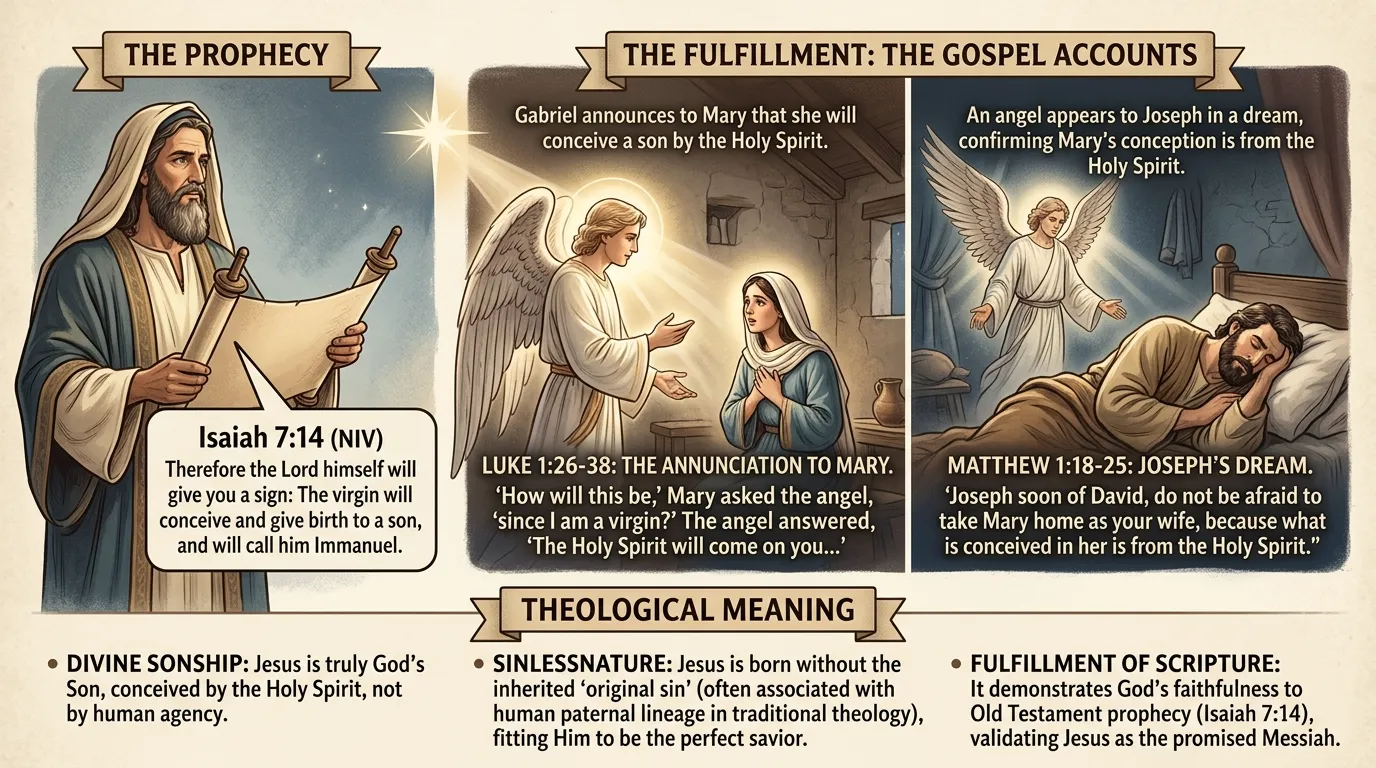
Only two Gospels record the birth of Jesus, and they tell the story from different angles. Matthew tells it from Joseph’s side: Mary was found to be pregnant through the Holy Spirit; Joseph planned to divorce her quietly; an angel told him the child was from the Holy Spirit and that he should name Him Jesus; and Matthew adds, “All this took place to fulfill what the Lord had said through the prophet: ‘The virgin will conceive and give birth to a son, and they will call him Immanuel'” (Matthew 1:22–23).
Luke tells it from Mary’s side: the angel Gabriel announced that she would conceive and bear a son; Mary asked, “How will this be, since I am a virgin?”; Gabriel answered, “The Holy Spirit will come on you, and the power of the Most High will overshadow you. So the holy one to be born will be called the Son of God” (Luke 1:35). The two accounts are independent and complementary. Matthew emphasizes fulfillment, kingship, and Joseph’s obedience. Luke emphasizes grace, the Spirit’s power, and Mary’s faith. Together they give a full picture: a miraculous conception, a virgin mother, a divine Son.
Isaiah 7:14: Prophecy and Fulfillment
Matthew’s quotation of Isaiah 7:14 has generated centuries of debate. The Hebrew word in Isaiah is almah, which means a young woman of marriageable age, often (though not always) implying virginity. The Greek translation of the Old Testament, the Septuagint, rendered it with parthenos, which unambiguously means virgin. Matthew, writing in Greek and quoting the Septuagint, understood the prophecy as a virgin birth. Critics have argued that Isaiah’s prophecy referred only to a child born in Isaiah’s own day. Matthew’s reading is not a denial of the near fulfillment; it is the claim that the prophecy found its fullest, deepest fulfillment in Jesus. The sign God gave to Ahaz was a shadow. The virgin birth is the substance.
The point of the prophecy is not merely biology. It is the sign: God would do something no human could do. A virgin conceiving is a sign precisely because it is impossible by natural means. It declares that the child is not the product of human initiative but of divine action.
Why the Virgin Birth Matters: Three Reasons
First, the virgin birth establishes Jesus’s identity as the Son of God. He is not merely a great teacher, a prophet, or a good man. He is the Son of God by nature, not by adoption. His Father is God. His mother is Mary. He is fully divine and fully human in one person. The virgin birth is the mechanism of the incarnation — the way the eternal Son took on human flesh without ceasing to be God.
Second, the virgin birth establishes Jesus’s sinlessness. The Bible teaches that sin is passed through the human line — “sin entered the world through one man” (Romans 5:12). The virgin birth breaks the chain. Jesus was born of a woman, fully human, but not conceived by a human father, and the Spirit’s overshadowing set Him apart from the inherited corruption of Adam’s line. He was “holy, blameless, pure, set apart from sinners” (Hebrews 7:26). His sinlessness is not a separate doctrine from the virgin birth. It is its consequence.
Third, the virgin birth establishes Jesus’s mission as Savior. The angel told Joseph, “You are to give him the name Jesus, because he will save his people from their sins” (Matthew 1:21). The name Jesus means “the LORD saves.” The virgin birth means the Savior is God Himself, come to do what no human could do. A merely human savior could not bear the sins of the world. Only God could. And only a man could stand in humanity’s place. The virgin birth gives us the God-man — the only one who can be both.
Answering the Objections
The most common objection is scientific: virgin births do not happen. The Christian answer is agreement — virgin births do not happen naturally. That is the point. The virgin birth is a miracle, and miracles by definition exceed natural processes. The question is not whether miracles are possible in a world governed by natural laws. The question is whether there is a God who made those laws and can act beyond them. If God created the universe from nothing, a virgin conception is a small thing.
Another objection is that the virgin birth was borrowed from pagan myths of gods fathering children. The parallels are superficial. Pagan stories involve gods having physical relations with women, producing demigods. The Gospel accounts involve no physical union. The Holy Spirit “overshadowed” Mary — a verb of divine presence, not of sexual activity. The conception was a creative act of God, not a mythological romance.
A third objection is that Mark and John do not mention the virgin birth. That is true, and it is not a problem. Mark begins with Jesus’s baptism. John begins with the eternal Word. Neither Gospel narrates the birth, but both affirm the deity of Jesus, which the virgin birth explains. Silence in two Gospels is not contradiction. It is selection of emphasis.
The Virgin Birth and the Christian Life
The virgin birth is not a doctrine to be admired from a distance. It shapes the Christian life. It means salvation is God’s initiative from start to finish. We did not produce the Savior. God gave Him. It means Jesus is approachable — He was born, He grew, He suffered, He understands. And it means new birth is possible. Just as the Spirit overshadowed Mary and brought forth the Son, the Spirit overshadows believers and brings forth new life. “No one can enter the kingdom of God unless they are born of water and the Spirit” (John 3:5). The miracle of the virgin birth is the pattern of every conversion: God does what we cannot do, and life begins where it was impossible.
The Virgin Birth in the Creeds
The virgin birth has been confessed by the church from the earliest centuries. The Apostles’ Creed declares that Jesus was “conceived by the Holy Spirit, born of the Virgin Mary.” The Nicene Creed affirms that He “was incarnate of the Holy Spirit and the Virgin Mary, and became man.” These creeds were not written as speculative theology. They were written as boundary markers — summaries of the apostolic faith, designed to distinguish true Christianity from counterfeits. The virgin birth was included because the church understood it as essential, not optional.
The creeds also show that the virgin birth was never a peripheral doctrine. It was part of the core confession from the beginning. The early church fathers — Ignatius, Irenaeus, Tertullian, Augustine — all affirmed it. The Reformers affirmed it. The confessions of the Reformation affirmed it. The doctrine has survived every century’s skepticism because it is rooted in the Gospel accounts and in the identity of Jesus Himself.
To deny the virgin birth is not merely to question a miracle. It is to question the identity of Jesus. If Jesus had a human father, He would be a merely human teacher, not the Son of God. The creeds understood that. The virgin birth is the church’s way of saying: Jesus is not just a man who spoke about God. He is God who became man. The creeds confess it because the Gospels teach it, and the Gospels teach it because it is true.
The Virgin Birth and the Incarnation
The virgin birth is the doorway to the incarnation. The incarnation is the claim that the eternal Son of God took on human flesh and became a man. The virgin birth is how it happened. Without the virgin birth, the incarnation would be inexplicable. With it, the incarnation has a mechanism: the Holy Spirit overshadowed Mary, and the divine Son took His human nature from her. The virgin birth is not a separate doctrine from the incarnation. It is the incarnation’s beginning. To affirm one is to affirm the other.
For the doctrine’s biblical basis and historical development, the Wikipedia article on the virgin birth of Jesus provides a detailed overview.










