Imagine sitting quietly at the end of a hard day. Your heart is tired, your questions feel heavy, and you simply want to know that God sees you.
This is one reason the Gospel of Luke meaning in the Bible is so beautiful. Luke tells the story of Jesus in a way that highlights God’s mercy, salvation, compassion, and care for people who feel forgotten or far from Him.
Luke shows Jesus welcoming sinners, healing the hurting, teaching the crowds, forgiving enemies, and seeking those who are lost. From the birth of Christ to His death and resurrection, the Gospel points us to a Savior who came for all people.
The message of Luke is not only about what Jesus did long ago. It also calls us to trust God, receive His grace, love others, pray faithfully, and live with hope.
What Is the Gospel of Luke?
The Gospel of Luke is the third book of the New Testament and one of the four Gospels. It tells the life, ministry, death, and resurrection of Jesus Christ.
Luke begins by explaining why he wrote his Gospel. He wanted to give an orderly account so that his reader could have confidence in the truth about Jesus.
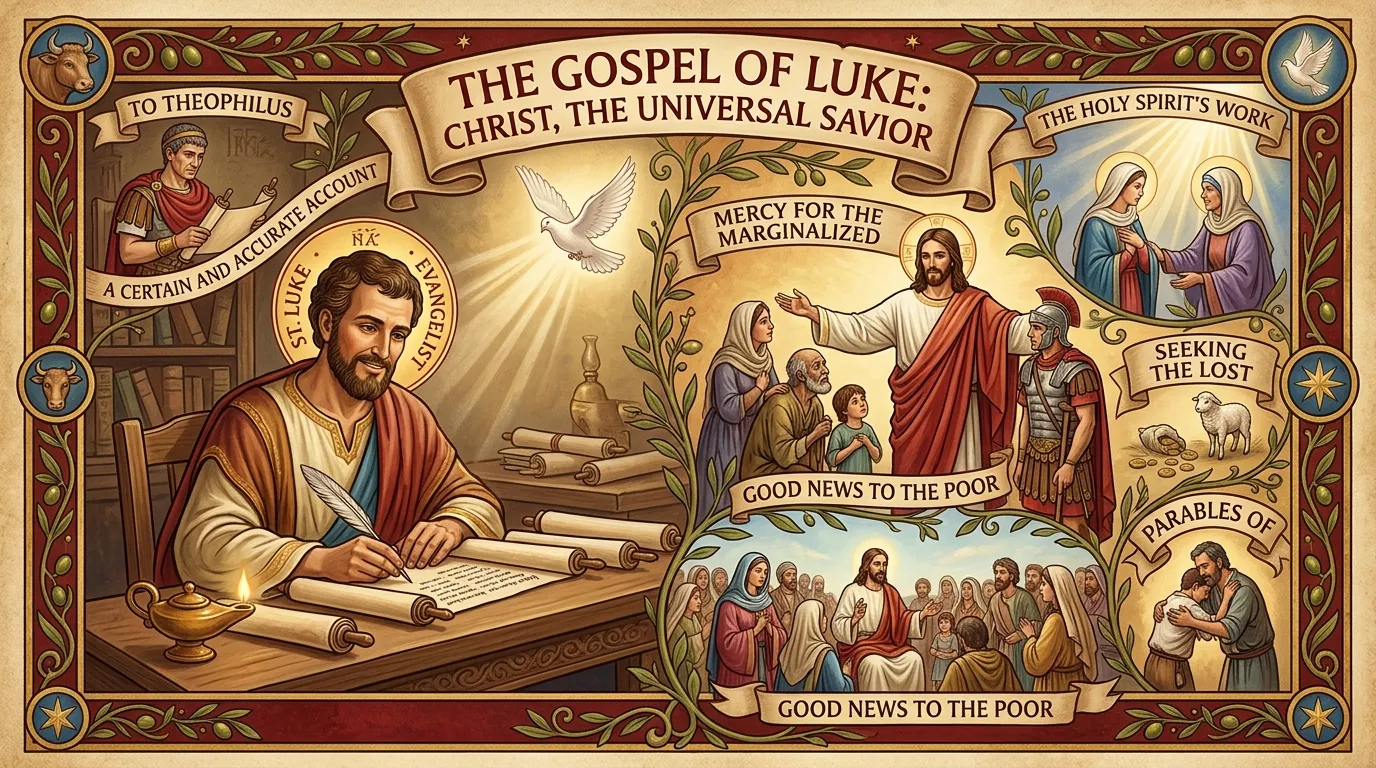
Luke 1:1–4 shows this purpose clearly. Luke says that he carefully investigated the events and wrote them down so that Theophilus could know the certainty of what he had been taught.
This gives us an important biblical meaning:
The Gospel of Luke is a carefully presented testimony about Jesus Christ and God’s work of salvation through Him.
Luke does not present Jesus as only a teacher or miracle worker. Jesus is the Savior, Lord, and Son of God who came to bring salvation.
Gospel of Luke Meaning in the Bible
The central meaning of Luke can be understood through the story it tells:
Jesus came to seek and save the lost, reveal God’s mercy, and bring salvation to people from every background.
This theme becomes especially clear near the end of the Gospel.
In Luke 19:10, Jesus says that the Son of Man came “to seek and to save the lost.” This verse captures one of Luke’s major themes.
Throughout the Gospel, Jesus reaches people who were often rejected by society.
He speaks with sinners. He welcomes children. He touches the sick. He notices the poverty. He forgives those who repent. He even prays for His enemies while suffering on the cross (Luke 23:34).
Luke therefore gives us a picture of a Savior whose heart is full of mercy and compassion.
Why Is the Gospel of Luke Important?
Luke is important because it gives Christians a rich picture of who Jesus is and what He came to do.
It also connects the story of Jesus with the work of the early Church. Luke continues his account in the Book of Acts, which begins with the risen Jesus and His followers.
Luke helps readers understand several major truths.
- Jesus is the promised Savior.
- God cares about people who are overlooked.
- Salvation is offered to all who respond to Christ in faith.
- Jesus has authority over sickness, demons, sin, nature, and death.
- Prayer is important in the life of a believer.
- God’s kingdom calls people to repentance and faith.
- Jesus’ death and resurrection are central to God’s saving plan.
These truths make Luke especially meaningful for people who are seeking hope and a deeper understanding of Jesus.
Major Themes in the Gospel of Luke
Salvation for the Lost
One of Luke’s strongest themes is salvation.
Jesus does not come only for people who already appear religious or righteous. He seeks people who know they need God’s mercy.
The parables in Luke 15 make this especially clear.
Jesus tells about a lost sheep, a lost coin, and a lost son. Each story points toward the joy of finding what was lost.
The story of the prodigal son in Luke 15:11–32 is especially powerful. The father welcomes his returning son with compassion.
The story illustrates God’s gracious heart toward those who turn back to Him.
God’s Mercy and Compassion
Luke repeatedly shows Jesus responding to human suffering with compassion.
In Luke 7:11–17, Jesus meets a widow whose only son has died. Luke says that Jesus had compassion for her before raising her son.
This does not mean Christians will always receive the exact miracle they request. Scripture does not promise that every earthly suffering will immediately disappear.
However, Luke clearly reveals that Jesus is compassionate toward hurting people.
That gives believers comfort when they walk through grief, illness, disappointment, or loneliness.
Jesus and the poverty
Luke often draws attention to the poverty and vulnerable.
Mary’s song in Luke 1:46–55 praises God for remembering the humble. Jesus later teaches about wealth, generosity, and care for those in need.
Luke 6:20–26 records Jesus’ teaching about the poverty, hungry, weeping, and rich. These words challenge His followers to see life through God’s kingdom rather than through worldly status.
The lesson is not that poverty automatically makes someone righteous or that wealth automatically makes someone sinful.
Rather, Luke warns against pride, greed, self-reliance, and neglect of others.
Prayer
Prayer is another important theme in Luke.
Jesus Himself prays at significant moments.
Luke records Jesus praying before major events, teaching His disciples to pray, and encouraging them to remain persistent.
For example, Luke 11:1–4 records Jesus teaching His disciples what is commonly called the Lord’s Prayer.
Luke 18:1 explains the lesson of the persistent widow: Jesus taught His followers that they should always pray and not give up.
For Christians today, this is a practical reminder:
Prayer is not a last resort. It is part of walking with God.
The Holy Spirit
Luke also gives strong attention to the work of the Holy Spirit.
The Spirit is involved in the birth narratives, Jesus’ ministry, and the beginning of His public work.
In Luke 4:18, Jesus reads from Isaiah and speaks of the Spirit of the Lord being upon Him.
This points to Jesus’ mission of proclaiming good news and bringing God’s saving work to people in need.
The Holy Spirit is not presented as a mysterious force to manipulate. Instead, Scripture presents Him as part of God’s work and purpose.
Gospel of Luke Meaning in the Bible + Hebrew Meaning
The Gospel of Luke meaning in the Bible + Hebrew meaning requires an important clarification.
Luke was written in Koine Greek, not Hebrew. The name Luke comes from the Greek name Loukas (Λουκᾶς). Therefore, there is no Hebrew word that directly means “Luke” in the same way that a Hebrew biblical name may have a specific Hebrew root.
The word gospel, however, has an important biblical connection to the Hebrew Scriptures.
The New Testament Greek word euangelion means good news or glad tidings. In the Old Testament, the idea of proclaiming good news is expressed by Hebrew words from the root בשר (b-s-r), associated with bringing or announcing good news.
For example, Isaiah 52:7 speaks of the messenger who announces good news and says that God reigns.
This helps us understand the larger biblical meaning of the Gospel of Luke:
Luke announces the good news that God’s saving King has come in Jesus Christ.
The Hebrew Scriptures provide the background of God’s promises, while Luke shows their fulfillment in the life and ministry of Jesus.
It is important not to claim that Luke’s name itself has a hidden Hebrew spiritual meaning that Scripture does not provide.
Jesus as Savior in the Gospel of Luke
Luke’s birth narrative gives special attention to Jesus as Savior.
In Luke 2:10–11, an angel announces good news to the shepherds and says that a Savior has been born, who is Christ the Lord.
This is one of the clearest statements about the purpose of Jesus.
He is not simply another person sent to give moral advice.
He is the Savior.
The shepherds are also significant. They were ordinary working people, yet God chose to announce the birth of Christ to them.
This fits Luke’s larger message: God’s kingdom reaches people who may not have worldly power or status.
The Good Samaritan and the Meaning of Loving Others
Luke 10:25–37 contains one of Jesus’ best-known parables: the Good Samaritan.
A man is attacked and left wounded. Several religious figures pass by, but a Samaritan stops and helps him.
The story teaches that love for one’s neighbor cannot be reduced to loving only people who are similar to us.
Jesus calls His followers toward compassionate action.
A Christian might apply this lesson by helping a struggling neighbor, visiting someone who is lonely, forgiving someone who has hurt them, or offering practical help to someone in need.
The point is not simply to feel sorry for people.
Biblical compassion moves us toward loving action.
The Prodigal Son and God’s Grace
Luke 15 contains the famous parable often called the Parable of the Prodigal Son.
A younger son leaves home, wastes his inheritance, and eventually returns to his father.
Instead of rejecting him, the father runs to meet him.
Jesus uses this story to teach about God’s joy over sinners who repent.
The father does not celebrate the son’s rebellion. He celebrates his return.
This gives a powerful spiritual lesson:
God’s grace does not excuse sin, but God’s mercy welcomes the repentant sinner.
If someone has wandered from God, Luke offers hope. Returning to God is not a hopeless journey.
The Cross and Resurrection in Luke
Luke does not present Jesus’ life without the cross.
Jesus willingly goes toward Jerusalem, knowing suffering awaits Him.
Luke 23 records His crucifixion. Even in His suffering, Jesus shows mercy. He speaks words of forgiveness and offers hope to the criminal who turns to Him in faith.
Then Luke 24 records the resurrection.
The women discover the empty tomb, and Jesus later appears to His disciples.
The resurrection is essential to Christian faith.
The Gospel of Luke does not end with death. It ends with the risen Christ and the hope of God’s victory.
This means Christian hope is not based simply on positive thinking. It is grounded in the biblical testimony of Jesus’ resurrection.
What Does Luke Symbolize Spiritually?
The Bible does not give a secret symbolic meaning for the Gospel of Luke.
However, Christians commonly draw several spiritual lessons from its themes.
Luke can remind believers of:
- Mercy — God calls His people to show compassion.
- Salvation — Jesus came to seek and save the lost.
- Grace — God welcomes those who turn to Him.
- Prayer — believers are encouraged to seek God continually.
- Humility — worldly status does not determine spiritual worth.
- Compassion — Christians should care for people who suffer.
- Hope — Christ’s resurrection points to God’s victory over death.
- Faithfulness — following Jesus requires trust and obedience.
These are biblical applications drawn from Luke’s message. They should not be treated as secret codes or guaranteed predictions.
What Does It Mean to See the Gospel of Luke in a Dream?
Some people may dream about reading Luke, holding a Bible, hearing the name Luke, or seeing a particular Gospel passage.
The Bible does show that God sometimes used dreams in specific situations. Joseph, for example, received dreams in Matthew 1–2.
However, Scripture does not teach that every dream is a message from God.
Because of this, Christians should be careful.
If you dream about the Gospel of Luke, you might use it as an opportunity to reflect on themes such as:
- Are you seeking God’s mercy?
- Do you need to return to God after wandering?
- Are you struggling to forgive someone?
- Are you neglecting someone who needs compassion?
- Do you need to strengthen your prayer life?
- Are you looking for hope during a difficult season?
These questions can encourage spiritual reflection, but they should not be treated as certain interpretations of the dream.
Test Dreams Against Scripture
The safest Christian approach is to test spiritual impressions against God’s revealed Word.
A dream should never be used to establish new doctrine or contradict Scripture.
If a dream tells you to do something sinful, harmful, or contrary to God’s Word, you should not follow it simply because it felt spiritual.
James 1:5 encourages believers to ask God for wisdom.
Prayer, Scripture, wise Christian counsel, and sound judgment are better foundations for important decisions than dream symbolism.
Gospel of Luke Lessons for Everyday Christian Life
Luke is not only a book to study. Its message can shape everyday choices.
When You Feel Forgotten
Remember how Jesus noticed people others overlooked.
If you feel invisible, Luke reminds you that human attention does not determine your value before God.
When Someone Needs Help
Think about the Good Samaritan.
Faith should affect how we treat people around us. A simple act of kindness can become a practical expression of Christian love.
When You Have Failed
Think about Luke 15.
Failure does not mean you must stay far from God.
Repentance means turning back toward Him.
When You Are Worried
Follow Jesus’ example of prayer.
Instead of carrying every burden alone, bring your concerns to God and ask for wisdom, strength, and peace.
When You Feel Spiritually Weak
Look again at Jesus.
The Gospel is not mainly a story about people being strong enough on their own. It is about God’s saving work through Christ.
That truth gives believers a firm place to stand.
What Is the Main Message of the Gospel of Luke?
The main message of Luke is that Jesus Christ is the Savior who came to seek and save the lost and reveal God’s saving grace to all kinds of people.
Luke presents Jesus as compassionate, holy, powerful, humble, prayerful, and obedient to the Father’s will.
His death and resurrection stand at the center of the Gospel.
The book therefore invites readers not merely to admire Jesus but to respond to Him with faith, repentance, love, and trust.
Frequently Asked Questions
What does the Gospel of Luke mean in the Bible?
The Gospel of Luke tells the story of Jesus Christ and emphasizes God’s salvation, mercy, compassion, prayer, and concern for the lost and overlooked. Luke 19:10 summarizes a central theme: Jesus came to seek and save the lost.
What is special about the Gospel of Luke?
Luke gives detailed attention to Jesus’ compassion, prayer life, the poverty and marginalized, women, sinners, and people who were often overlooked. It also provides the opening account that continues into Acts.
What is the main theme of Luke?
A major theme is Jesus as the Savior who seeks and saves the lost. Luke also emphasizes God’s mercy, the kingdom of God, prayer, repentance, faith, and the work of the Holy Spirit.
Does Luke have a Hebrew meaning?
The name Luke comes from the Greek Loukas, so Scripture does not give it a direct Hebrew meaning. The Gospel itself was written in Koine Greek. The broader idea of “gospel” or good news connects with the Hebrew biblical concept of proclaiming good news.
What does Luke symbolize spiritually?
Luke does not have a secret spiritual code. Christians may use its major themes—such as mercy, salvation, prayer, grace, compassion, and hope—as biblical reminders for their own walk with God.
What does it mean if I dream about the Gospel of Luke?
A dream about Luke may prompt you to reflect on biblical themes such as mercy, repentance, prayer, salvation, or compassion. However, Scripture does not provide a fixed meaning for such dreams. Any spiritual impression should be tested against the Bible.
Why is Luke important to Christians?
Luke gives a detailed account of Jesus’ life, ministry, death, and resurrection. It helps believers understand Christ’s compassion and saving mission while pointing them toward faith, prayer, humility, and love.
Final Thoughts
The Gospel of Luke meaning in the Bible points us back to the heart of the Christian message: Jesus Christ came to seek and save the lost.
Luke shows us a Savior who sees hurting people, welcomes the repentant, cares for the poverty, teaches His followers to pray, and offers hope to those who feel far from God.
Its message is both comforting and challenging.
It comforts us because God’s mercy is greater than our failures. It challenges us because followers of Jesus are called to show that same compassion to others.
If you are reading Luke during a difficult season, slow down and notice how Jesus responds to people. Pray over His words. Ask God to help you understand His character and follow Him faithfully.
And when you do not know what tomorrow holds, remember the hope Luke gives us.
Jesus is risen. God’s promises remain true. His grace is available to those who turn to Him, and His Word gives us a trustworthy foundation for faith.
Take your questions to God in prayer. Search the Scriptures with an open heart. And wherever life leads you, continue to trust the Savior who came to seek and save the lost.