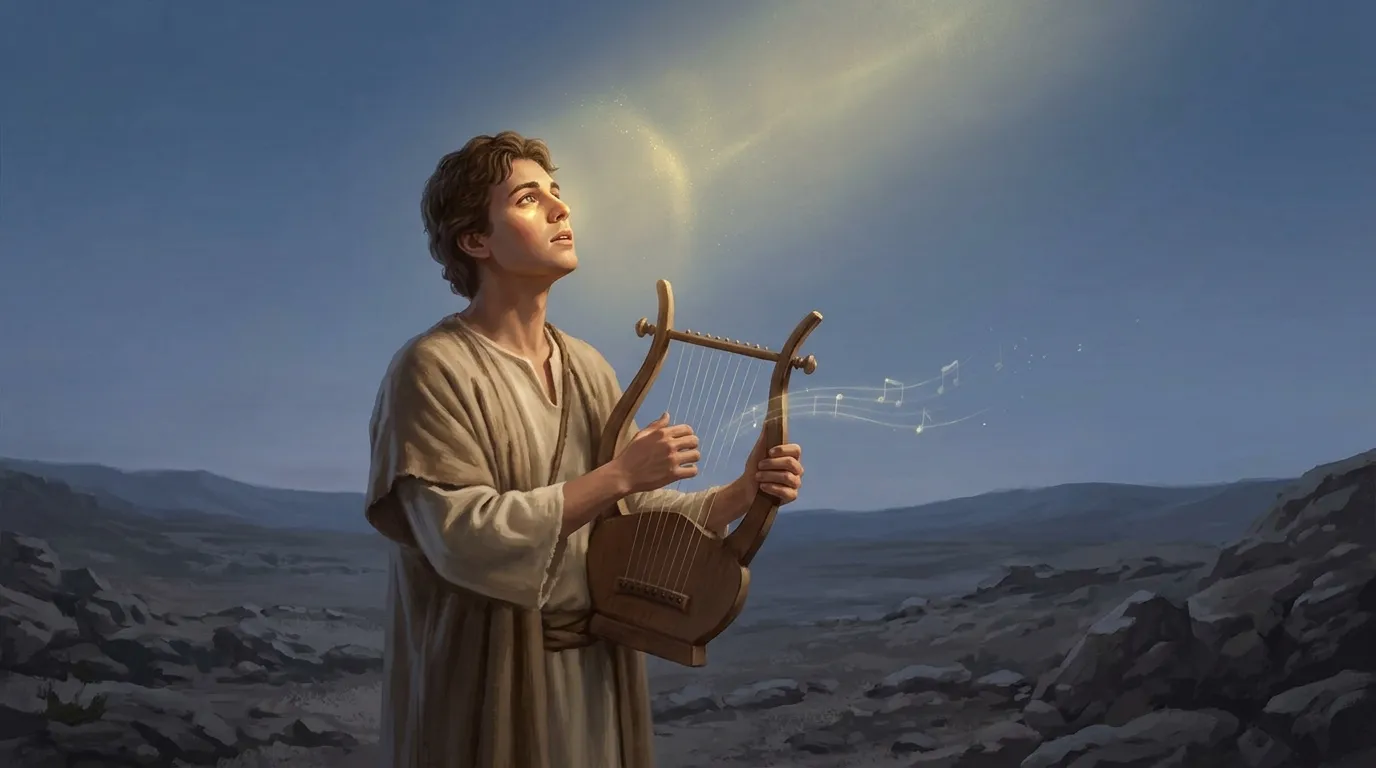
Before Israel ever had a prophet’s scroll, it had a prophet’s song. When Moses’ life was nearly over, God gave him an unusual final assignment: write this song and teach it to the people of Israel, that this song may be a witness for me against them (Deuteronomy 31:19). Not a sermon. Not a statute. A song — commissioned as prophecy, designed to outlive the generation that first sang it, so that centuries later, when the predicted unfaithfulness arrived, the old melody would rise in their memory and testify.
That assignment reveals something the whole Bible keeps demonstrating: in Scripture, song is one of prophecy’s native languages. Not background music for the message, but the message itself set to melody. From the shores of the Red Sea to the throne room of Revelation, God’s people have sung the future before it happened, interpreted the past as theology, and proclaimed God’s character in verses that out-preached every sermon. To understand prophetic songs is to discover that worship, at its deepest, is not the warm-up for God’s Word — it is God’s Word, sung.
Miriam: The First Song After the Sea
The Bible’s first recorded song is also one of its first prophecies. When Israel walked out of the divided sea on dry ground and watched Pharaoh’s army drown behind them, Moses led the men in the Song of the Sea (Exodus 15:1-18) — and “Miriam the prophetess, the sister of Aaron, took a tambourine in her hand, and all the women went out after her with tambourines and dancing” (Exodus 15:20). Notice her title, given here for the first time: prophetess. Her instrument is named in the same breath as her office. In this moment, music and prophecy are not two activities; they are one.
And listen to what the song actually does. It does not merely celebrate the past — “Pharaoh’s chariots and his host he cast into the sea” — it prophesies the future: “You will bring them in and plant them on your own mountain” (Exodus 15:17). Sung on the far shore of the Red Sea, forty years before it happened, the song already plants Israel in the promised land. That is prophecy in its purest form: the present victory so certain of God’s character that the future victory can be sung as already accomplished. Every worship song that declares “He will” on the strength of “He has” is standing in Miriam’s tambourine line.
Deborah: A Battle Report Sung as Theology
A few centuries later, after the defeat of Sisera’s iron chariots, Deborah and Barak sang a song that does something even bolder: it interprets a military victory as a cosmic event. “From heaven the stars fought, from their courses they fought against Sisera” (Judges 5:20). No war correspondent would file that report. But Deborah the prophetess (Judges 4:4) is not filing a report; she is preaching a sung sermon, and her thesis is that Israel’s battlefield was heaven’s battlefield — that behind the human clash stood the God who commands the stars.
This is the second thing prophetic songs do: they read history theologically. The song names names — the tribes that came, the tribes that stayed home by their sheepfolds (Judges 5:15-17) — and turns the muster roll into moral instruction. It blesses Jael’s violent courage and curses Meroz for neutrality: “Curse Meroz, says the angel of the LORD, curse its inhabitants thoroughly, because they did not come to the help of the LORD” (Judges 5:23). Imagine singing a curse as worship. Yet that is what prophetic song does: it refuses to let the congregation merely feel good about victory and forces it to take sides. Sung prophecy comforts the afflicted, yes — but it also afflicts the comfortable, in four-four time.
Hannah: The Childless Woman Who Sang of a King
The most astonishing prophetic song in the Old Testament was sung by a woman with no army, no office, and — at the time of singing — a newborn son she was about to give away. Hannah’s song (1 Samuel 2:1-10) erupts from her answered prayer for Samuel, but it ranges far beyond her personal joy into territory she had no human reason to foresee: “He will give strength to his king and exalt the horn of his anointed” (1 Samuel 2:10).
Stop and feel the weight of that line. When Hannah sang it, Israel had no king and would not have one for decades. The word she uses for “anointed” is mashiach — Messiah. A barren woman, holding her miracle baby, sings of a coming anointed king who will judge “the ends of the earth.” This is not retrospective theology added by a later editor; the narrative presents it as her Spirit-given utterance, and the book of Samuel then spends its remaining chapters bringing her song to pass — Saul, David, and finally the promise of an everlasting throne (2 Samuel 7). Hannah’s song is the overture to the entire monarchy, sung by someone with no seat in the council chamber.
Her song also establishes the great reversal theme that will echo through every prophetic song after it: “The bows of the mighty are broken, but the feeble bind on strength… He raises up the poor from the dust; he lifts the needy from the ash heap” (1 Samuel 2:4, 8). This is prophecy’s moral grammar — God topples the proud and lifts the lowly — and Hannah sang it first, from the ash heap itself. Every later singer of this theme is quoting her.
Mary: The Magnificat and Its Older Sister
Which is why, a thousand years later, when an obscure Galilean teenager learned she would bear the Messiah, the song that came out of her mouth was Hannah’s song, rewritten in the present tense. “My soul magnifies the Lord, and my spirit rejoices in God my Savior” (Luke 1:46-47) — the Magnificat — follows Hannah’s structure, borrows her phrases, and sings her reversals as accomplished fact: “He has brought down the mighty from their thrones and exalted those of humble estate; he has filled the hungry with good things, and the rich he has sent away empty” (Luke 1:52-53).
Mary’s song is prophecy in the fullest sense. She sings of the mighty being toppled while Herod still sits on his throne, of the hungry filled while Rome still taxes the poor into hunger. Like Miriam at the sea, she sings the future as finished — “he has” — because the child in her womb is the guarantee. And like Hannah, she is nobody by the world’s measure: no office, no army, no platform. Prophetic song in the Bible has a persistent habit of choosing unlikely singers, as if God enjoys entrusting His biggest announcements to the voices the world overlooks.
Her relative Zechariah, “filled with the Holy Spirit,” then “prophesied” his own song (Luke 1:67-79) — Luke uses the actual word prophesied for a sung utterance, erasing any line between the two activities. The Benedictus declares that God “has visited and redeemed his people” and names the newborn John as the forerunner. Song, Spirit, and foretelling: the same chord Miriam struck at the sea, now sounding at the Jordan’s edge.
Why Prophecy Keeps Singing
Why did God so often entrust His messages to melody? Part of the answer is memory. God told Moses outright: put the prophecy in a song because songs are remembered when sermons are forgotten — “when many evils and troubles have come upon them, this song shall confront them as a witness” (Deuteronomy 31:21). A generation that could not recite the Law could still sing the song, and the song would preach to them in exile. Every parent who has watched a child absorb theology from a chorus understands the strategy. Sung truth sticks.
Part of the answer is that singing does something to the singer. David’s final oracle begins, “The Spirit of the LORD speaks by me; his word is on my tongue” (2 Samuel 23:2) — the king’s last words are a prophecy, and they come as poetry. The act of singing engages the whole person — breath, body, emotion, memory — in a way that mere hearing does not. Prophecy sung is prophecy embodied; the congregation does not just learn God’s truth, it performs its allegiance to it.
And the pattern runs all the way to the end of the story. Around the throne in Revelation, the redeemed sing “the song of Moses, the servant of God, and the song of the Lamb” (Revelation 15:3) — the oldest prophetic song in the Bible, the one Moses sang at the sea, now sung again beside the final victory, with new verses added. Heaven’s worship is prophetic song’s graduation: the future Miriam sang as promise is now sung as history, and the church’s task in between is to keep singing the “not yet” with the same confidence as the “already.”
That is the invitation for every congregation and every believer. When you sing “He will hold me fast” in a season He seems distant, you are doing what Miriam did. When a worship song declares God’s justice over a corrupt age, it stands with Deborah. When the childless, the overlooked, and the nobodies sing of the coming King, Hannah and Mary are singing with them. Prophetic song is not a lost art of the Bible’s past. It is the church’s present calling: to sing the truth so deeply that the future starts to sound like a memory.
Readers who want to see how the church has treasured the greatest of these songs across the centuries will find the history of Mary’s Magnificat on Wikipedia — its text, its musical settings, and its remarkable career as both worship and protest song.










