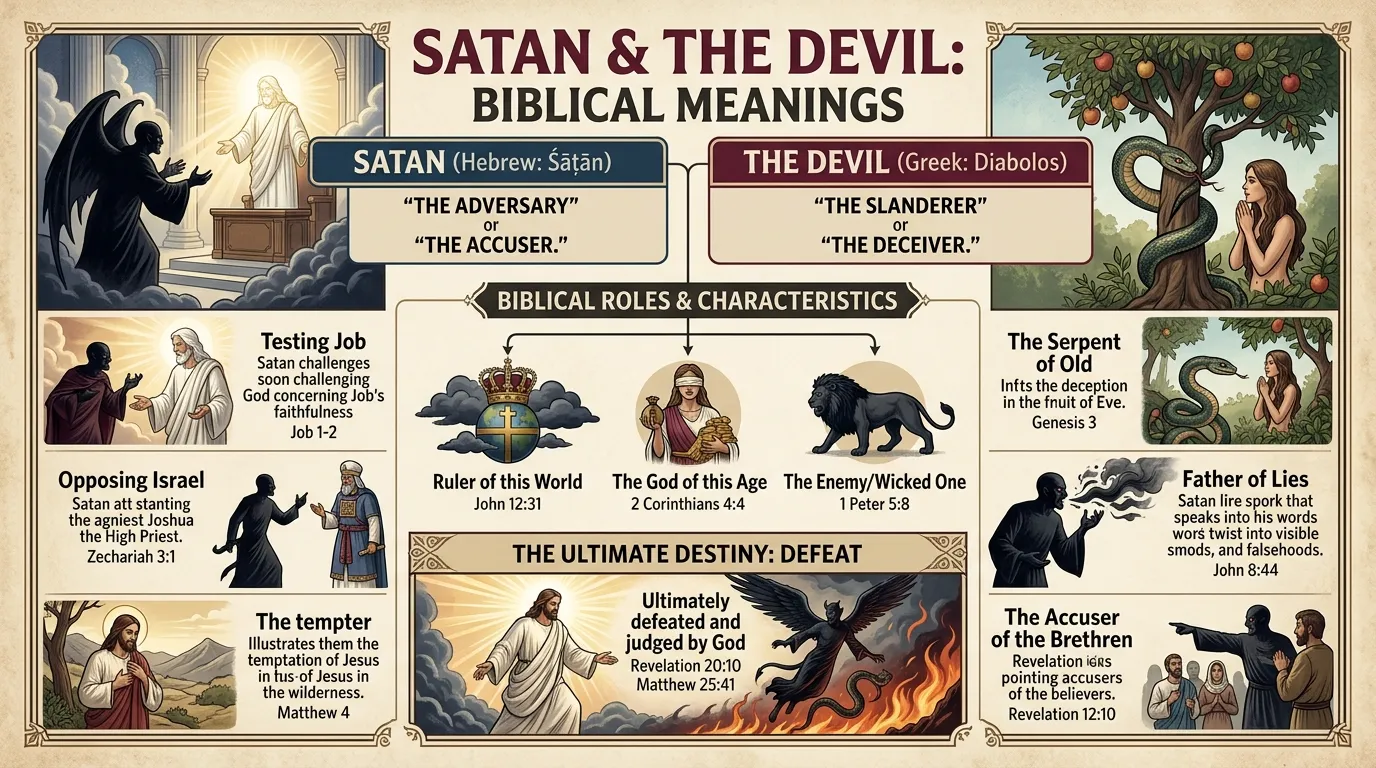
The Bible’s teaching about Satan is often mishandled in two opposite directions, and both are dangerous. Some Christians obsess over him — seeing a demon behind every difficulty, giving him a prominence Scripture never gives him. Others ignore him entirely — treating the devil as a medieval superstition, which is exactly what he would prefer. The meaning of Satan the devil in the Bible sits between those errors: Scripture tells us enough to take him seriously and not enough to fear him, because every passage about the enemy is ultimately a passage about the God who defeated him.
His names alone are a character study. Satan means “adversary” or “accuser.” Devil comes from the Greek diabolos — “slanderer.” He is called the tempter (Matthew 4:3), the evil one (Matthew 13:19), the prince of this world (John 12:31), the god of this age (2 Corinthians 4:4), the accuser of the brethren (Revelation 12:10), a roaring lion (1 Peter 5:8), a liar and the father of lies (John 8:44), and that ancient serpent (Revelation 12:9). Each title is a warning label. Together they describe an enemy who is real, intelligent, and already defeated.
The Accuser: What He Does
Satan’s primary activity in Scripture is not the Hollywood version — it is legal and psychological. In Job 1–2, he appears among the heavenly beings as the accuser, challenging Job’s motives: “Does Job fear God for nothing?” His strategy is to slander God’s people to God and to slander God to His people — the same two-front war in every generation. In Zechariah 3, he stands at the right hand of the angel to accuse Joshua the high priest, who is dressed in filthy clothes — and the Lord rebukes him and reclothes Joshua. The pattern is set: accusation met by divine defense.
Revelation 12:10 names him plainly: “the accuser of our brothers and sisters, who accuses them before our God day and night.” If you have ever felt a voice rehearsing your failures, magnifying your guilt, whispering that you are beyond forgiveness — Scripture identifies that voice. It is not your conscience (which convicts specifically and leads to repentance); it is the accuser (who condemns generally and leads to despair). The difference matters enormously: conviction says “you did wrong; come home.” Accusation says “you are wrong; stay away.” One is the Holy Spirit’s surgery; the other is the devil’s poison.
His second activity is deception. “He is a liar and the father of lies” (John 8:44), and his lies follow the Eden template: question God’s word (“Did God really say?”), question God’s goodness (“you will not certainly die”), promise godhood without obedience. In the wilderness, he quoted Scripture to Jesus — accurately, out of context (Matthew 4:6) — proving that the devil’s most effective lies are wrapped in truth. Paul warns that he “masquerades as an angel of light” (2 Corinthians 11:14): the danger is not that evil looks evil, but that it looks reasonable, spiritual, even biblical.
His third activity is temptation through the ordinary: “the lust of the flesh, the lust of the eyes, and the pride of life” (1 John 2:16) — the same three avenues he used on Eve and on Christ. He does not need new strategies. The old ones still work.
The Fallen One: Where He Came From
Scripture gives two great passages traditionally understood to describe Satan’s origin and fall, both addressed on the surface to human kings but reaching beyond them. Isaiah 14 taunts the king of Babylon, then the language swells past any mortal: “How you have fallen from heaven, morning star, son of the dawn!… You said in your heart, ‘I will ascend to the heavens; I will raise my throne above the stars of God'” (Isaiah 14:12–13). Five “I wills” — the anatomy of pride, the original sin, committed before humanity existed. Ezekiel 28 laments the king of Tyre, then describes one who was “in Eden, the garden of God,” “anointed as a guardian cherub,” “blameless in your ways… till wickedness was found in you” (Ezekiel 28:13–15).
The picture that emerges: Satan was a glorious created being — an angel of high rank — who chose rebellion, trading worship for ambition. He was not created evil; he became evil by choice. This matters because it means evil is not eternal or ultimate. It had a beginning, which means it will have an end. And it means the devil, for all his power, is a creature — finite, limited, permitted only what God allows (as Job’s story proves twice over). He is not God’s equal and opposite. He is a rebellious servant whose leash is exactly as long as sovereignty permits.
When he fell, he took others with him. Revelation 12 describes “his tail” sweeping “a third of the stars out of the sky” (Revelation 12:4) — traditionally understood as the fallen angels who became demons. His kingdom is real but derivative: he can only imitate, accuse, and destroy. He cannot create, forgive, or give life.
The Defeated One: What Christ Did
Here is the center of the Bible’s teaching, and the reason Christians need not live in fear. The New Testament presents Christ’s entire mission as a campaign against the devil. “The reason the Son of God appeared was to destroy the devil’s work” (1 John 3:8). At the wilderness temptation, Jesus defeated him with Scripture rightly used — “It is written” (Matthew 4:4, 7, 10) — modeling the believer’s own weapon. In His ministry, every exorcism was a raid on occupied territory: “if I drive out demons by the Spirit of God, then the kingdom of God has come upon you” (Matthew 12:28).
But the decisive battle was the cross — which looked like Satan’s greatest victory and was his total defeat. “Having disarmed the powers and authorities, he made a public spectacle of them, triumphing over them by the cross” (Colossians 2:15). Hebrews says Jesus shared in humanity “so that by his death he might break the power of him who holds the power of death — that is, the devil” (Hebrews 2:14). The resurrection was the announcement; the cross was the accomplishment. Satan’s two great weapons — accusation (answered by justification: “who will bring any charge against those whom God has chosen?” Romans 8:33) and death (answered by resurrection) — were both broken in one weekend.
His end is already written: “the devil, who deceived them, was thrown into the lake of burning sulfur” (Revelation 20:10). The most feared being in the universe has a scheduled appointment with final judgment. He knows it — which is why, Peter says, he prowls now “like a roaring lion looking for someone to devour” (1 Peter 5:8). A mortally wounded predator is still dangerous, but the outcome is not in doubt.
Living in the Victory: The Believer’s Posture
So what does the Christian actually do with this? Scripture’s instructions are practical and balanced. Resist him — “Resist the devil, and he will flee from you” (James 4:7). The promise is remarkable: resistance works. He flees. He is not an immovable object; he is a bully who retreats when confronted with submitted-to-God authority. Stand firm — Paul’s armor passage (Ephesians 6:10–18) is entirely defensive except for one weapon: “the sword of the Spirit, which is the word of God.” Truth, righteousness, faith, salvation, Scripture, prayer — the armor is Christ Himself, worn by faith.
Stay sober and alert (1 Peter 5:8) — not paranoid, not casual. The Christian neither hunts the devil nor ignores him. And remember the hierarchy: “the one who is in you is greater than the one who is in the world” (1 John 4:4). Greater — not slightly, not arguably, but categorically. The Holy Spirit in the weakest believer outranks the devil himself.
The devil is real, and the Bible wants you to know his tactics — accusation, deception, temptation — so you can recognize them. But the Bible wants you to know something far more: he is fallen, he is limited, and he is defeated. The roaring lion has been declawed at the cross; the accuser has been overruled by the Advocate (1 John 2:1); the serpent’s head has been crushed by the woman’s seed (Genesis 3:15). Know your enemy — and trust your Savior infinitely more. For the historical development of this figure across traditions and centuries of thought, the Wikipedia article on the Devil traces the concept from ancient texts through medieval theology to modern understanding.










