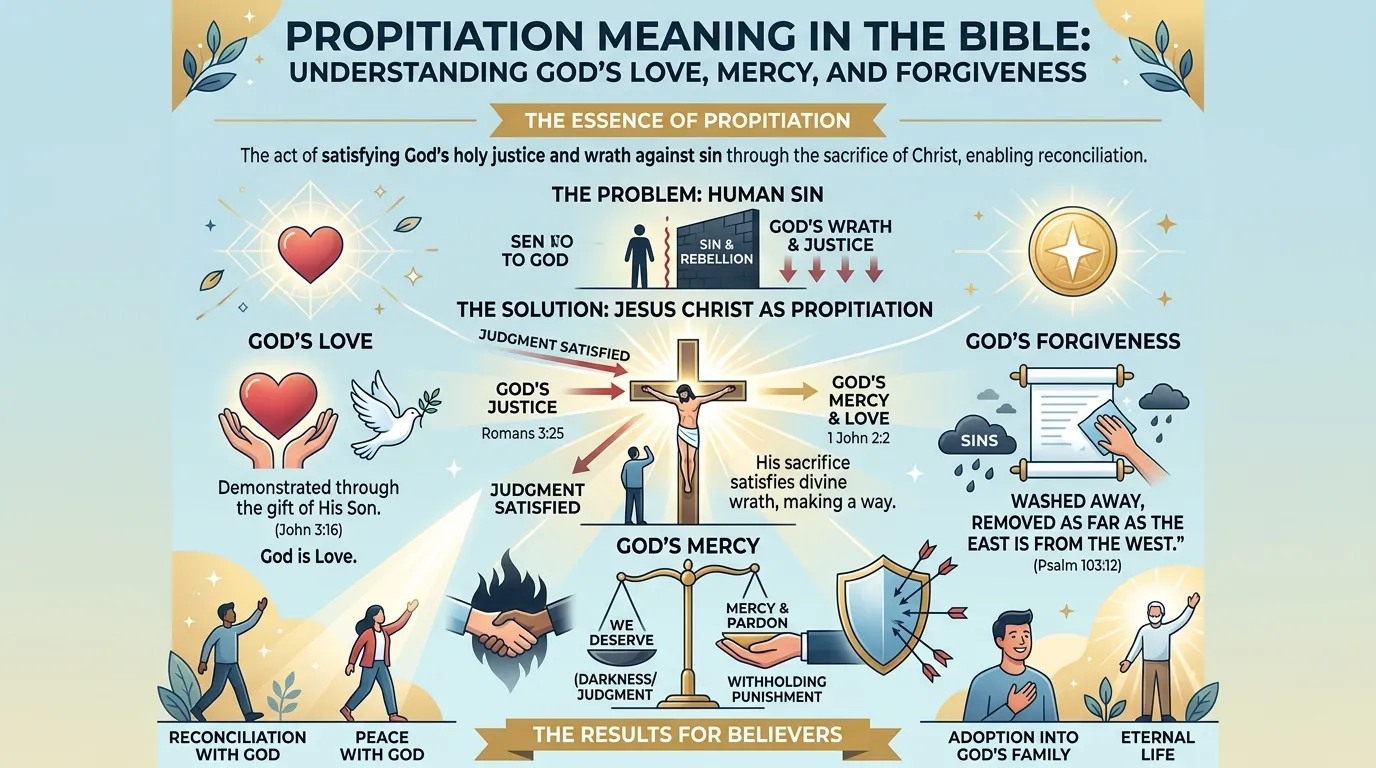
It is the word most Christians skip. Eyes glide over it in Romans 3:25, stumble in 1 John 2:2, and move on to friendlier vocabulary. Propitiation. Five syllables, zero warmth, the kind of term that feels like it belongs in a seminary exam rather than a devotional. But underneath the forbidding Latinate shell sits one of the tenderest truths in Scripture — the answer to the question every honest heart eventually asks: how can a holy God embrace an unholy person without ceasing to be holy? Propitiation is the Bible’s answer, and it is worth the effort of the word.
First, the Plain Meaning
Strip away the theology-speak: propitiation means a sacrifice that turns away wrath. When human anger needs appeasing, we speak of “propitiating” someone — soothing their justified fury with an appropriate offering. The biblical claim is that God’s wrath against sin is real, righteous, and settled — not by our efforts, not by God’s forgetfulness, but by a sacrifice God himself provides.
This is where propitiation differs from its gentler cousin expiation. Expiation is about the sin — wiping it away, canceling the offense. Propitiation is about the offended party — satisfying righteous anger, restoring the relationship. Scripture holds both: our sins are removed and God’s wrath is turned aside. The cross does double duty, and propitiation names the half we find hardest to say out loud.
Hilasterion: The Mercy Seat
The Greek word Paul uses in Romans 3:25 is hilasterion — and it is not an abstract theological coinage. It is the ordinary Greek word for the mercy seat: the solid gold lid of the ark of the covenant, where the high priest sprinkled blood once a year on the Day of Atonement (Leviticus 16:14–15). Picture the scene: above the lid, the cherubim; within the ark, the broken law; between them, the blood. God’s presence dwells over the blood-sprinkled cover — wrath against the broken law is met, every year, by sacrifice.
When Paul writes that God put Christ forward as a hilasterion, he is saying: Jesus is the mercy seat. The annual ritual was a shadow; the cross is the substance. The blood that was sprinkled yearly in the holy of holies has been shed once, finally, on a hill outside Jerusalem. “He entered once for all into the holy places… by means of his own blood, thus securing an eternal redemption” (Hebrews 9:12). The mercy seat walked out of the temple and onto a cross.
The Old Testament Shadows
Long before Paul wrote the word, Israel lived the reality in ritual. On the Day of Atonement, two goats told the two halves of the story: one goat bore the people’s sins into the wilderness — expiation, sin removed (Leviticus 16:21–22); the other’s blood was sprinkled on the mercy seat — propitiation, wrath turned aside (16:14–15). The ritual taught Israel annually what the cross would accomplish finally.
The Passover taught it too. On the night of the exodus, the destroying angel passed through Egypt — and the only thing that turned judgment aside from an Israelite household was blood on the doorposts: “when I see the blood, I will pass over you” (Exodus 12:13). The blood did not make the family sinless; it marked them as sheltered. Paul draws the line straight to Christ: “Christ, our Passover lamb, has been sacrificed” (1 Corinthians 5:7). Every lamb in Israel’s history was a rehearsal; the cross was the performance.
Even the bronze serpent lifted in the wilderness (Numbers 21:8–9) — which Jesus applies to himself in John 3:14 — follows the pattern: judgment deserved, provision given, look and live. The whole Old Testament is a long drumbeat of the same rhythm: wrath real, sacrifice provided, mercy extended. Propitiation is not a New Testament innovation; it is the Old Testament’s heartbeat finally named.
Romans 3:25 — Wrath and Love in One Verse
“Whom God put forward as a propitiation by his blood, to be received by faith.” Every phrase in Romans 3:25:25 carries weight:
- “God put forward.” Propitiation is God’s initiative, not ours. Pagan religions imagined humans propitiating angry gods with bribes; the gospel reverses the direction — God provides the sacrifice that satisfies God. “In this is love, not that we have loved God but that he loved us and sent his Son to be the propitiation for our sins” (1 John 4:10). Wrath and love are not opposites here; love is what moved to answer wrath.
- “By his blood.” The cost is stated bluntly. God’s wrath was not waved away or redefined; it was absorbed. “The wages of sin is death” (Romans 6:23) — and the wage was paid, in full, in blood.
- “To be received by faith.” The propitiation is accomplished for all and applied to those who believe. The mercy seat is there; faith is the act of sheltering under it.
Paul’s context makes the logic airtight. Romans 1–3 establishes universal guilt (“all have sinned,” 3:23) and God’s righteous wrath (“the wrath of God is revealed from heaven,” 1:18). Then 3:24–26 shows how God can be “just and the justifier” simultaneously. Without propitiation, God must choose between his holiness and his mercy. With it, he keeps both — justice satisfied, sinners embraced.
1 John: The Advocate’s Argument
John uses the same word in a pastoral setting. “My little children, I am writing these things to you so that you may not sin. But if anyone does sin, we have an advocate with the Father, Jesus Christ the righteous. He is the propitiation for our sins, and not for ours only but also for the sins of the whole world” (1 John 2:1–2).
Notice the courtroom picture: when the believer sins, the accuser has a case — real guilt, real offense. But the defense does not argue the client’s innocence. The Advocate points to the propitiation: the penalty has been borne; wrath has been turned aside; there is nothing left to prosecute. This is why John can write to struggling Christians with confidence rather than terror. Assurance is not built on our performance but on his propitiation.
And the scope — “not for ours only but also for the sins of the whole world” — guards against every small, tribal gospel. The sacrifice is sufficient for all; its sufficiency is the ground of the church’s worldwide mission. No one is beyond the reach of a propitiation this wide.
Why the Hard Word Matters
Modern ears resist the concept of divine wrath, and some theologians have tried to soften propitiation into mere expiation — God cleansing sin without any anger to satisfy. But Scripture will not let the wrath go. “It is a fearful thing to fall into the hands of the living God” (Hebrews 10:31). “Our God is a consuming fire” (Hebrews 12:29). A God who is not angry at cruelty, exploitation, and deceit would not be good; he would be indifferent.
Here is the wonder: the Bible never asks us to choose between God’s wrath and God’s love, because the cross holds them together. Wrath proves love is serious — God cares enough about evil to judge it. Love proves wrath is not the last word — God cared enough about sinners to bear it himself. Propitiation is where the holy God and the guilty sinner meet without either being compromised. Remove the word and you lose the meeting place.
Common Questions
Does propitiation mean God was angry and Jesus calmed him down, like a pagan sacrifice?
No — and the difference is everything. In paganism, humans offer bribes to change a god’s mood. In the gospel, God himself provides the offering: “God was in Christ reconciling the world to himself” (2 Corinthians 5:19). The Father is not the reluctant party talked into mercy by the Son; Father and Son act together in love to satisfy justice together.
If God’s wrath is satisfied, why do Christians still face consequences for sin?
Because propitiation removes condemnation, not discipline. “There is therefore now no condemnation” (Romans 8:1) — the courtroom is closed. But a loving Father still trains his children: “the Lord disciplines the one he loves” (Hebrews 12:6). Consequences teach; condemnation is gone.
How should propitiation change the way I pray?
It is the ground of boldness. “Let us then with confidence draw near to the throne of grace” (Hebrews 4:16) — confidence, not because we are worthy, but because wrath has been turned aside and the way is open. Pray like someone whose case is already won, because it is.
Preaching It to Yourself
Propitiation is not only doctrine to defend but medicine to take. When guilt whispers that God’s patience must be exhausted, answer with Romans 3:25: the wrath has been turned aside, the blood has been shed, the mercy seat is occupied. When shame says you are too much for grace, answer with 1 John 2:2: the propitiation is “for the sins of the whole world” — and you are in the world. Preach the hard word to your own heart until the tender truth sinks in: there is no condemnation left for those in Christ, because there is no wrath left unspent. It was all spent — on him, for you.
The word itself has a long history in theology — debated, defined, and defended across centuries — and the encyclopedia’s article on propitiation traces how the concept has been understood from ancient religion to Christian doctrine. But the heart of it needs no commentary: God turned his own wrath aside, at his own cost, so that sinners could come home. That is the hardest word in the Bible — and the tenderest truth.










