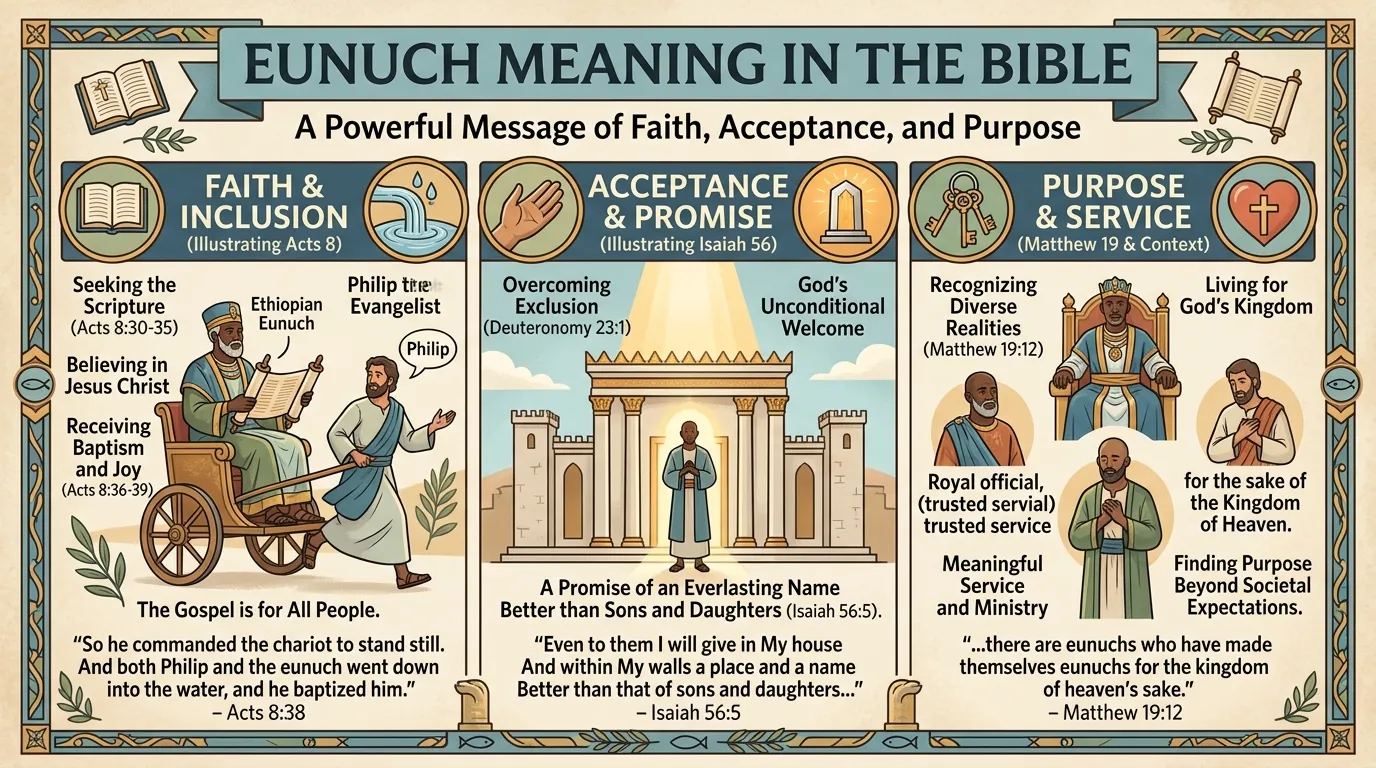
The chariot is rolling south from Jerusalem toward Gaza, and the man riding in it holds one of the highest offices in the ancient world — treasurer to the queen of Ethiopia, a court official of wealth, education, and rank. He has just been to Jerusalem to worship. He is reading Isaiah’s scroll as the wheels turn. And he is a eunuch — a man whose body made him, by the old covenant’s rules, permanently ineligible for full participation in Israel’s worship (Deuteronomy 23:1). He has traveled a thousand miles to seek God, and the law has a door with his name barred on it.
Then God sends Philip running alongside the chariot, and the story that follows — Acts 8:26–39 — is one of the most tender chapters in the New Testament. It is also the Bible’s definitive statement on what eunuchs mean to God. Whatever the world made of them, heaven’s verdict is written in this desert encounter: you are wanted, you are welcome, and the water is for you too.
Who Eunuchs Were in the Ancient World
Honesty requires plain facts, handled with care. In the ancient Near East, eunuchs were men who had been castrated — usually as boys — most often to serve in royal courts and harems, where rulers wanted officials with no competing family loyalties and no dynastic ambitions of their own. It was frequently not a choice; it was something done to them, often through violence, war, or the slave trade. The Bible never commands or endorses the practice. It simply records a world in which eunuchs existed — as court officials in Egypt (Genesis 39:1, where Potiphar is called a eunuch-officer), in Babylon (Daniel 1:3–7), and in Persia (Esther’s court is full of them).
Because eunuchs stood outside the normal patterns of marriage and fatherhood, ancient cultures often treated them as perpetual outsiders — useful but not fully belonging. Israel’s law reflected the brokenness of the ancient world rather than God’s ideal: the exclusion in Deuteronomy 23:1 belongs to the same fallen order as the practice itself. What matters is where the story goes from there.
Isaiah’s Astonishing Promise
Centuries before Philip’s chariot ride, Isaiah spoke directly to eunuchs — by name, with a promise so generous it still startles:
“Let not the eunuch say, ‘Behold, I am a dry tree.’ For thus says the Lord: ‘To the eunuchs who keep my Sabbaths, who choose the things that please me and hold fast my covenant, I will give in my house and within my walls a monument and a name better than sons and daughters; I will give them an everlasting name that shall not be cut off'” (Isaiah 56:3–5).
Read that slowly. The eunuch’s deepest grief — a dry tree, no children, no continuing line, no legacy — is answered not with pity but with upgrade: a name better than sons and daughters. God does not merely tolerate eunuchs in his house; he gives them a monument there — a memorial, a place of honor. And the condition is beautiful in its simplicity: not bodily wholeness, not family status, but covenant faithfulness — keep my Sabbaths, choose what pleases me, hold fast my covenant. The door Deuteronomy seemed to close, Isaiah flings open.
The Chariot on the Desert Road
Now watch Isaiah 56 come alive in Acts 8. The Ethiopian eunuch is reading — of all passages — Isaiah 53, the suffering servant: “Like a sheep he was led to the slaughter.” He looks up at Philip and asks the question that unlocks everything: “About whom does the prophet say this, about himself or about someone else?” (Acts 8:34). Beginning with that Scripture, Philip tells him the good news about Jesus — the servant who was cut off so that the cut-off could be brought in.
The eunuch’s response is immediate and practical: “See, here is water! What prevents me from being baptized?” (8:36). The question hangs in the desert air, weighted with a lifetime of closed doors. What prevents me? — the law, the temple, the whispers, the body itself. Philip’s answer is the gospel in action: nothing. “He commanded the chariot to stop, and they both went down into the water, Philip and the eunuch, and he baptized him” (8:38).
And then the detail Luke cannot resist: “he went on his way rejoicing” (8:39). The first Gentile convert whose baptism is narrated in detail is a eunuch — a sexual outsider, a bodily outsider, a geographical outsider from the ends of the earth (Ethiopia represented the far south to ancient readers). The gospel’s welcome could not be more emphatic: the farthest outsider becomes the first insider.
Jesus’ Own Words
Jesus himself addressed the subject directly, once, in Matthew 19:12 — and with characteristic compassion he names three categories: “there are eunuchs who have been so from birth, and there are eunuchs who have been made eunuchs by men, and there are eunuchs who have made themselves eunuchs for the sake of the kingdom of heaven.”
The middle category — made eunuchs by men — is the Ethiopian’s category, and Jesus names it without flinching and without shaming. The first category acknowledges those born with conditions affecting sexual development — spoken of with the same matter-of-fact dignity. The third speaks of voluntary celibacy for kingdom service, which Paul later commends (1 Corinthians 7:7–8). What Jesus does not do is mock, exclude, or treat any of them as defective disciples. He simply tells the truth about a broken world’s realities — and then keeps welcoming.
Daniel’s story adds one more thread: the young exiles taken to Babylon were very likely made eunuchs (Daniel 1:3–7 implies it; Isaiah 39:7 predicts it), yet Daniel becomes the most honored sage in the empire and a prophet of God — “greatly loved” (Daniel 10:19). Bodily brokenness by men’s cruelty never disqualified anyone from God’s highest callings.
Why Luke Tells This Story Where He Does
Placement is theology in the book of Acts. The Ethiopian’s baptism comes in chapter 8 — before Saul’s conversion (chapter 9) and before Cornelius, the first full Gentile household (chapter 10). Luke is showing the gospel’s expanding circles: Jerusalem, then Samaria (Acts 8:5), then — in the person of this one traveling official — to the ends of the earth. Ethiopia was, to Luke’s readers, the edge of the known world. The eunuch carries the gospel south before Paul ever carries it west.
Church tradition holds that he did exactly that — that the Ethiopian church traces its roots to this chariot ride. Whether or not every detail of the tradition holds, the narrative logic is clear: God chose as his first long-distance missionary a man the old system would have kept at a distance. The gospel’s first great traveler is grace’s great exhibit. Heaven loves that kind of irony.
What This Means for the Excluded Today
The eunuch passages preach to everyone who has ever stood outside a closed door. A few truths to carry:
- God’s house has no “dry tree” section. Whatever makes you feel permanently disqualified — your body, your past, your family situation, what was done to you — Isaiah 56 answers with a monument and a name. In Christ, outsiders are not merely admitted; they are honored.
- Baptism is for the willing, not the qualified. Philip asked for one thing: faith in Jesus. “What prevents me?” Nothing — then or now — except unbelief.
- Joy is the proper ending. The eunuch went on his way rejoicing — not merely tolerated but transformed. The gospel does not give outsiders a grudging seat in the back; it gives them a song for the road.
- The church must be Philip, not the gatekeeper. God told Philip to go near and join the chariot (Acts 8:29). The Spirit’s direction is always toward the excluded, never away. Any church culture that recreates Deuteronomy’s closed door has missed Acts’ open water.
From Isaiah’s monument to Philip’s baptismal water, the Bible’s message to eunuchs — and to everyone who has ever felt like one, standing outside what others enjoy — is unchanging: you belong here, your name is written here, and the joy is for you too.
A Closing Word to the Wounded
If you carry wounds like the Ethiopian’s — things done to you, not chosen by you — hear the gospel’s specific tenderness toward you. God never confuses what was done to you with who you are. The eunuch’s condition came from others’ cruelty; God’s response was personal honor — a monument, a name, a baptism, a song. “He heals the brokenhearted and binds up their wounds” (Psalm 147:3) is not a general sentiment; it is a targeted promise. Bring him the wound. He specializes in turning the marks of cruelty into monuments of grace — and in setting the wounded on chariots headed home, rejoicing.
For historical context on the court office, the ancient practice, and its long and often painful history across civilizations, the encyclopedia’s article on eunuchs provides careful background. Scripture’s verdict, though, is the one that heals: a name better than sons and daughters, a monument within God’s walls, and water in the desert for everyone who believes.










