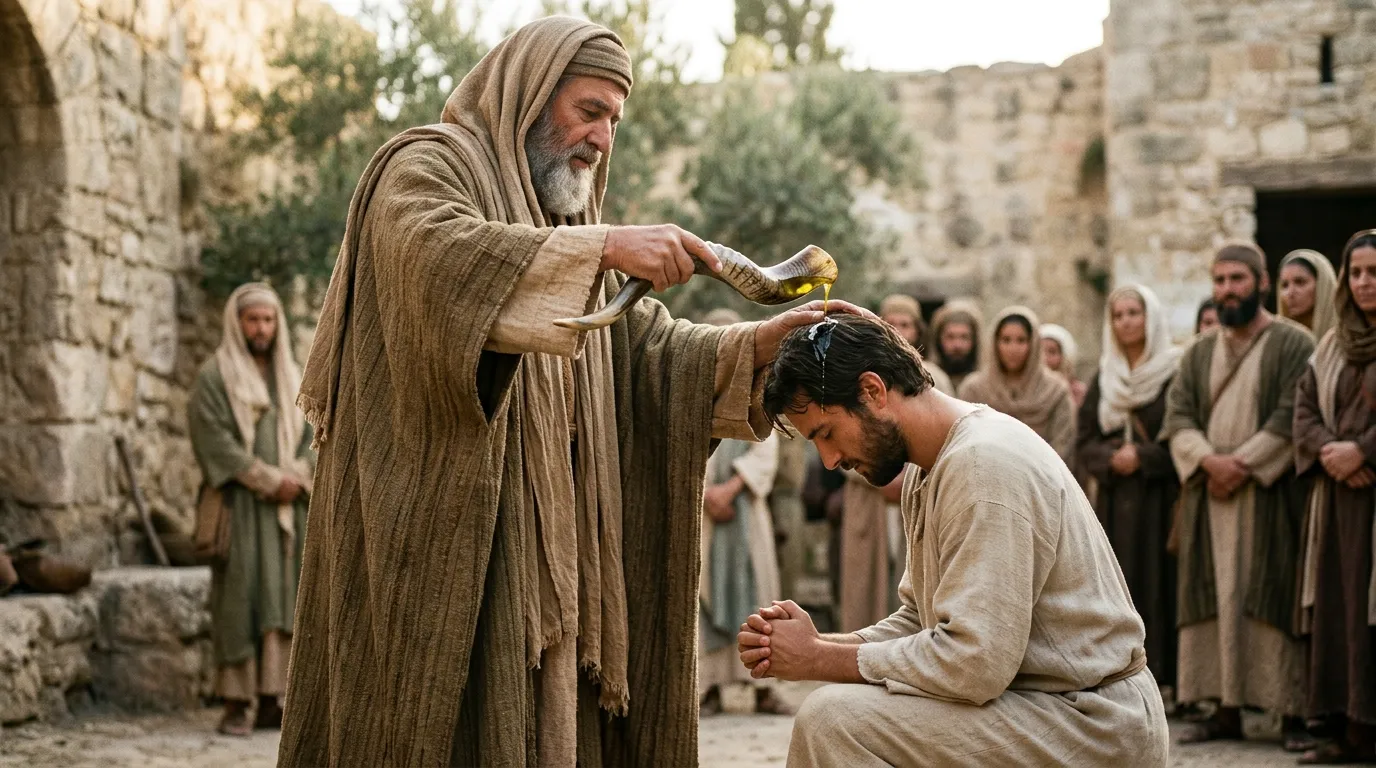
The old prophet’s horn is full of oil, and the youngest son of Jesse is standing in a field smelling of sheep. Samuel tips the horn, and oil runs down David’s head — “and the Spirit of the Lord rushed upon David from that day forward” (1 Samuel 16:13). In that single act, three things happen at once: a person is chosen, a task is assigned, and power is supplied. That is what anointing means in the Bible — not a vague spiritual glow, but God’s public marking of a person for a mission, with God’s own Spirit as the equipment.
Oil on the Head: Kings, Priests, and Prophets
Anointing in Scripture is always vocational. The Hebrew mashach — to smear or rub with oil — is performed on people being set apart for three offices:
- Kings. Samuel anoints Saul (1 Samuel 10:1), then David (16:13). The oil declares: this reign is God’s appointment, not merely the people’s choice. When David later refuses to harm Saul — “the Lord’s anointed” (1 Samuel 24:6) — he honors the office even when the officeholder has failed. Anointing outranks personal merit.
- Priests. Aaron and his sons are anointed and consecrated to serve (Exodus 28:41; Leviticus 8:12). Oil runs down Aaron’s beard in Psalm 133:2 as a picture of unity — the anointing that marks mediators between God and people.
- Prophets. Elijah is told to anoint Elisha as prophet in his place (1 Kings 19:16). The prophet’s anointing authorizes the word: “The Spirit of the Lord God is upon me, because the Lord has anointed me to bring good news to the poor” (Isaiah 61:1).
Oil itself carried meaning: olive oil was the ancient world’s fuel for light, medicine for wounds, and luxury for feasts. To be anointed was to be set apart as light-bearer, healer, and honored guest of God — all at once.
The Anointed One: From Mashiach to Christos
As Israel’s history darkened, the Anointed One — ha-mashiach — became the title of the ultimate office-holder, the one who would be prophet, priest, and king in a single person. The Greek translation, Christos, is where we get Christ: every “Jesus Christ” in the New Testament is really “Jesus the Anointed One.”
Jesus claims the anointing explicitly. In the Nazareth synagogue he unrolls Isaiah’s scroll and reads — “The Spirit of the Lord is upon me, because he has anointed me to proclaim good news to the poor” — then sits down and announces: “Today this Scripture has been fulfilled in your hearing” (Luke 4:18, 21). At his baptism the Spirit descends like a dove (Mark 1:10) — the heavenly anointing matching the earthly ritual, oil replaced by the Spirit himself. Peter’s summary of Jesus’ ministry begins there: “God anointed Jesus of Nazareth with the Holy Spirit and with power” (Acts 10:38).
This reframes the cross. The Anointed One — the ultimate King — is anointed not only with oil and Spirit but, in a terrible sense, with suffering. “Christ redeemed us from the curse… by becoming a curse for us” (Galatians 3:13). The mission his anointing assigned him led through Gethsemane. God’s marking is not a promise of ease; it is a promise of purpose.
The Spirit’s Anointing in Acts
At Pentecost the anointing spills beyond the individual to the whole community. Peter explains the rushing wind and tongues of fire as the fulfillment of Joel: “I will pour out my Spirit on all flesh” (Acts 2:17). What was once reserved for kings, priests, and prophets at their commissioning now falls on “your sons and your daughters… your young men… your old men… even on the male and female servants” (2:17–18). The mission has gone universal, so the anointing has gone universal.
This democratization does not cheapen the concept; it fulfills it. Moses once wished “that all the Lord’s people were prophets, that the Lord would put his Spirit on them!” (Numbers 11:29). Pentecost is God’s answer to Moses’ wish. The whole church becomes an anointed people — a “royal priesthood” (1 Peter 2:9), the very offices of the old anointing now worn by every believer.
You Have an Anointing
John writes to ordinary Christians — not apostles, not clergy — and tells them something startling: “you have been anointed by the Holy One, and you all have knowledge” (1 John 2:20). And again: “the anointing that you received from him abides in you” (2:27). Paul agrees: “it is God who establishes us with you in Christ, and has anointed us, and who has also put his seal on us and given us his Spirit in our hearts” (2 Corinthians 1:21–22).
What does the believer’s anointing do? Three things, matching the old offices. It teaches — John’s anointing gives discernment against deception (1 John 2:26–27); the Spirit guides into truth (John 16:13). It empowers witness — “you will receive power when the Holy Spirit has come upon you, and you will be my witnesses” (Acts 1:8). It consecrates — the anointed life is set apart, “a living sacrifice, holy and acceptable to God” (Romans 12:1).
Notice what it does not do: it does not make you a celebrity, exempt you from suffering, or signal that your opinions are infallible. The biblical anointing is for service, not status. David was anointed years before he wore the crown — and the years between were caves, not palaces. Anointing marks you for the mission; the mission still runs through the wilderness.
Oil for the Sick, Oil for the Everyday
Anointing was not only for coronations. When Jesus sent out the Twelve, “they anointed with oil many who were sick and healed them” (Mark 6:13) — oil as medicine and mercy combined. James later instructs the church: “Is anyone among you sick? Let him call for the elders of the church, and let them pray over him, anointing him with oil in the name of the Lord” (James 5:14).
Christians have understood this differently — some seeing a continuing ordinance, others a cultural expression of prayerful care — but all agree on the heart of it: the sick are not to suffer alone, prayer is the church’s first medicine, and God’s healing presence meets his people in their weakness. The God who anointed kings for thrones also anoints the fevered in their beds. No one is beneath the oil’s reach.
There is also a quieter, daily anointing commended in Scripture. “But when you fast, anoint your head and wash your face” (Matthew 6:17) — Jesus assumes his followers still practice the ordinary cultural anointing, and folds it into hidden devotion: look normal, serve God secretly, let the Father who sees in secret reward you. And the woman who anoints Jesus’ feet with costly ointment (John 12:3) shows that anointing can flow upward too — our costly devotion poured out on him, “a beautiful thing” (Mark 14:6) that he defends against every critic.
Walking in the Anointing This Week
A few practical implications of being anointed people:
- Expect the Spirit’s help in ordinary obedience. The anointing is not reserved for platform moments. It is for the difficult conversation, the quiet integrity, the unseen kindness — “it is God who works in you, both to will and to work for his good pleasure” (Philippians 2:13).
- Discern teaching carefully. John’s anointing protects against falsehood — but only if you use it. Test what you hear against Scripture (Acts 17:11); the Spirit and the Word never contradict.
- Serve from appointment, not ambition. David waited for God’s timing after his anointing. Ambition grabs the throne; anointing waits for the call.
- Remember the oil flows down. Psalm 133 pictures anointing oil running from head to beard to robes — blessing that descends and spreads. Anointed people leak grace onto everyone around them.
From Samuel’s horn to Pentecost’s fire, the Bible’s message is one: God marks people for his purposes and supplies his own Spirit for the task. The Anointed One has come; the anointed people are here. The mission continues.
Anointed for Obscurity
A final corrective, because our age misunderstands anointing badly: in Scripture, anointing frequently leads to obscurity, not platform. David is anointed in 1 Samuel 16 and returns to the sheep — then to the battlefield as a delivery boy (17:17–18), then to the caves as a fugitive. Years pass between the oil and the crown. Elisha is anointed prophet and goes back to plowing with twelve yoke of oxen (1 Kings 19:19). The anointing did not immediately change their circumstances; it changed their assignment within their circumstances.
This matters for every believer who has sensed God’s call and wonders why the stage hasn’t appeared. The anointing is for faithfulness where you are, not fame where you wish you were. “Whatever you do, work heartily, as for the Lord” (Colossians 3:23) — the anointed accountant, the anointed mother, the anointed mechanic, each marked for mission in the ordinary. Most anointed life is lived far from crowds: the oil on the head matters more than the eyes on the stage. Serve the small assignment with the great anointing, and let God handle the timing of everything else.
The practice itself — its oils, its rituals, its spread across religions and history — is surveyed in the encyclopedia’s article on anointing, a helpful backdrop. But Scripture’s emphasis stays vocational and personal: chosen, marked, and equipped — not for privilege, but for purpose.










