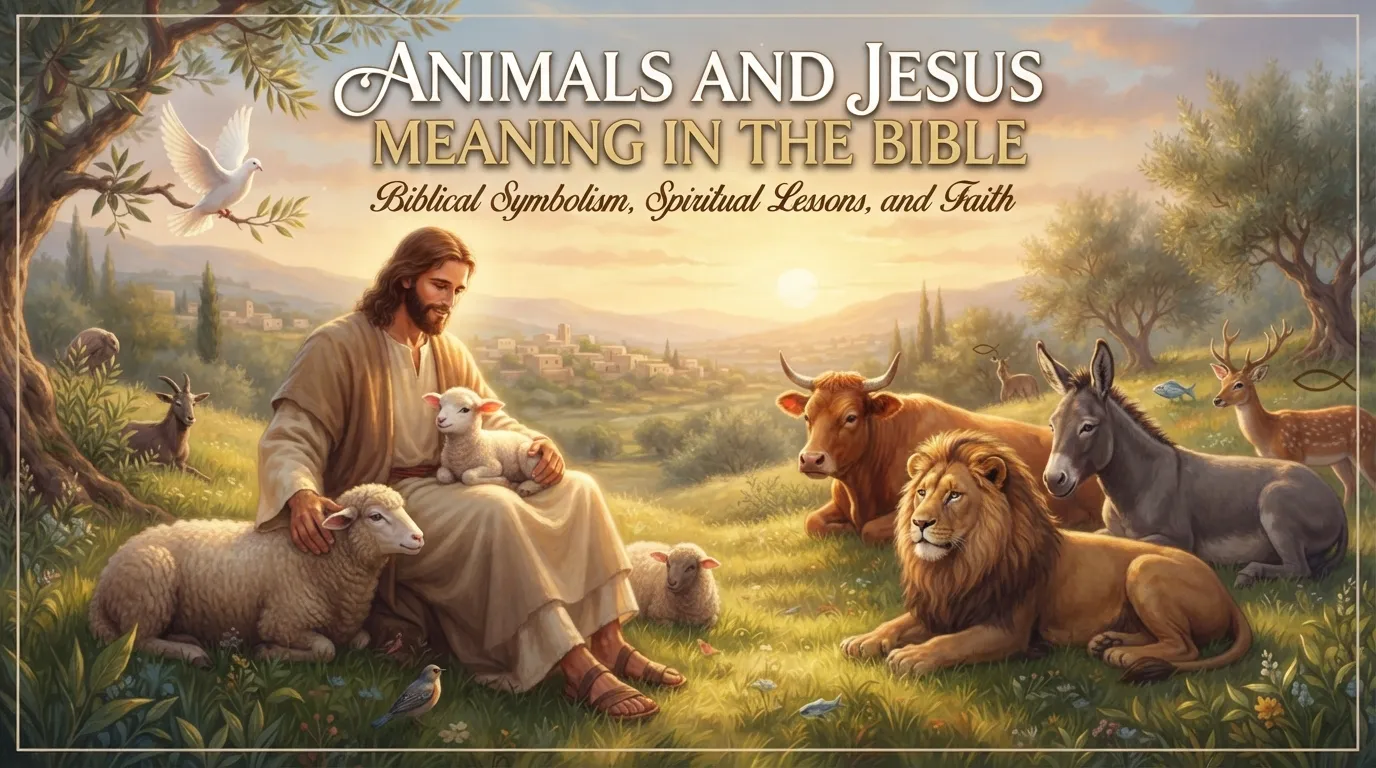
A lamb. A dove. A donkey. A lion. A net full of fish. If you gathered the animals most closely connected with Jesus in the Bible, you would have a strange menagerie — and a surprisingly complete portrait of who He is. The animals and Jesus meaning in the Bible is not about secret codes or supernatural messages hidden in every creature you see. It is about how Scripture uses familiar animals to teach about Christ: His sacrifice, His humility, His peace, His authority, and His care. Think of this as a field guide — five animals, five truths, each grounded in a passage you can open and read.
The Lamb: Sacrifice
The lamb is the most important animal image connected with Jesus. John the Baptist saw Jesus and declared, “Behold, the Lamb of God” (John 1:29). That statement ties Jesus to the sacrificial lamb imagery running through Scripture. In the Old Testament, lambs were used in sacrifices, and the Passover lamb in Exodus 12 is especially important: its blood marked the homes of the Israelites and was connected with God’s deliverance from Egypt. The New Testament presents Jesus as the fulfillment of that larger sacrificial theme. First Peter 1:18–19 describes Christ as a lamb without blemish or defect, connecting His sacrifice with redemption.
This does not mean Jesus was literally an animal. The lamb represents the sacrificial and innocent nature of Christ’s saving work. The cross reminds Christians that salvation is not something we earn through human achievement. It is rooted in God’s grace and Christ’s sacrifice.
The Dove: The Spirit’s Presence
A dove appears at Jesus’ baptism. Matthew 3:16 says the Spirit of God descended like a dove after Jesus was baptized. The passage does not say the Holy Spirit was literally a dove — Scripture says the Spirit descended like a dove. The image is often associated with peace, gentleness, purity, and the presence of the Holy Spirit.
Christians should be careful not to turn the dove into a magical symbol. Its significance comes from the biblical account of Jesus’ baptism, at the beginning of His public ministry. The dove recalls the Spirit’s presence and the peace God offers — not a promise that Christians will never experience trouble, but a deeper peace rooted in God’s presence.
The Donkey: Humble Kingship
Jesus entered Jerusalem riding on a donkey, fulfilling the prophecy in Zechariah 9:9. Matthew 21:5 explains that the King would come humble and riding on a donkey. The contrast is deliberate. Jesus did not enter Jerusalem like a military ruler displaying earthly power. He came as a humble King.
The donkey therefore illustrates humility, peaceful kingship, and God’s different understanding of true greatness. Christian faith is not built around pride or status. Jesus repeatedly taught His followers to serve rather than seek worldly greatness — and He modeled it Himself, arriving on the humblest of mounts.
The Lion: Royal Authority
The lion is the other side of the portrait. Revelation 5:5 calls Jesus the Lion of the tribe of Judah, pointing to His royal authority and victory. Yet the same chapter immediately presents Christ under the image of a lamb. The combination is deeply meaningful: Jesus is both the victorious King and the sacrificial Lamb. His victory is not separated from His sacrifice.
Jesus is not merely a teacher offering helpful advice. Scripture presents Him as Lord and King. The lion reminds believers that the gentle Jesus is also the reigning Jesus — and that His authority is exercised through the very sacrifice the lamb represents.
The Fish: Mission and Provision
Fish appear frequently in the Gospels. Jesus called fishermen such as Peter, Andrew, James, and John to follow Him. He performed miracles involving fish, including the feeding of large crowds and the miraculous catch of fish. And He told His disciples they would become “fishers of men” (Matthew 4:19).
That was not a command to interpret every fish as a supernatural sign. Jesus used a familiar part of His disciples’ daily lives to teach them about their future mission. For modern Christians, the reminder is that God can use ordinary experiences to teach spiritual truths. Fish in the Gospels speak of discipleship, provision, and evangelistic mission.
The Sheep and the Shepherd
Beyond the five, one more animal image deserves its own place: the sheep. In John 10, Jesus calls Himself the Good Shepherd, explaining that the good shepherd knows his sheep and lays down his life for them. Sheep depend on a shepherd for guidance, protection, and care. They wander and become vulnerable without direction. Jesus uses this picture to describe His relationship with His people.
For Christians today, the lesson is deeply personal. Jesus does not merely lead His people from a distance. He knows them and cares for them. When life feels confusing, the Good Shepherd image reminds believers they do not have to navigate every situation alone. And in Matthew 6:26, Jesus pointed to the birds of the air while teaching His followers not to live in anxious worry — a reminder that God cares about His creation and far more for His people. Not even a sparrow falls outside the Father’s care (Matthew 10:29).
Other animals carry meanings too, always within context. The eagle appears in passages about strength, renewal, and God’s care. The serpent can signify deception and sin — or, in a comparison Jesus Himself uses in John 3:14, something lifted up for healing. The same animal can carry different meanings in different passages, so biblical symbolism is never one-to-one. Not every animal mentioned in the Bible has a special spiritual meaning; some appear simply as part of historical description or everyday events. Context matters. Responsible interpretation asks what the original passage was communicating before applying a spiritual lesson to modern life.
The Language of Creation
The Bible’s animal vocabulary is rich. The Hebrew word behemah is commonly used for animals or livestock, such as cattle and other domesticated creatures. Chayyah can refer to living creatures or wild animals. Nephesh appears in contexts involving living creatures — Genesis 1:20 describes living creatures in the waters. The biblical picture is that animals are living parts of God’s creation: not gods, not magical objects, not independent spiritual authorities.
Jesus’ own name has a Hebrew background as well. Yeshua is related to the idea of salvation and connected with the Hebrew name Joshua. Matthew 1:21 explains the significance: He would save His people from their sins. So the connection runs deep: animals illustrate truths about creation, sacrifice, humility, and care, while Jesus is presented as the Savior.
A Word of Caution About Signs
One more guardrail is worth stating plainly. The Bible records God using various parts of creation in His communication, but it does not teach Christians to treat every animal encounter as a divine message. A bird appearing while you pray, a lamb seen during a difficult season, an animal that reminds you of a story you just read — these moments can prompt reflection, but they are not prophecies. If you find yourself anxious about missing a sign, remember the good news: God has already given His people His Word, His promises, and Jesus Christ. You do not need to decode creation to hear from God. You need to open Scripture, pray, and trust the Good Shepherd who speaks clearly through His Word.
How to Respond When Creation Reminds You of Christ
Seeing an animal in everyday life can stir a powerful emotional response — a bird while you are praying, a lamb during a difficult season, an image that recalls a Bible story you just read. It is reasonable to pause and reflect. But Christians should avoid concluding automatically that every unusual animal encounter is a divine sign. Let the experience lead you back to Scripture. If a bird reminds you of Matthew 6 and God’s provision, use that moment to thank God. If a lamb reminds you of Christ’s sacrifice, reflect on the gospel. The spiritual value comes from what Scripture teaches, not from the animal having supernatural power.
The same discernment applies to dreams. Scripture contains dreams God used for specific purposes — Joseph’s dreams in Genesis, and the dreams surrounding Jesus’ birth in Matthew 1–2 — but it does not teach that every dream is a message from God. Ecclesiastes 5:3 even connects dreams with the many concerns of the mind. If you dream about an animal, ask: what does Scripture actually say about this animal? Does the interpretation agree with God’s character? Does it point me toward Christ or merely create fear? Could it reflect emotions, experiences, or daily thoughts? Test spiritual impressions against God’s Word rather than building doctrine around a dream.
Why did Jesus use animals in His teaching at all? Because they made spiritual truths easier to understand. His listeners lived close to farming, fishing, shepherding, and nature. They knew what it meant to care for sheep, watch birds, or find fish. Jesus took those familiar experiences and connected them with eternal truths. The principle still works today: God can teach us through ordinary parts of life, as long as we let Scripture explain the lesson rather than inventing a meaning Scripture never gives. When creation reminds you of its Creator, let that moment encourage prayer, gratitude, wisdom, and faith — and rest in the grace of the Good Shepherd who knows His sheep and never abandons them. Readers who want a broader catalog of the creatures Scripture mentions, from the familiar to the obscure, will find the Wikipedia article on animals in the Bible a useful reference.










