Few words in the Bible frighten sincere Christians the way blasphemy does. Some believers lie awake wondering whether a stray thought or an angry word has placed them beyond forgiveness. Others hear the term thrown around so loosely — in arguments, on social media, in sermons — that it has lost its weight. Both reactions miss what Scripture actually teaches. The Bible speaks of blasphemy with great seriousness and great precision, and understanding it rightly brings not terror but clarity, reverence, and even comfort.
What the Word Actually Means
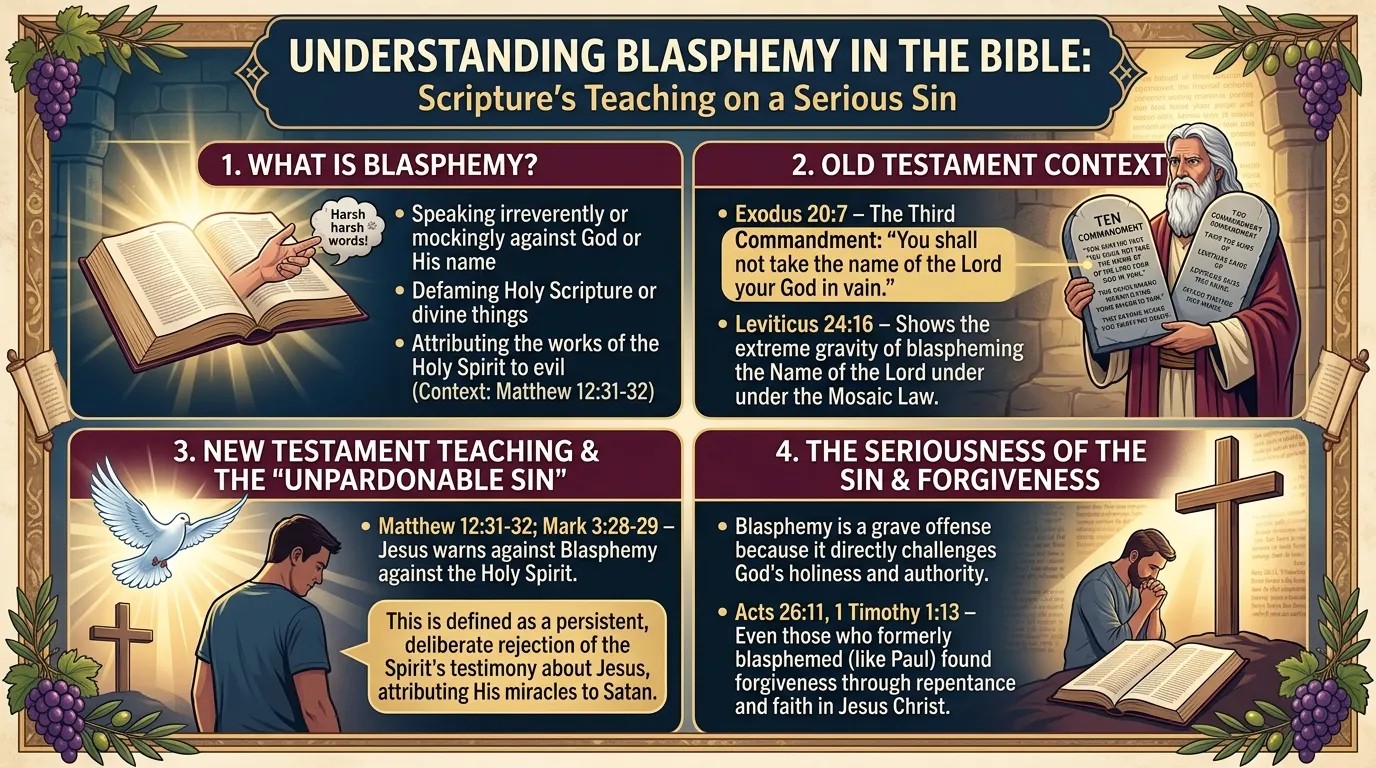
The English word comes from the Greek blasphemia, which literally means “harmful speech” — words spoken to injure someone’s reputation. In Scripture it carries a specific direction: speech that insults, reviles, or shows contempt toward God, His name, His works, or His people. The third commandment draws the boundary at the start: “You shall not take the name of the LORD your God in vain, for the LORD will not hold him guiltless who takes his name in vain” (Exodus 20:7).
In the Old Testament, blasphemy was treated as a capital offense — not because God is fragile, but because in a covenant nation, cursing the King was treason. Leviticus 24:16 records the law: “Whoever blasphemes the name of the LORD shall surely be put to death.” When the Assyrian commander Rabshakeh mocked God before the walls of Jerusalem, the prophet Isaiah called it blasphemy and God answered it with judgment (2 Kings 19:6). Scripture treats words about God as morally weighty because words reveal the heart’s posture toward heaven.
But here is what blasphemy is not: it is not honest doubt, not angry prayer, not a question shouted at God in grief. The Psalms are full of raw, anguished speech directed at God — “How long, O LORD?” — and God calls that worship, not blasphemy. Job questioned, wrestled, and demanded answers, and God ultimately said Job had spoken rightly. Blasphemy is not struggling with God; it is speaking against God with settled contempt.
When Blasphemy Shook Nations
Scripture does not treat blasphemy as a private slip; twice it nearly toppled a kingdom. The first was Sennacherib’s siege of Jerusalem. His commander Rabshakeh stood outside the walls and shouted — in Hebrew, so the common people could understand — that Hezekiah’s God was no stronger than the gods of the nations Assyria had already crushed. “Do not let Hezekiah mislead you by saying, ‘The LORD will deliver us'” (2 Kings 18:30). Isaiah’s verdict on the speech was one word: blasphemy — “the words with which the servants of the king of Assyria have reviled me” (2 Kings 19:6). That night, the angel of the LORD struck down 185,000 Assyrian soldiers. The lesson is stark: mocking God in the hearing of His people is not clever rhetoric; it is a provocation God answers.
The second story is quieter and darker. Jezebel wanted Naboth’s vineyard for Ahab, so she arranged false witnesses to accuse Naboth of having “cursed God and the king” — the charge was blasphemy, and under the law of Leviticus 24, it carried the death penalty (1 Kings 21:10-13). An innocent man was stoned so a king could steal a field. Here blasphemy appears in its most corrupt form: the holy law twisted into a murder weapon. God sent Elijah to pronounce judgment on Ahab’s house for it. These two stories frame the doctrine from both sides — God defends His own name against mockers, and God judges those who weaponize His name against the innocent.
Both stories also reveal why Jesus took the Pharisees’ accusation so seriously. When they attributed His Spirit-empowered miracles to Satan, they were doing what Rabshakeh did — standing before God’s clear work and calling it worthless — while wearing the robes of the religious. Contempt for God’s work, dressed in piety, is the most dangerous form of blasphemy precisely because it is the hardest to recognize in oneself.
The Hardest Text: Blasphemy Against the Holy Spirit
Every discussion of this topic must face Jesus’ most sobering words on the subject. When the Pharisees watched Him cast out demons and attributed His miracles to Beelzebul, the prince of demons, Jesus replied: “Every sin and blasphemy will be forgiven people, but the blasphemy against the Spirit will not be forgiven… whoever speaks against the Holy Spirit will not be forgiven, either in this age or in the age to come” (Matthew 12:31-32; see also Mark 3:28-29).
What exactly is this sin? Look at the context carefully. The Pharisees saw the undeniable work of God’s Spirit — a tormented man set free — and called it the work of Satan. They looked at light and named it darkness. The blasphemy against the Holy Spirit is the settled, willful rejection of God’s clearest self-revelation: seeing the Spirit’s work and deliberately calling it evil, hardening the heart against the very One who brings conviction and new birth.
Theologians have long described it not as a single slip of the tongue but as a persistent posture — a final, fixed refusal of grace. That is why it is “unforgivable”: not because God’s mercy has a limit, but because the person has rejected the only Agent who brings sinners to repentance. You cannot be forgiven while you are at war with the Forgiver.
The Comfort Hidden Inside the Warning
Here is the pastoral truth that has steadied anxious believers for centuries: the fact that you are worried about having committed this sin is strong evidence that you have not. A heart hardened beyond repentance does not tremble at the thought of having grieved God. The Pharisees who committed it felt no remorse; they doubled down. A conscience that fears it has gone too far is a conscience the Holy Spirit is still tenderly at work in.
Consider the pattern of Scripture. Peter denied Christ with curses and was restored. Paul called himself a “blasphemer” in his former life — “though formerly I was a blasphemer, persecutor, and insolent opponent, I received mercy” (1 Timothy 1:13). If the apostle who breathed threats against the church could be forgiven and made an apostle, then no repentant sinner stands outside the reach of grace. “If we confess our sins, he is faithful and just to forgive us our sins and to cleanse us from all unrighteousness” (1 John 1:9) — all unrighteousness, with no footnote excluding yours.
The warning about the unforgivable sin functions like a fence at the edge of a cliff. Its purpose is not to make travelers afraid of the path but to keep them from the plunge. Jesus spoke these words to hardened opponents, not to tender consciences. Read them as a call to keep your heart soft toward God, not as a trap for the anxious.
What Reverent Speech Looks Like Today
Blasphemy in daily life rarely looks like a formal curse. More often it is casual: using God’s name as punctuation, joking about sacred things, or — more subtly — claiming God’s authority for our own opinions. Whenever we say “God told me” to baptize our preferences, or use Scripture as a weapon rather than a lamp, we edge toward the territory Scripture warns about.
The positive command is reverence. The same mouth that must not curse is meant to bless. James notes the contradiction sharply: with one tongue “we bless our Lord and Father, and with it we curse people who are made in the likeness of God… My brothers, these things ought not to be so” (James 3:9-10). Cursing people made in God’s image is itself a form of blasphemy against the God whose likeness they bear.
Practically, this means three things. First, weigh your words about God — speak of Him truthfully, never carelessly. Second, weigh your words about His works — when you see genuine grace, humility, and transformation in someone’s life, call it what it is: the Spirit’s work. Third, keep short accounts with God. A tender, quickly-repentant heart is the safest place a sinner can be, and “the LORD is near to the brokenhearted and saves the crushed in spirit” (Psalm 34:18).
Can a Christian accidentally commit the unforgivable sin?
No. The sin Jesus describes is deliberate, persistent, and unrepentant — a settled verdict against the Holy Spirit’s clear work, not a stray thought, intrusive doubt, or word spoken in ignorance or anguish. Intrusive blasphemous thoughts that horrify you are a sign of a sensitive conscience, not a hardened heart.
What about using God’s name casually?
That violates the third commandment and should be repented of, but it is not the blasphemy against the Holy Spirit. It is forgivable — and the right response is simple: confess it, ask God to retrain your speech, and let reverence become a habit (1 John 1:9).
Blasphemy, rightly understood, is neither a small matter nor a trap for the tender-hearted. It is Scripture’s guardrail around the holiness of God — and for the repentant, the guardrail has a gate, and the gate is Christ. For a fuller survey of how this concept has been understood across history and law, see the article on blasphemy.