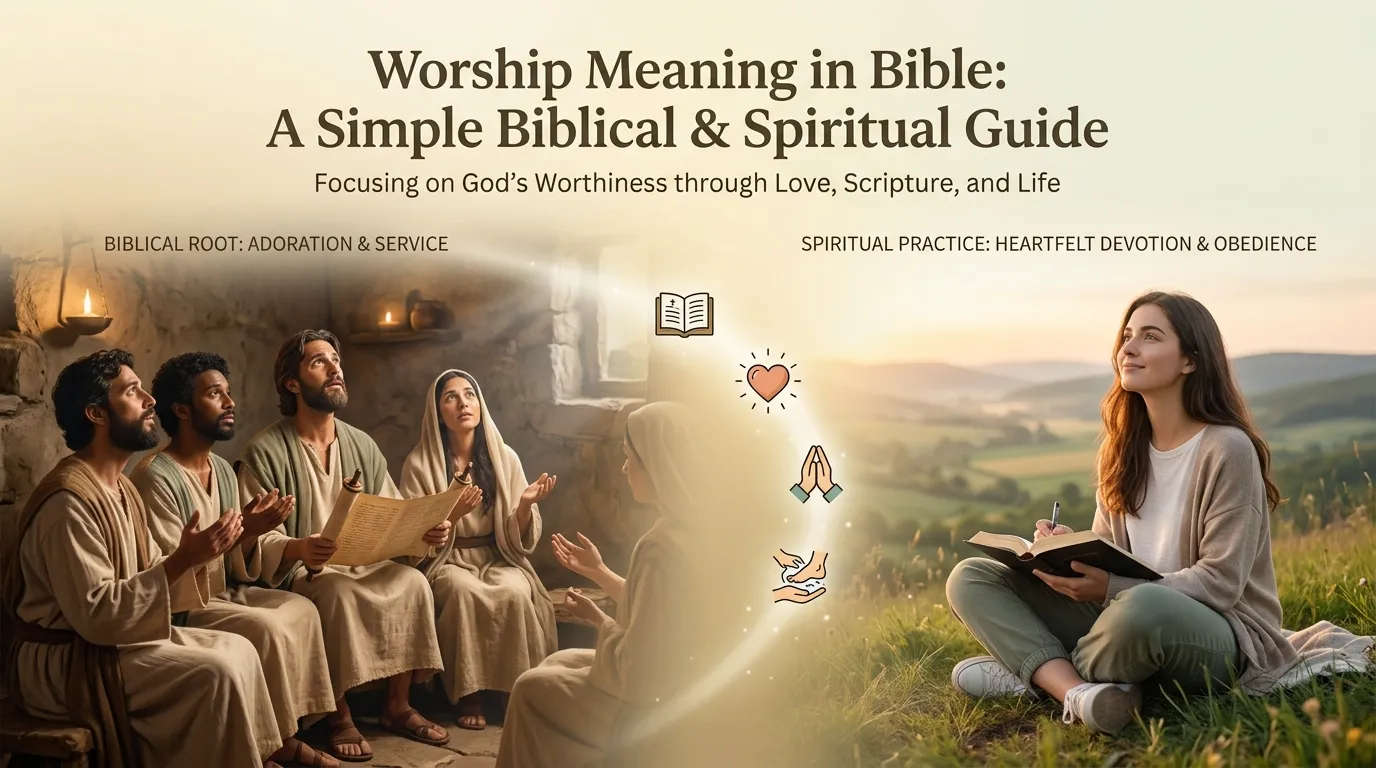
When most people hear the word worship, they picture a Sunday service: lights low, band playing, hands raised. There is nothing wrong with that picture — but it is far too small. In the Bible, worship is older than music, bigger than a building, and more costly than a song. The first time the word appears in Scripture, no instrument is playing and no congregation is gathered. A father is climbing a mountain with his son, carrying wood and a knife, and he calls that worship.
Worship Before There Was Music: Abraham’s Mountain
“I and the boy will go over there and worship and come again to you,” Abraham told his servants in Genesis 22:5. What followed was the binding of Isaac — Abraham’s willingness to offer his promised son in obedience to God. However we wrestle with that command, the vocabulary is unmistakable: in the Bible’s first use of the word, worship means total surrender to God at great personal cost.
This reframes everything. Worship is not primarily the feeling we get when the melody swells; it is the offering we make when obedience hurts. The Hebrew word Abraham used, shachah, means to bow down, to prostrate oneself — the posture of a subject before a king, a creature before the Creator. Worship is, at its root, a body bent low. Every raised hand in a modern service is an echo of that ancient bow: You are God, and I am not.
Two Greek Words That Expose Our Narrowing
The New Testament deepens the picture with two key words. Proskuneo — the most common word for worship — literally means to kiss toward, like a dog licking its master’s hand: reverent, intimate submission. It is the word used when the wise men fell down before the child Jesus (Matthew 2:11), when the healed leper worshiped Him (Matthew 8:2), and when all heaven worships the Lamb (Revelation 5:14). True worship always has an object, and the object is always a Person.
The second word, latreuo, means service rendered as sacred duty — the work of priests at the altar. Paul startles his readers by applying this temple word to ordinary life: “present your bodies as a living sacrifice, holy and acceptable to God, which is your spiritual worship” (Romans 12:1). Your body — at the office, in the kitchen, on the commute — is the altar. Your Monday is the liturgy. Worship is not an event you attend; it is a life you offer.
In Spirit and in Truth: Jesus Redefines the Venue
At Jacob’s well, a Samaritan woman raised the great worship controversy of her day: which mountain is the right one? Jesus dissolved the question: “The hour is coming, and is now here, when the true worshipers will worship the Father in spirit and truth, for the Father is seeking such people to worship him. God is spirit, and those who worship him must worship in spirit and truth” (John 4:23-24).
Two phrases carry the revolution. “In spirit” means worship is not localized or mechanical — it rises from the inner person, animated by the Holy Spirit, not from geography or ritual precision. “In truth” means it must correspond to who God really is, as He has revealed Himself — not our projections, not our preferences. Feeling without truth is sentimentality; truth without spirit is formalism. God seeks worshipers who bring both: hearts on fire and minds anchored.
This is also why Jesus quoted Isaiah against empty worship: “This people honors me with their lips, but their heart is far from me” (Isaiah 29:13; Matthew 15:8). God is not impressed by decibels. A silent, surrendered heart out-worships a loud, distant one. The question is never “was the music good?” but “was the heart bowed?”
The Whole-Life Liturgy
Follow the thread through Scripture and worship turns out to include far more than singing. It includes obedience — “to obey is better than sacrifice” (1 Samuel 15:22). It includes giving — Paul calls the Philippians’ financial gift “a fragrant offering, a sacrifice acceptable and pleasing to God” (Philippians 4:18). It includes suffering faithfully — the martyrs’ worship in Revelation rises from those who held their testimony at the cost of their lives. It includes rest — the Sabbath itself is worship, a weekly declaration that God, not our labor, sustains us.
Even our work qualifies. The same God who commanded priests to serve at the altar commands all of us: “Whatever you do, work heartily, as for the Lord” (Colossians 3:23). The farmer’s field, the nurse’s ward, the coder’s desk — all become sanctuaries when the work is offered to God. This is the Protestant doctrine of vocation in seed form: there is no sacred/secular divide in a worshiped life.
The Worship of Heaven: Revelation’s Throne Room
If you want to see worship undistorted by human preference, look at Revelation 4 and 5. Around the throne, four living creatures “never cease to say, ‘Holy, holy, holy, is the Lord God Almighty, who was and is and is to come!'” (Revelation 4:8). Twenty-four elders fall down, cast their crowns before the throne, and sing of creation. Then the Lamb who was slain takes the scroll, and the song shifts to redemption: “Worthy are you… for you were slain, and by your blood you ransomed people for God from every tribe and language and people and nation” (Revelation 5:9).
Three observations shape our worship. First, heaven’s worship is God-centered, not self-centered — the songs are about His holiness and the Lamb’s worth, not about the singers’ experience. Second, it is both ancient and new: the elders sing a “new song,” yet it echoes Isaiah’s seraphim from centuries earlier (Isaiah 6:3). Faithful worship honors the past without being trapped in it. Third, it is total — crowns cast down, faces to the ground, harps and bowls of incense which are “the prayers of the saints” (Revelation 5:8). Our earthly gatherings are rehearsals for this: every Sunday is a practice session for eternity.
The Sacrifice of Praise
Hebrews gives worship its most searching New Testament definition: “Through him then let us continually offer up a sacrifice of praise to God, that is, the fruit of lips that acknowledge his name” (Hebrews 13:15). A sacrifice of praise — the phrase assumes praise sometimes costs. It is easy to praise God when the diagnosis is good and the account is full. The sacrifice comes when you sing through tears, give thanks in the hospital waiting room, and acknowledge His name when every circumstance argues against it. That is the worship God calls precious: not the praise that rides on blessings, but the praise that persists without them.
The verse continues: “Do not neglect to do good and to share what you have, for such sacrifices are pleasing to God” (Hebrews 13:16). Here is Romans 12:1 again in different dress — worship as generosity, worship as a shared meal and an open wallet. The writer of Hebrews will not let us separate the song from the life. Lips that praise and hands that withhold are, in heaven’s accounting, out of tune.
When Worship Goes Wrong
Scripture is equally clear about counterfeits. Idolatry is worship aimed at the wrong object — and the Bible insists that everyone worships something; the only question is what. Hypocrisy is worship with a divided heart, lips near and heart far. Will-worship, as Paul calls it in Colossians 2:23, is self-made religion — impressive severity, zero value. And consumer worship treats God as a vendor of experiences: we come to get, not to give; to be entertained, not to be offered.
The test is simple and searching: does your worship cost you anything? David refused to offer God “burnt offerings that cost me nothing” (2 Samuel 24:24). Worship that costs nothing — no time, no pride, no comfort, no obedience — may be appreciation, but it is not yet worship in the biblical sense. The mountain, the altar, the living sacrifice: biblical worship always involves laying something down.
Is singing required for worship?
Singing is a glorious biblical expression of worship (Psalms, Ephesians 5:19), but it is one expression among many. A life of obedience with no singing is more worshipful than an hour of singing with no obedience. That said, God’s people have always sung — joy in God naturally overflows into music.
Can I worship alone, outside church?
Absolutely — Jesus’ “in spirit and truth” teaching makes every place a potential sanctuary. But Scripture also commands gathered worship (Hebrews 10:25): private devotion and corporate gathering are both essential, and neither replaces the other.
Worship, in the Bible’s full meaning, is the whole person — body bowed, heart surrendered, life offered — responding to the whole God in spirit and in truth. It begins on a mountain with a knife and ends with a living sacrifice: you. For a wide-angle view of how this practice has been understood across traditions, see the article on worship.










