“Call me Mara, for the Almighty has dealt very bitterly with me.” The woman who spoke those words had left Bethlehem years earlier with a husband, two sons, and hope. She came back with none of them — only a widowed daughter-in-law from Moab and a grief so complete it demanded a new name. Her old name was Naomi, which means pleasant. Pleasant no longer fit. Or so she thought. The book of Ruth is the story of how God proved her wrong, and it remains one of Scripture’s tenderest portraits of restoration.
Pleasant: The Name She Was Given
In ancient Israel, names were not decorations; they were declarations — hopes, prophecies, or descriptions pressed into a single word. Naomi’s parents named her “pleasant,” “lovely,” “delightful.” Perhaps she was a sunny child. Perhaps they were praying the quality into her. Either way, the name set the theme of her life: this is a story about whether pleasantness can survive devastation.
The Hebrew root no’am carries the sense of delight and beauty — the same word used in Psalm 90:17, “Let the favor [pleasantness] of the Lord our God be upon us.” Naomi’s name tethered her to the loveliness of God Himself. That tether would be tested in ways she never imagined, but as the story shows, it never broke. God does not rename His children according to their worst season.
The Famine in the House of Bread
The story opens with an irony the original readers would have felt instantly: “In the days when the judges ruled there was a famine in the land” — and a man from Bethlehem left for Moab (Ruth 1:1). Bethlehem means “house of bread.” There was no bread in the house of bread. The book of Judges, which sets the era, repeats its bleak refrain: “In those days there was no king in Israel. Everyone did what was right in his own eyes” (Judges 21:25). Famine in a covenant land was one of the curses promised for unfaithfulness (Deuteronomy 28), and Elimelech’s decision to seek refuge in Moab — Israel’s old enemy, born of Lot’s disgrace — reads as a quiet act of desperation, perhaps even of diminished faith.
Naomi did not choose the famine, the exile, or the losses that followed. She is one of Scripture’s great examples of a righteous sufferer caught in circumstances beyond her control — like Job, like the man born blind in John 9, whose suffering Jesus refused to blame on personal sin. Her story begins where many believers’ stories begin: doing your best in a bad era, watching the pillars fall one by one, and wondering where God went. The narrator offers no condemnation of Naomi, only the spare facts. That restraint is itself pastoral: sometimes Scripture simply sits with the sufferer before it explains anything.
Notice, too, what Naomi did in Moab. She raised sons who married Moabite women — Orpah and Ruth — and when the time came to return, her farewell speech to them is one of the most selfless in Scripture: “Go, return each of you to her mother’s house. May the LORD deal kindly with you, as you have dealt with the dead and with me” (Ruth 1:8). Even emptied, Naomi blessed. Even bitter, she prayed kindness over others. The pleasantness her name promised had not died; it was buried, waiting for resurrection.
Mara: The Name She Chose
Famine drove Elimelech’s family to Moab. There, the losses came like waves: first her husband died, then both sons, Mahlon and Chilion, after they had married Moabite women. Naomi was left “without her two sons and her husband” (Ruth 1:5) — a sentence almost too spare to carry its weight. In that culture, a widow without sons had no income, no protection, and no future. Naomi decided to return to Bethlehem, and on the road she urged her daughters-in-law to turn back. Orpah wept and left. Ruth clung.
When the women of Bethlehem saw her, they cried, “Is this Naomi?” And she answered, “Do not call me Naomi; call me Mara, for the Almighty has dealt very bitterly with me. I went away full, and the LORD has brought me back empty” (Ruth 1:20-21). Mara means bitter.
We should not rush past this moment or scold her for it. Naomi’s lament is honest grief, not blasphemy — and notice that even in her bitterness, she still says “the Almighty.” She has not stopped believing in God; she is arguing with Him, the way Job argued, the way the psalmists argued. Scripture makes room for the renamed seasons. God can handle being told that life tastes bitter. What He will not do is leave the story there.
Ruth: The Turning She Did Not Engineer
Naomi’s restoration began not with a miracle but with a person. Ruth — the Moabite widow who refused to leave — uttered the most famous vow of loyalty in Scripture: “Where you go I will go, and where you lodge I will lodge. Your people shall be my people, and your God my God” (Ruth 1:16). Naomi had nothing left to offer Ruth, and Ruth stayed anyway. Grace often arrives disguised as someone else’s stubborn love.
Back in Bethlehem, at barley harvest, Ruth gleaned in the fields of Boaz — a relative of Elimelech, “a worthy man” (Ruth 2:1). The narrative’s quiet providence is one of its glories: Ruth “happened to come” to Boaz’s field, and the reader knows heaven arranged the happenstance. Boaz noticed her, protected her, fed her, and left extra grain for her to find. When Naomi heard whose field it was, the old strategist flickered back to life: Boaz was a kinsman-redeemer, one who could marry Ruth and preserve the family line.
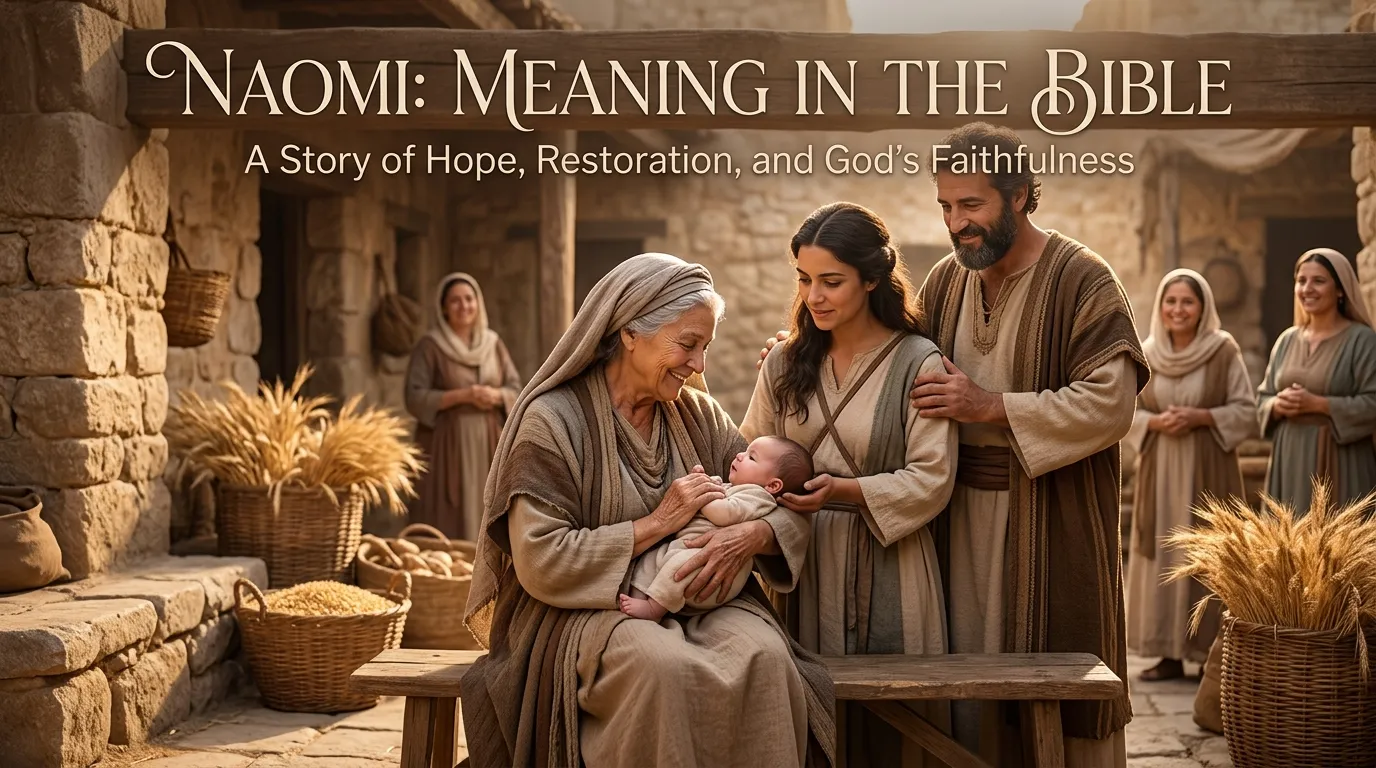
Naomi’s plan at the threshing floor (Ruth 3) was bold and culturally proper — and it worked. Boaz, moved by Ruth’s character, took on the redeemer’s role. The two married. And then the sentence that undoes “Mara”: “So Boaz took Ruth, and she became his wife… and she bore a son” (Ruth 4:13). The women of Bethlehem told Naomi, “Blessed be the LORD, who has not left you this day without a redeemer” — and they named the child Obed, saying, “A son has been born to Naomi” (Ruth 4:14, 17). Born to Naomi. The empty woman was full again. And Obed became the father of Jesse, the father of David — placing Naomi, the bitter widow, in the direct ancestry of Israel’s greatest king and, generations later, of Jesus Himself (Matthew 1:5).
What Naomi Teaches the Grieving
Naomi’s life has become a quiet counselor to sufferers, and her counsel is worth gathering. First, grief can be honest without being faithless. “Call me Mara” was not unbelief; it was lament, and lament is a biblical language God understands. Nearly a third of the Psalms are laments. Bringing bitter words to God is an act of faith — it assumes He is listening.
Second, bitterness is a season, not an identity. Naomi felt Mara, but God named her Naomi, and God’s naming won. Feelings are real and deserve their hearing, but they are not the final authority on who you are. Let God have the last word over your self-definition.
Third, restoration often comes through people, not thunderbolts. God rebuilt Naomi’s life through Ruth’s loyalty and Boaz’s integrity — ordinary faithfulness, not spectacular miracles. When you pray for restoration, watch the people around you; heaven often answers through hands and feet.
Fourth, your worst chapter may become someone else’s first. Naomi’s emptiness became the doorway for Ruth the Moabite to enter God’s people — and through Ruth, the line of David and of Christ. The losses that felt like the end of her story were the beginning of a far greater one. You cannot see the genealogy God is writing from your grief. Naomi couldn’t either, until Obed was laid in her arms.
Naomi Again: The Name God Restored
The book never records anyone calling her Mara again. The townswomen’s verdict stands as the final word: Naomi. Pleasant. Not because her pain was imaginary — it was real, and Scripture honored it — but because God’s ending rewrote her middle. “He has become a restorer of life and a nourisher of your old age,” they said of the child (Ruth 4:15). Restoration, in the Bible, is not the erasure of the bitter years; it is their redemption.
Naomi’s story is the gospel in miniature. We arrive empty, rename ourselves by our wounds, and cling to a Redeemer we did not earn — and God writes a lineage of grace out of our loss. If you are in a Mara season, Naomi’s life testifies that God is not finished. The same Lord who turned a famine-driven flight into the ancestry of the Messiah can turn your bitterness into a blessing you cannot yet imagine. He did not let “Mara” be her last name, and He will not let your worst chapter be your last one either.
For the historical and literary background of Naomi’s story within the book of Ruth, see Naomi (biblical figure).










