The old prophet arrived in Bethlehem with a horn of oil, and Jesse paraded seven impressive sons past him. God rejected every one. Then the youngest was summoned from the sheep — ruddy, young, overlooked — and the LORD said, “Arise, anoint him, for this is he.” Samuel poured the oil over David’s head, “and the Spirit of the LORD rushed upon David from that day forward” (1 Samuel 16:12-13). In that single scene — oil, Spirit, and a surprising choice — the Bible shows us what anointing means. It is God’s way of marking a person for a purpose, and its meaning stretches from shepherds to kings to Christ Himself.
What Anointing Actually Did
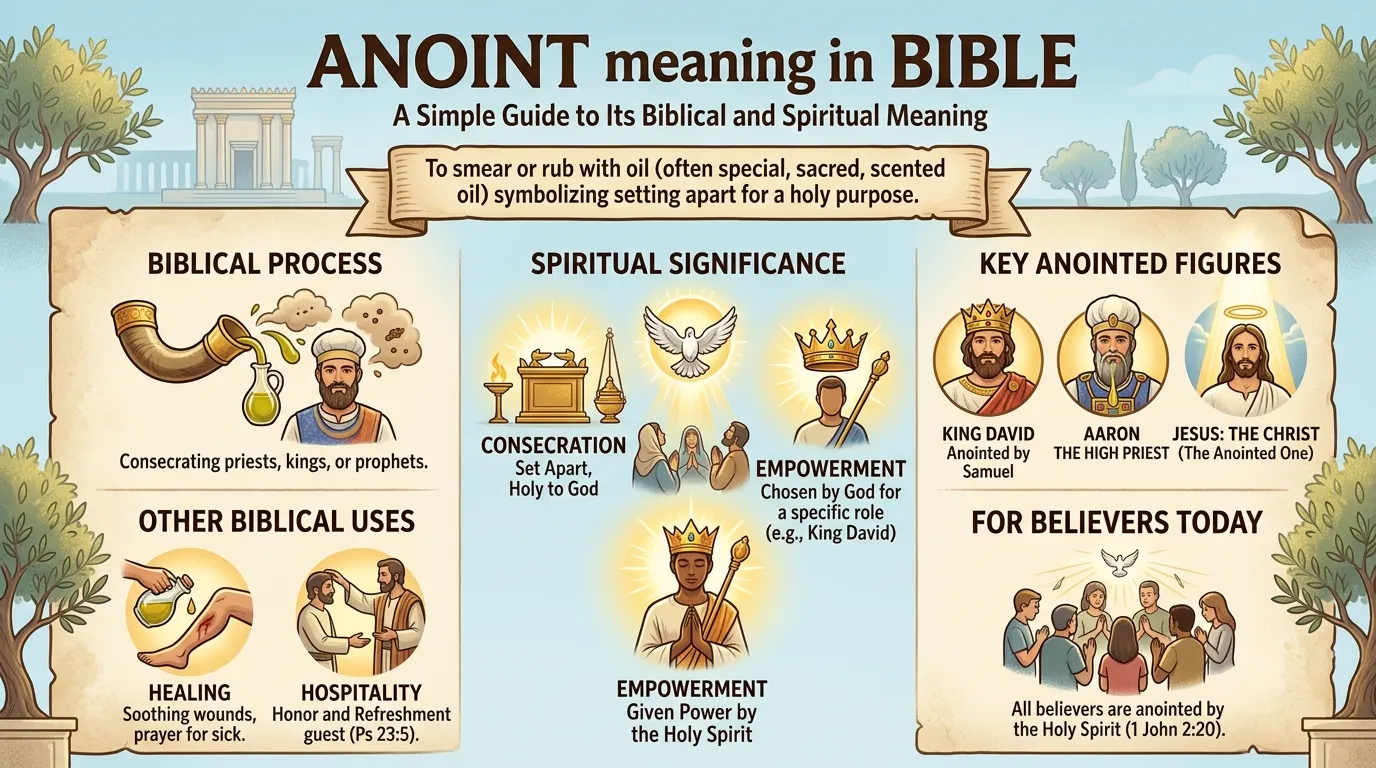
In the Old Testament, anointing was the ceremony by which God publicly appointed someone to an office. Three groups were anointed: kings (Saul in 1 Samuel 10:1, David in 1 Samuel 16:13, Solomon in 1 Kings 1:39), priests (Aaron and his sons in Exodus 28:41, Leviticus 8), and prophets (Elisha in 1 Kings 19:16). The pattern was consistent: oil poured or smeared on the head, and the Spirit of God coming upon the person for the task.
Notice what anointing was not. It was not a reward for achievement — David was anointed years before he did anything kingly. It was not a magic potion conferring holiness by chemistry — Saul was anointed and later rebelled disastrously. Anointing was a declaration: this one is Mine, set apart for My assignment. The oil was visible; the reality was the Spirit’s empowering for a God-given role. The ceremony pointed beyond itself to a divine equipping no human ritual could manufacture.
The Hebrew word is mashach — to smear or anoint — and from it comes mashiach, Messiah: “the Anointed One.” Every anointing in Israel’s history was a whisper of the greater Anointing to come, the One who would perfectly fulfill all three offices — Prophet, Priest, and King — in a single person.
The Oil Itself: A Recipe Full of Meaning
God did not leave the anointing oil to human improvisation. Exodus 30:22-33 gives the exact formula: myrrh, cinnamon, cane, cassia, blended with olive oil — “a holy anointing oil.” It was reserved exclusively for sacred use; making it for common purposes or putting it on an unauthorized person was punishable. The exclusivity taught Israel that what God marks is Himself — holy, set apart, not for casual handling.
Throughout Scripture, oil symbolizes the Holy Spirit: it soothes, it heals, it fuels lamps, it consecrates. When Samuel anointed David, the text immediately adds “and the Spirit of the LORD rushed upon David” — the oil was the sign, the Spirit was the substance. This is why the New Testament can speak of believers having “an anointing from the Holy One” (1 John 2:20) without a drop of literal oil: the reality the oil pictured — the Spirit’s presence and teaching — now belongs to every Christian.
David himself sang of it personally: “You anoint my head with oil; my cup overflows” (Psalm 23:5). For the shepherd-king, anointing was not just a coronation memory; it was the language of intimate blessing — a host honoring a guest, God honoring His child with abundance.
Sealed and Anointed: Paul’s Twin Images
Paul gives the New Testament’s richest description of what anointing means for ordinary believers, and he pairs it with a second image: “And it is God who establishes us with you in Christ, and has anointed us, and who has also put his seal on us and given us his Spirit in our hearts as a guarantee” (2 Corinthians 1:21-22). Three verbs — established, anointed, sealed — and all of them are God’s work, not ours. The anointing here is not a ceremony Paul performed; it is a reality God accomplished the moment these Corinthians believed.
The seal image deepens the anointing image. In the ancient world, a seal marked ownership and authenticity — the king’s signet pressed into wax declared “this is mine, and it is genuine.” To be sealed with the Spirit (Ephesians 1:13) means God has stamped you as His property and His authentic work. Anointing says empowered for purpose; sealing says owned and authentic. Together they answer the believer’s two deepest insecurities: “Am I equipped for what God asks?” (anointing: yes) and “Am I really His?” (seal: yes).
And the Spirit is given “as a guarantee” — the Greek is arrabon, a down payment, earnest money. In commercial law, the arrabon was the first installment that legally bound the buyer to complete the purchase. God’s logic is staggering: the Spirit’s presence in you now is heaven’s non-refundable deposit on your final redemption. He has put down earnest money on you. That is what it means to be anointed: not a feeling to chase in a service, but a status to rest in — marked, sealed, and guaranteed by God Himself.
The Anointed One: How Jesus Fulfills It All
The Greek equivalent of Messiah is Christos — Christ. Every time we say “Jesus Christ,” we are confessing “Jesus the Anointed One.” At His baptism, the Spirit descended upon Him like a dove (Matthew 3:16) — the true anointing, without oil, because He needed no symbol; He is the reality. Peter preached that “God anointed Jesus of Nazareth with the Holy Spirit and with power” (Acts 10:38).
Jesus claimed the anointing explicitly. In the Nazareth synagogue He unrolled Isaiah’s scroll and read: “The Spirit of the Lord is upon me, because he has anointed me to proclaim good news to the poor… to set at liberty those who are oppressed” (Isaiah 61:1; Luke 4:18). Then He sat down and said, “Today this Scripture has been fulfilled in your hearing.” The anointed offices converge in Him: He is the Prophet who speaks God’s final word (Hebrews 1:1-2), the Priest who offered Himself once for all (Hebrews 9), and the King whose kingdom will never end (Luke 1:33).
This is why “anointing” in Christian vocabulary centers on Christ first and us second. We are anointed only because we are in the Anointed One — branches sharing the life of the root, members sharing the honor of the Head.
Anointed Today: What It Means for You
The New Testament applies anointing language to ordinary believers in two directions. First, the inward anointing of the Spirit: “You have been anointed by the Holy One, and you all have knowledge… the anointing that you received from him abides in you” (1 John 2:20, 27). John wrote this to Christians confused by false teachers, and his comfort was profound: you do not need a special guru; the Spirit Himself teaches you and keeps you in the truth. Every believer carries the divine marking — the Spirit’s presence as the seal of belonging (Ephesians 1:13).
Second, the outward anointing with oil in prayer for the sick: “Is anyone among you sick? Let him call for the elders of the church, and let them pray over him, anointing him with oil in the name of the Lord” (James 5:14). Here oil accompanies prayer as an act of faith — not medicine, not magic, but a tangible appeal to the Great Physician, offered “in the name of the Lord.” The healing, James insists, comes from the Lord who raises up, not from the oil itself. Churches that practice this today do so as obedience and trust, leaving results to God.
Anointing vs. Consecration: What’s the Difference?
These two biblical ideas are cousins, not twins, and confusing them muddles both. Anointing is God’s act of marking and empowering — He pours (literally or spiritually) His Spirit on a person for a task. The direction is God to us: appointment, equipping, authorization. Consecration is our act of dedicating — we set ourselves apart for God in response. The direction is us to God: surrender, devotion, holiness of life. David was anointed by Samuel (God’s appointment) and then lived a consecrated life of devotion (his response). You cannot consecrate yourself into an anointing — the calling is God’s gift — but an anointing unanswered by consecration withers, as Saul’s tragic story proves. Keep the order straight and both flourish: seek God’s appointing in prayer and obedience, and answer it with a consecrated life — the oil of His Spirit on the vessel you’ve set apart for Him.
Can I be “anointed” for something specific today?
Yes — in the New Testament sense. The Spirit distributes gifts “as he wills” (1 Corinthians 12:11) and empowers believers for specific callings: teaching, mercy, leadership, evangelism. This anointing is recognized by fruit and confirmed by the church, not claimed by title. If God has given you a task, ask Him for the Spirit’s empowering for it — that is the biblical way to seek anointing.
From Samuel’s horn of oil to the Spirit’s descent at the Jordan, anointing tells one story: God marks, God empowers, God sends — and the Anointed One shares His anointing with all who belong to Him. For the wider history of this practice across cultures and religions, see anointing.










