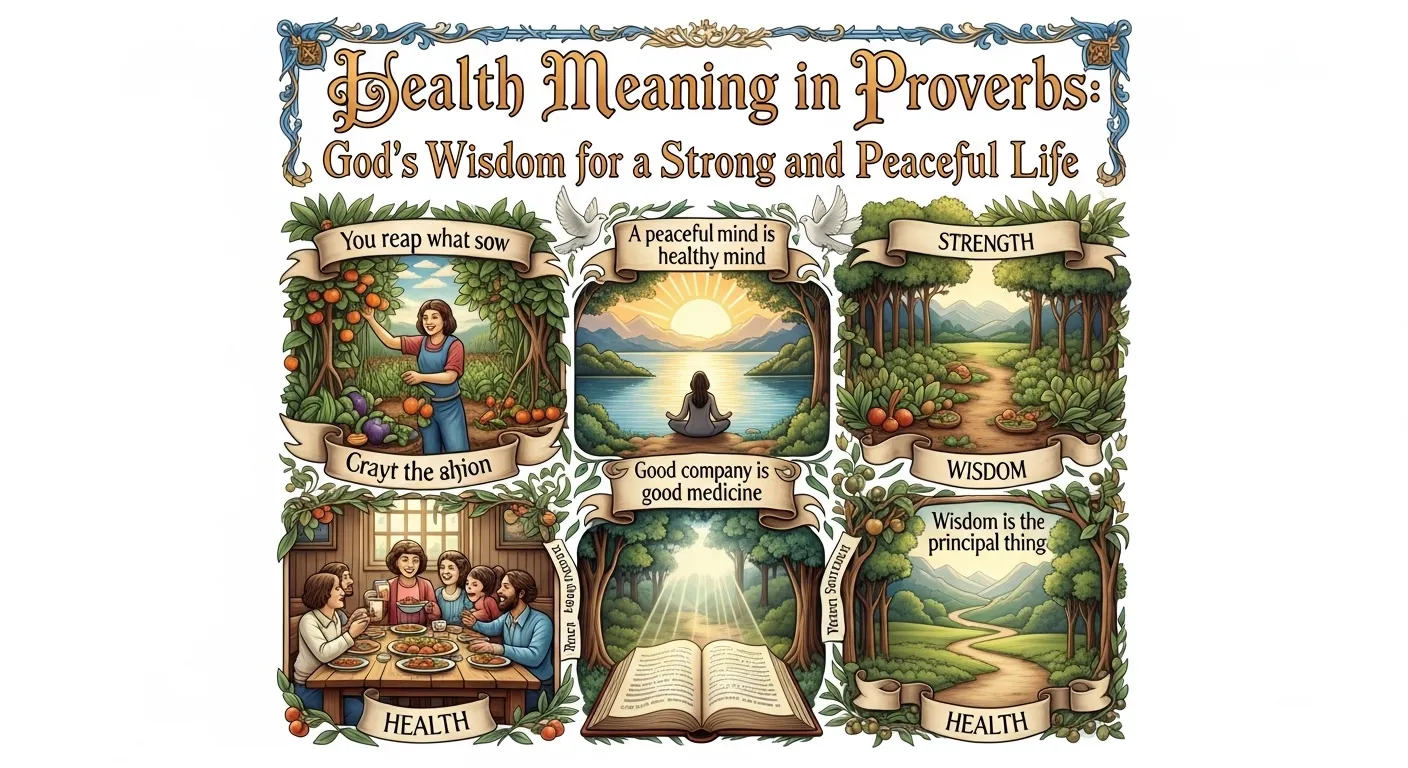
“This will bring health to your body and nourishment to your bones.” That is the promise of Proverbs 3:7–8 — and it is a strange promise to modern ears. We are used to separating the spiritual from the physical: the soul goes to church, the body goes to the doctor, and neither visits the other. Proverbs refuses the split. In the wisdom book’s vision, the human being is one fabric — heart, mind, body, spirit woven together — and what happens in the soul eventually shows up in the bones. The health meaning in Proverbs is not a medical textbook. It is something rarer: an ancient account of how inner life shapes outer life, and how God’s wisdom reaches all the way down into the body.
The Bones Know: How Proverbs Sees the Body
To hear Proverbs rightly, you have to borrow its anatomy. The Hebrew lev — “heart” — means the center of thought, will, and emotion together; there is no separate word for “mind” as we use it. And “bones” (atzamot) represent the deepest self, the structural core of a person. So when Proverbs says “a heart at peace gives life to the body, but envy rots the bones” (Proverbs 14:30), it is describing total-person reality: inner peace vitalizes the whole organism; envy decays it from the inside out. “Rot” is the word for wood decaying, for fruit spoiling. Envy is presented as a slow-acting poison — not metaphorically, but as a description of what bitterness does to a human being.
The most quoted verse in this theme makes the medicine explicit: “A cheerful heart is good medicine, but a crushed spirit dries up the bones” (Proverbs 17:22). A cheerful heart — not a problem-free life, not perfect circumstances, but a glad orientation — functions like medicine. And a crushed spirit does the opposite: it desiccates, it dries up the marrow of life. Modern research into stress, immunity, and psychosomatic illness has spent billions confirming what Proverbs stated in one sentence: the state of the inner life measurably affects the body. The wisdom writers got there three thousand years early, because they understood that humans are unities, not compartments.
Wisdom as Medicine
Proverbs goes further: God’s wisdom itself is prescribed as health. “My son, pay attention to what I say… for they are life to those who find them and health to one’s whole body” (Proverbs 4:20–22). The father’s instruction — the words of wisdom — are “life” and “health.” Scripture as medicine: not as a magic charm, but as the steady intake of truth that orders the inner life, and the ordered inner life steadies the body. “Above all else, guard your heart, for everything you do flows from it” (Proverbs 4:23) — the famous verse that follows is really a health directive. The heart is the wellspring; guard the spring and the whole downstream system — words, choices, relationships, body — runs cleaner.
What does this “medicine” look like in practice? Proverbs sketches it across its pages: peace instead of envy (14:30) — the heart at rest rather than the heart at war with others’ blessings. Joy instead of despair (17:22) — cheerfulness as a discipline, not just a temperament. Self-control instead of indulgence — “Do not join those who drink too much wine or gorge themselves on meat” (23:20); the wisdom book is frank about gluttony and drunkenness as body-destroyers. Gentle words instead of quarrels — “A gentle answer turns away wrath” (15:1); chronic conflict is a health hazard Proverbs recognized millennia before cardiologists linked hostility to heart disease. Trust instead of anxiety — “Anxiety weighs down the heart, but a kind word cheers it up” (12:25). The prescription is a way of life, not a pill.
What Sickens the Soul — and an Honest Qualification
Proverbs is equally frank about the pathogens: envy rotting the bones (14:30), a crushed spirit drying them (17:22), “a lying tongue” and the stress of deceit, rage that “stirs up conflict” (29:22). The wisdom book’s pathology is moral before it is medical — and here honesty demands a crucial qualification, because this teaching has been badly misused.
Proverbs states principles, not promises. “A cheerful heart is good medicine” describes the general way God ordered the world — inner health tends toward outer health — but it is not a guarantee, and it must never be wielded as a weapon against the sick. Job was “blameless and upright” and lost his health (Job 1:1; 2:7). Paul prayed three times about his “thorn in the flesh” and was told God’s grace was sufficient (2 Corinthians 12:7–9). Timothy had frequent stomach ailments and Paul prescribed wine, not repentance (1 Timothy 5:23). Elisha died of an illness (2 Kings 13:14). The Bible’s own heroes got sick — some were healed, some were not, and none of it measured their faith.
So hear Proverbs’ health teaching the way it was meant: as wisdom for living, not as a verdict on suffering. If you are ill, your illness is not proof of hidden sin — Jesus explicitly rejected that logic (John 9:3). Proverbs teaches that a wisely ordered inner life tends toward health; it does not teach that sickness equals failure. Anyone who tells you otherwise is misusing the wisdom book.
Rest: The Forgotten Prescription
Proverbs has strong words for laziness — “a little sleep, a little slumber… and poverty will come on you like a thief” (Proverbs 6:10–11) — but it never prescribes exhaustion. The wisdom book honors diligence, not burnout, and there is a difference the modern believer needs. Diligence works hard and rests well; burnout works anxiously and rests guiltily. Proverbs’ health vision includes the rhythm: “In vain you rise early and stay up late, toiling for food to eat — for he grants sleep to those he loves” (Psalm 127:2). The psalmist and the sage agree: sleep is a gift, not a weakness, and the refusal to rest is not devotion but distrust — as though the world stops when you do.
The creation pattern underneath Proverbs is the Sabbath: six days of work, one of rest, woven into the universe by a God who Himself rested (Genesis 2:2–3). Rest is not the absence of faithfulness; it is an act of faithfulness — the weekly declaration that God runs the world and you don’t have to. The health implications are the ones Proverbs keeps circling: the rested heart is the peaceful heart, and the peaceful heart “gives life to the body” (Proverbs 14:30). Chronic exhaustion, by contrast, makes every other wisdom practice harder — the tired are more irritable (goodbye, gentle answers), more impulsive (goodbye, self-control), more anxious (goodbye, trust). Rest is not retreat from the battle. It is maintenance of the soldier.
So take Proverbs’ forgotten prescription seriously. Keep something like a Sabbath — a real, regular, guilt-free stop. Sleep as though God loves you (He does, and He said so). And notice the promise attached to diligence-with-rest: “The blessing of the LORD brings wealth, without painful toil for it” (Proverbs 10:22). Without painful toil — the anxious, grinding, never-enough kind. Work hard. Rest deeply. Trust fully. That is the wisdom book’s whole health program in six words.
A Word of Care
Because this topic touches real bodies and real suffering, plain counsel belongs here. See medical professionals. Proverbs’ wisdom about the heart complements medicine; it does not replace it. Luke, the beloved physician, traveled with Paul (Colossians 4:14) — the New Testament has no quarrel with doctors. If you are sick, get care. If you struggle with mental health, seek qualified help alongside prayer; a crushed spirit sometimes needs a counselor’s skill as well as a pastor’s comfort, and there is no shame in either. Pray for healing and trust God’s wisdom. “Is anyone among you sick? Let them call the elders of the church to pray over them” (James 5:14) — prayer for healing is biblical, commanded, and good. And when healing tarries, as it did for Paul, grace remains sufficient.
Tend the inner life as health practice. This is Proverbs’ actual prescription, and it is available to the sick and the well alike: confess envy before it rots, forgive before bitterness calcifies, rest before exhaustion breaks you (“In vain you rise early and stay up late,” Psalm 127:2), speak gently, laugh when you can, and anchor the heart in trust rather than dread. These are not cures; they are the conditions in which human beings — body and soul together — flourish best.
The health meaning in Proverbs, held honestly, is neither a prosperity promise nor a guilt trip. It is the wisdom of a God who made you one piece — who knows that peace reaches the bones and envy rots them, who offers His words as life and health, and who walks with you through both wellness and illness without ever confusing the two with worthiness. For background on the book itself — its structure, authorship, and place in the wisdom tradition — see the Wikipedia article on the Book of Proverbs; for the medicine it prescribes, begin where it begins: guard your heart, for everything — including, in ways we are still discovering, your health — flows from it.










