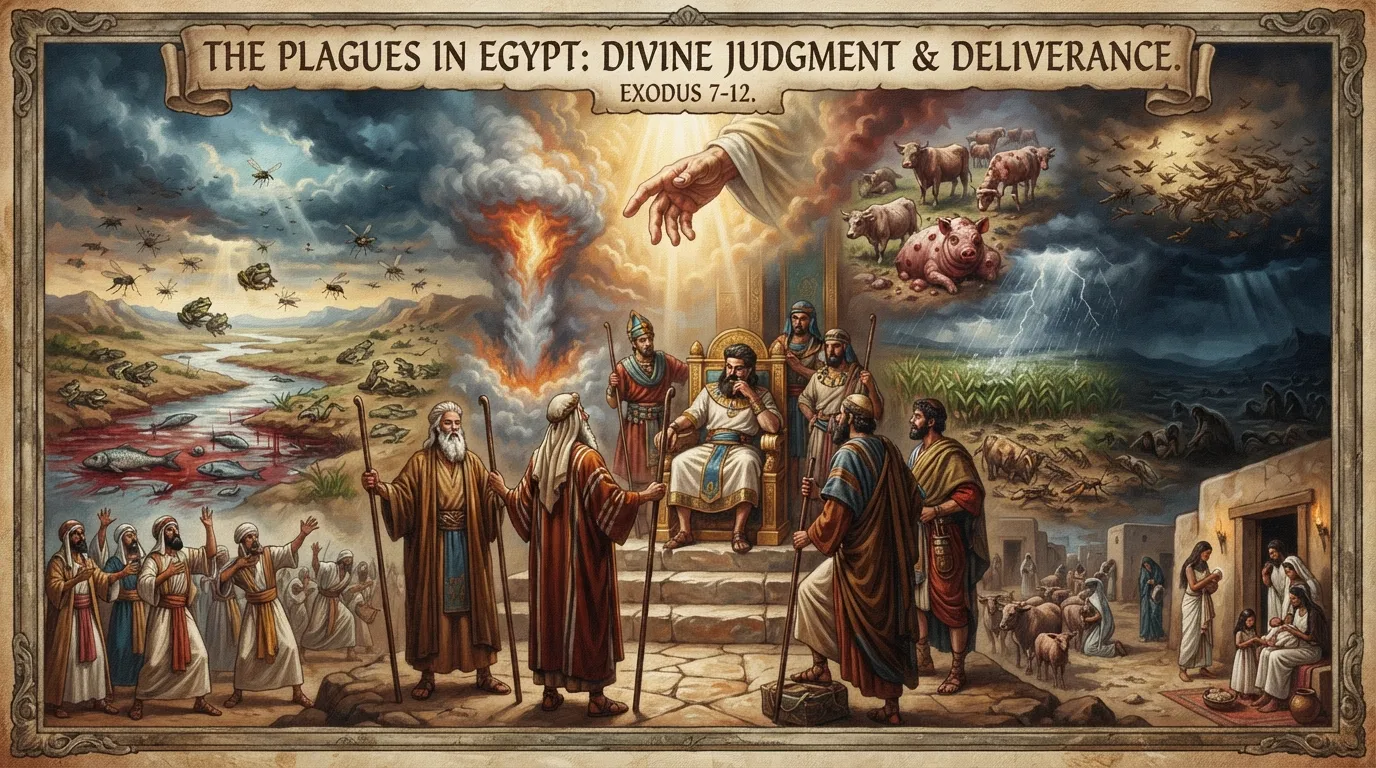
God heard the crying first. Before the plagues, before Moses, before the burning bush, there was a sound: “The people of Israel groaned because of their slavery and cried out for help. Their cry for rescue from slavery came up to God. And God heard their groaning, and God remembered his covenant with Abraham, with Isaac, and with Jacob” (Exodus 2:23–24). The plagues of Egypt are not the story of an angry God looking for a reason to punish. They are the story of a covenant God answering the cries of oppressed people — and confronting the king who refused to let them go.
The ten plagues unfold in Exodus 7–12 as a series of escalating confrontations. Each one is a judgment, a revelation, and a rescue operation at once. To read them well, follow their movement: the contest begins, the distinction appears, the heart hardens, and the deliverance comes.
The Contest Begins: Power Against Power
The first plagues are a contest of authority. Moses tells Pharaoh, “Let my people go,” and Pharaoh answers, in effect, “Who is the LORD, that I should obey his voice?” (Exodus 5:2). The plagues are God’s answer to that question — delivered not in a speech, but in signs Pharaoh could not ignore.
Water turned to blood. The Nile, Egypt’s source of life, food, transport, and worship, became undrinkable. Fish died; the river stank (Exodus 7:14–25). The message: the God of the slaves commands the river the empire depends on.
Frogs. They swarmed houses, bedrooms, ovens, and kneading bowls (Exodus 8:1–15). Pharaoh begged Moses to pray them away — and when relief came, he hardened his heart. The pattern begins: crisis repentance that evaporates the moment the crisis does. Temporary relief does not produce lasting change.
Gnats. The dust of the ground became gnats, and Egypt’s magicians, who had imitated the first two signs, could not reproduce this one. “This is the finger of God,” they told Pharaoh (Exodus 8:19). Human power had hit its limit. The magicians’ confession is one of the great turning points in the story: Egypt’s own experts admitted they were outmatched.
The Distinction Appears: Judgment With a Shelter
Beginning with the fourth plague, something new happens: God draws a line. “I will set apart the land of Goshen, where my people dwell, so that no swarms of flies shall be there” (Exodus 8:22). The plagues are no longer indiscriminate. They fall on Egypt and spare Israel — not because Israel was sinless, but because Israel was God’s covenant people, sheltered by His promise.
Flies. Swarms ruined Egypt while Goshen was untouched. The distinction announced that God’s judgments are not blind natural disasters; they are precise, purposeful, and personal.
Livestock disease. Egyptian cattle, sheep, and horses died in a severe pestilence, while “not one of the livestock of the people of Israel died” (Exodus 9:7). Egypt’s wealth — its herds, its food supply, its economic backbone — was struck, and Israel’s was preserved.
Boils. Ash from a furnace, tossed into the air, became boils breaking out on people and animals — so severe that the magicians could not even stand before Moses (Exodus 9:8–12). The priests of Egypt, who prided themselves on bodily purity, were covered in sores.
Hail. The worst hailstorm in Egypt’s history destroyed crops, livestock left in the fields, and trees — but Goshen was spared again (Exodus 9:13–35). Pharaoh confessed, “This time I have sinned,” and then sinned again the moment the sky cleared. His confession was weather-dependent. Real repentance does not evaporate with the storm.
Locusts. They devoured what the hail had left, until “the land was darkened” (Exodus 10:15). Pharaoh’s own officials begged him: “Do you not yet understand that Egypt is ruined?” (Exodus 10:7). The empire’s inner circle could see what its king could not.
Darkness. Three days of darkness “that can be felt” covered Egypt, while Israel had light in Goshen (Exodus 10:21–23). The sun, which Egypt worshiped, went out. The symbolism was unmistakable: the nation that claimed to be the light of the world was sitting in darkness, and the slaves had light.
The Hardened Heart: How a Man Becomes Stone
One of the most debated threads in the plague narrative is the hardening of Pharaoh’s heart. Sometimes the text says Pharaoh hardened his own heart (Exodus 8:15, 32). Sometimes it says God hardened it (Exodus 9:12; 10:1). The two statements are not contradictory; they describe a single process from two sides. Pharaoh repeatedly chose defiance, and God eventually confirmed him in the choice he had made. The pattern is a sober warning: the heart that refuses to bend eventually cannot bend. Every refusal to repent makes the next repentance harder, until God’s judgment is simply to hand a person over to the hardness he has chosen.
Exodus 9:16 gives the purpose behind it all: God raised Pharaoh up “to show you my power, so that my name may be proclaimed in all the earth.” Pharaoh’s stubbornness became the stage for God’s power. The king who tried to erase God’s name from the earth became the reason it was proclaimed across it.
The Final Plague: Passover
The tenth plague — the death of the firstborn — is the most terrible and the most theologically loaded. Every firstborn in Egypt died, from Pharaoh’s heir to the prisoner’s son, and “there was a great cry in Egypt, for there was not a house where someone was not dead” (Exodus 12:30). The horror is real, and Scripture does not soften it. This was judgment on a nation that had drowned Israel’s baby boys in the Nile (Exodus 1:22). The measure Egypt had used against Israel’s children was measured back to Egypt.
But the same night, deliverance came to Israel — not through immunity, but through a lamb. Each household killed a lamb without blemish, painted its blood on the doorposts, and ate the Passover meal in haste, dressed for travel. “When I see the blood, I will pass over you” (Exodus 12:13). The blood was the difference. Israel was not spared because they were better; they were spared because they trusted God’s word and sheltered under the blood.
That is why Passover became the defining feast of Israel — and why the New Testament calls Christ “our Passover lamb” (1 Corinthians 5:7). The plagues end where the gospel begins: judgment and mercy, met at the doorpost of a blood-marked house.
Why the Plagues Still Matter
The plagues teach three truths that have not aged. First, God hears the oppressed. The cries of slaves reached heaven before Moses reached Pharaoh. No suffering is invisible to God, however long the silence. Second, God’s power is absolute and His judgments are just. The gods, magicians, armies, and economies of the world’s greatest empire could not stop Him. Third, deliverance comes through a substitute: the lamb’s blood then, the Lamb’s blood now.
The Passover Meal and the Exodus Morning
The night of the final plague was not only a night of judgment. It was also the night of the first Passover meal, and the meal itself is full of meaning. The Israelites ate in haste, with their belts fastened, sandals on their feet, and staffs in their hands — dressed for travel, eating a meal that was also a departure. The lamb was roasted whole, eaten with bitter herbs and unleavened bread. The bitter herbs recalled the bitterness of slavery. The unleavened bread recalled the haste of leaving — there was no time for the bread to rise. Every element of the meal told the story: we were slaves, God delivered us, and we left in a hurry.
The next morning, Israel walked out of Egypt — six hundred thousand men, plus women and children, plus livestock, plus a mixed multitude of Egyptians who had joined them. They carried the wealth of Egypt with them, given freely by neighbors who were desperate to see them go. The empire that had enslaved them watched them leave, led by a pillar of cloud by day and fire by night. The God who had heard their groaning had answered — with signs, with wonders, and with a lamb. And the meal they ate that night became the defining feast of Israel, celebrated every year, in every generation, as the reminder that God delivers His people.
For Christians, the Passover meal points forward to the Last Supper, where Jesus took the bread and the cup and said, “This is my body” and “This is my blood.” The exodus from Egypt foreshadowed the greater exodus from sin. The lamb that saved Israel pointed to the Lamb who saves the world. The plagues were not the end of the story. They were the beginning of the redemption that would reach its fullness at the cross.
The story ends with Israel walking out of Egypt, carrying Egypt’s wealth, led by a pillar of fire. The empire that had enslaved them watched them go. The God who had heard their groaning had answered — with signs, with wonders, and with a lamb. For a detailed survey of each plague and its interpretation, see the article on the Plagues of Egypt in biblical and historical perspective.










