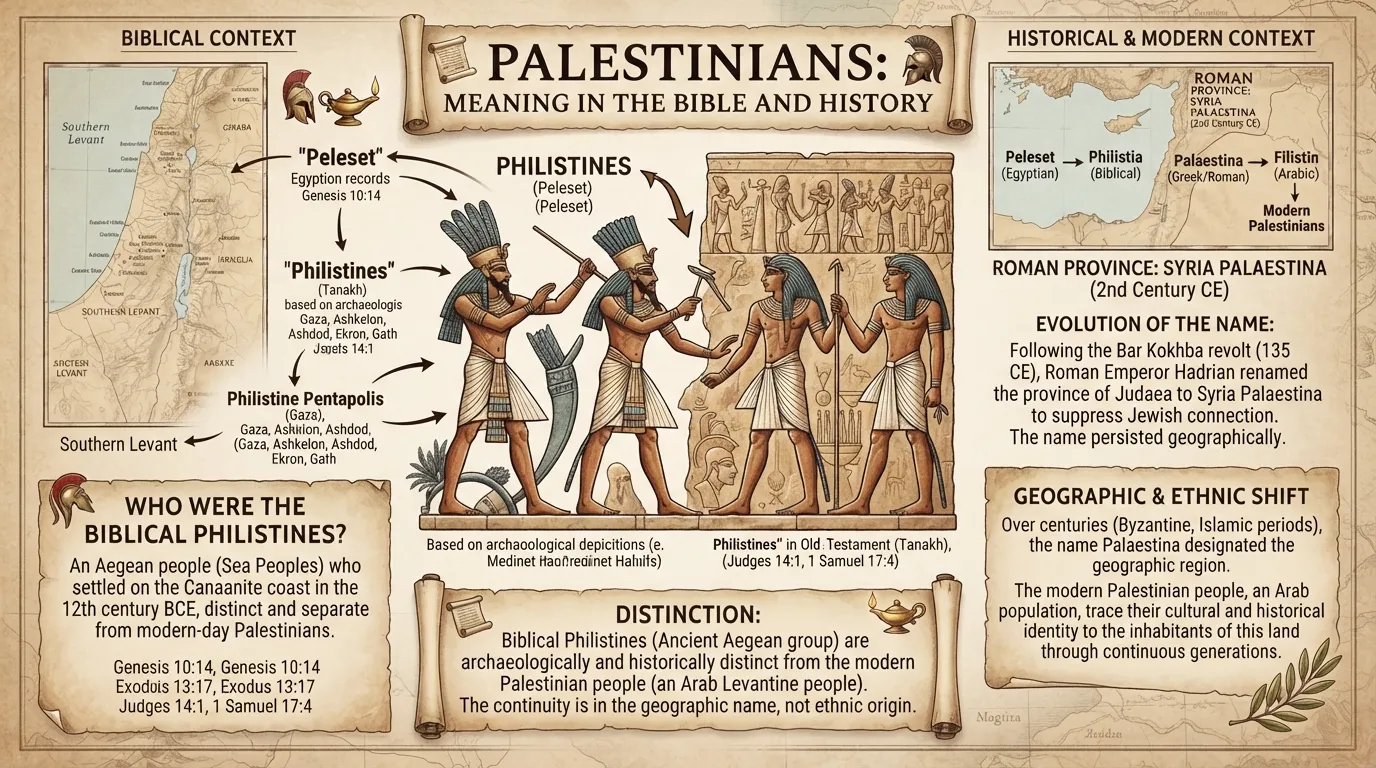
Open an English Bible and you will not find the word “Palestinians” in the way a modern newspaper uses it. What you will find, hundreds of times, is a similar-sounding word: Philistines. The confusion between the two is understandable — the names are related — but it has caused more misunderstanding than almost any other word in the Bible. The ancient Philistines and the modern Palestinian people are not the same thing, and Scripture does not use one as a prophecy about the other.
Getting this right matters, because the Bible’s Philistine stories are among its most famous — Samson, Goliath, the capture of the ark — and because those stories are sometimes misused to justify hatred toward people living today. The Bible tells history. It does not license contempt. Read carefully, the Philistine passages teach about God’s sovereignty, human pride, and the danger of turning ancient conflicts into modern grudges.
Who the Philistines Actually Were
The Philistines were a seafaring people who settled along the southern coast of Canaan, in a region the Bible calls Philistia. Their five great cities — Gaza, Ashkelon, Ashdod, Ekron, and Gath — formed a pentapolis, a league of five city-states that controlled the coastal trade routes and the iron technology that made them a military power. Genesis 10:14 traces their origins to the descendants of Mizraim (Egypt), and archaeology associates them with the Sea Peoples who migrated into the region around the twelfth century BC.
The Hebrew name for them is Pelishtim, and their territory is Pelesheth — Philistia. The Philistines appear throughout the historical books: in Judges, where Samson fights them; in 1 Samuel, where they capture the ark and later face David; in the Psalms and prophets, where they appear as a symbol of Israel’s enemies. They were not a nomadic tribe. They were an organized, urban, technologically advanced civilization that dominated Israel for long stretches of its early history.
Their conflict with Israel was persistent and often brutal. The Philistines oppressed Israel during the judges’ era, killed King Saul and his sons on Mount Gilboa, and occupied Israelite territory repeatedly. But Scripture does not present every Philistine as personally evil. The Philistine king Achish sheltered David when David was fleeing from Saul. The Philistine city of Gath produced Ittai, who marched with David in loyalty when David’s own son rebelled. The Bible tells the story of nations and armies, but it also tells the story of individuals — and individuals are never reducible to their nationality.
From Philistia to “Palestine”: How the Name Traveled
Here is where the confusion begins. The modern word “Palestine” comes from the Roman renaming of the region. After the Bar Kokhba revolt in AD 135, the Roman emperor Hadrian renamed the province of Judea as “Syria Palaestina,” drawing on the old name of the Philistines, apparently to erase the Jewish connection to the land. The name stuck through Byzantine, Islamic, Ottoman, and British rule, and eventually came to describe the region and, in modern usage, the Arab people who live there.
That history is important, because it means the modern term “Palestinian” describes a people shaped by two thousand years of history — Roman, Byzantine, Islamic, Crusader, Ottoman, and British — not a direct continuation of the ancient Philistines. The ancient Philistines ceased to exist as a distinct people long before the modern era; they were absorbed into the empires that conquered the region. To claim that today’s Palestinians are the biblical Philistines is not biblical interpretation. It is a category error that confuses a geographical name with a genetic lineage.
Christians should therefore be careful with two opposite mistakes. The first is using Philistine passages to justify hostility toward modern Palestinians — as if Goliath’s defeat were a policy toward people living in Gaza today. The second is using the Bible to settle modern territorial claims by proof-texting. Scripture was written to reveal God and His redemption, not to serve as a deed registry for the twenty-first century. The Bible’s land promises to Israel are real and theologically significant, but they do not license hatred toward anyone, and they do not erase the Bible’s command to love one’s neighbor.
Three Philistine Stories and What They Teach
Samson. The Samson cycle in Judges 13–16 is the story of a man gifted by God who wasted his strength on revenge, pride, and lust. The Philistines were his antagonists, but the real enemy in the story is Samson’s own character. His final act — pulling down the temple of Dagon on himself and his enemies — is both a victory and a tragedy. The lesson is not “Philistines are evil.” It is “strength without obedience destroys the strong man along with his enemies.”
The ark. In 1 Samuel 4–6, the Philistines captured the ark of the covenant and set it in the temple of Dagon. The next morning, Dagon’s statue lay face-down before the ark; the morning after, it was decapitated. Tumors broke out in the Philistine cities. The Philistines sent the ark back with gold offerings. The lesson: God does not need Israel’s armies to defend His honor. He can defend Himself — and He did, in the heart of the enemy’s temple, without a single Israelite soldier lifting a sword.
David and Goliath. The most famous Philistine was Goliath of Gath, a giant who taunted Israel for forty days. David, a shepherd boy with a sling, answered: “You come to me with a sword and with a spear and with a javelin, but I come to you in the name of the LORD of hosts” (1 Samuel 17:45). The battle was not a contest between two warriors; it was a contest between two trusts — Goliath trusted his size, David trusted his God. The lesson is not that God favors one ethnicity over another. It is that God favors the one who trusts Him, whatever the odds.
What the Philistines Teach About God
The Philistine stories, taken together, teach three things. First, God is sovereign over nations. The Philistines rose and fell according to God’s purposes, and the prophets — Amos, Jeremiah, Zephaniah, Zechariah — pronounced judgments on them just as they did on Israel. God does not grade on a national curve. Second, God opposes pride wherever He finds it. The Philistines’ sin was not their ethnicity; it was their arrogance, their idolatry, and their oppression of the weak. Third, God’s mercy crosses enemy lines. Achish, Ittai, and even the Philistine priests who advised returning the ark all show that God’s grace was never confined to one people.
That last point is the one the New Testament makes explicit. The gospel went to “all nations” — including the descendants of Israel’s ancient enemies. In Christ, the categories of insider and outsider are redrawn around faith, not bloodline. The wall between Jew and Gentile, between Israelite and Philistine, was broken down at the cross (Ephesians 2:14). Any reading of the Philistine passages that rebuilds that wall has missed the gospel.
How to Read These Passages Today
The Philistines in the Prophets
The Philistines do not vanish after David. The prophets keep speaking about them for centuries, and the prophetic oracles add an important dimension: God judges Philistia the same way He judges every nation — including Israel. Amos opens his book with judgments on Gaza and Ashdod for their cruelty in the slave trade. Zephaniah announces that Gaza will be deserted and Ashkelon a desolation. Zechariah declares that God will take away the blood from the Philistines’ mouths — a picture of ending their idolatrous feasts — and that a remnant will belong to God. The last note is striking: the prophets do not end with Philistia’s destruction. They end with the hope that even Philistines could be included among God’s people. The God of the prophets is not a tribal god who blesses one ethnicity and curses all others. He is the judge of all nations and the Savior of anyone who turns to Him.
The Philistines eventually disappeared as a distinct people, absorbed into the Persian, Greek, and Roman empires that swept the region. Their cities survived — Gaza, Ashkelon, and Ashdod are still inhabited today — but the Philistine people, language, and culture are gone. The lesson is sobering: nations rise and fall, empires come and go, and the peoples who seem permanent prove to be temporary. Only God’s kingdom endures. The Philistine story is a reminder that no nation, however powerful, is exempt from God’s judgment — and that no person, whatever their ancestry, is beyond His mercy.
When you meet the Philistines in Scripture, read them as history, not as a mirror for modern peoples. Ask what the passage teaches about God’s character, human pride, and the need for trust. Resist the urge to map ancient nations onto modern populations — the Bible does not do that, and neither should we. And remember the command that runs through the whole story: love your neighbor, pray for your enemies, and do good to those who hate you. The God who defeated Goliath is the God who died for His enemies. That is the God the Philistine stories ultimately point to. For the historical background on this ancient people, see the article on the Philistines and their cities, culture, and fate.










