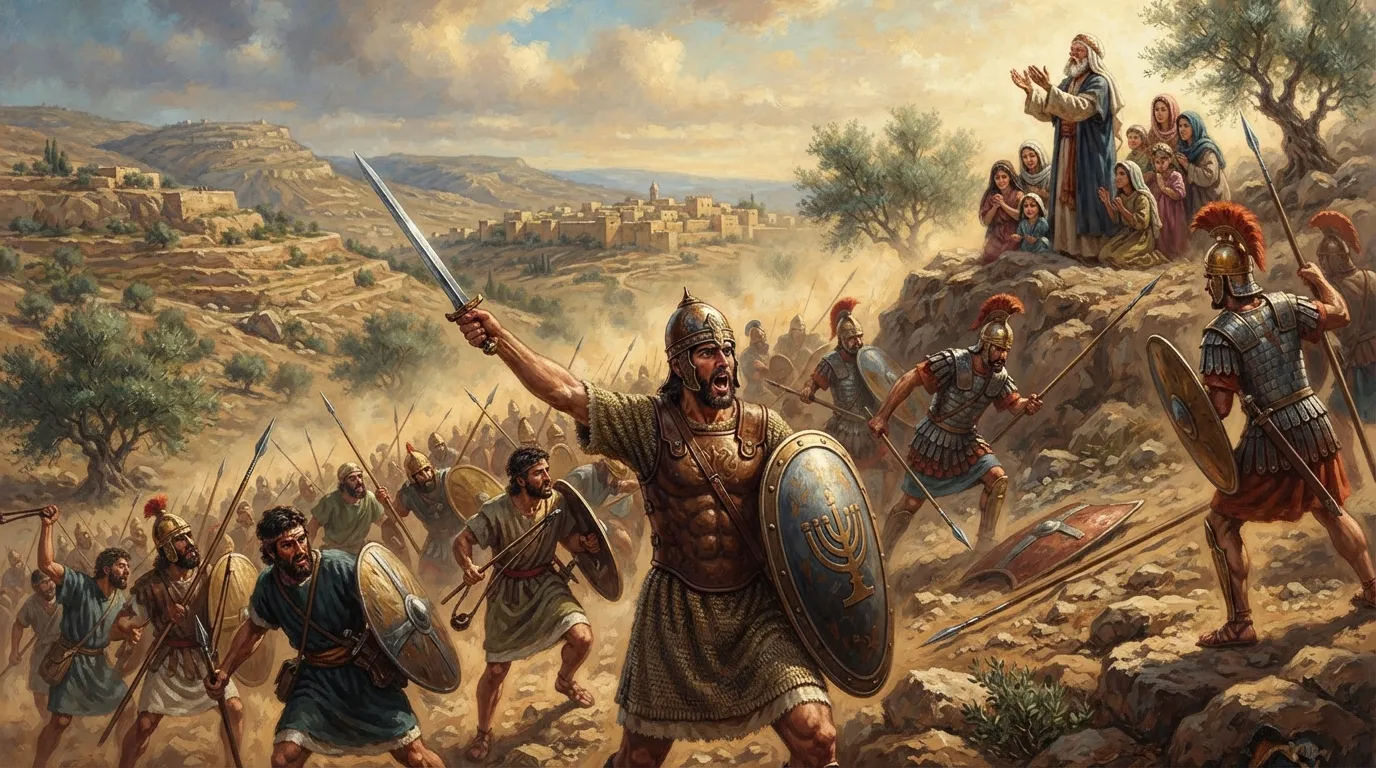
Between the last page of Malachi and the first page of Matthew, four hundred years pass in silence. No prophet speaks. No Scripture is written. And then, in the middle of that silence, a family of priests from a small village starts a revolt that changes the world. Their story is told in the books of Maccabees — books that sit in Catholic Bibles, are honored as history by Protestants and Jews, and are the reason Hanukkah exists. To understand the New Testament, you have to understand the Maccabees, because they are the bridge between the testaments.
The story begins with an empire, a king with a god complex, and a question every believer eventually faces: what do you do when the world demands that you stop being faithful to God?
The Crisis: A King Who Declared War on God
After Alexander the Great’s empire fractured, Judea fell under the Seleucid kings of Syria. The crisis came under Antiochus IV Epiphanes — “Epiphanes” meaning “God manifest,” a title the king gave himself. Antiochus was determined to unify his empire around Greek culture, and he saw Jewish distinctiveness as a threat. In 167 BC, he banned circumcision, Sabbath observance, and the dietary laws. He turned the Jerusalem temple into a shrine for Zeus and sacrificed a pig on its altar — an act Jews remember as the “abomination of desolation.” Jews who obeyed the Torah were tortured and killed; mothers who circumcised their sons were executed with their children.
This was not a political dispute. It was an attempt to erase a people’s identity by erasing their worship. Antiochus understood what every persecutor understands: a people’s faith is carried by its practices. Take away the practices, and the faith dies within a generation. The question was whether anyone would resist.
The Priest Who Said No
In the village of Modein, a priest named Mattathias was ordered to offer a pagan sacrifice. When a fellow Jew stepped forward to comply, Mattathias killed him and the king’s officer, then tore down the altar and fled to the hills with his five sons, crying, “Let everyone who is zealous for the law and supports the covenant come out with me!” (1 Maccabees 2:27). Mattathias died within the year, but the revolt he started would last a generation.
Mattathias’s sons became the movement. John, Simon, Eleazar, Jonathan, and Judas — and Judas would become its legend. The family name Maccabee is traditionally understood to mean “hammer,” a fitting title for a man who hammered an empire. Some scholars connect it to the Hebrew phrase Mi kamocha ba’elim, YHWH — “Who is like You among the gods, LORD?” — the battle cry of Exodus 15:11. Either way, the name came to stand for the whole resistance: the Maccabees.
Judas the Hammer
Judas Maccabeus was the revolt’s military genius. With a small, underequipped force fighting guerrilla warfare in the Judean hills, he defeated Seleucid armies several times his size. His victories were not only tactical; they were theological. Before battle, his men prayed, fasted, and read Scripture. After victory, they gave God the credit. 1 Maccabees 3 describes him as a lion in battle — and as a man who trusted God with the outcome.
In 164 BC, Judas recaptured Jerusalem and cleansed the temple. The lamps were relit, the sacrifices resumed, and the people celebrated for eight days — the first Hanukkah, the Feast of Dedication. The celebration is remembered in John 10:22, where Jesus Himself attends the Feast of Dedication in Jerusalem. The Maccabees had won what seemed impossible: the temple stood again, and Jewish worship survived.
The victory was not permanent. Judas was killed in battle in 160 BC. His brothers Jonathan and Simon carried on, and Simon eventually secured a measure of independence for Judea. The family founded the Hasmonean dynasty, which ruled Judea for a century — until Rome arrived, and the world into which Jesus was born took shape. The Maccabees’ revolt bought the time and the freedom in which Judaism survived to the coming of Christ.
Two Books, Two Angles
The story survives in two books, and they are very different. 1 Maccabees is a sober, detailed historical account — battles, treaties, dates, genealogies — written to record what happened. 2 Maccabees is a theological retelling, focusing on martyrdom, prayer, the temple, and the hope of resurrection. Its stories of martyrs — the mother who watched seven sons die rather than break the law, the scribe Eleazar who refused to eat pork — are among the most powerful in all ancient literature.
2 Maccabees also contains one of the clearest pre-Christian statements of resurrection hope. The martyred brothers declare that the King of the universe “will raise us up to an everlasting renewal of life” (2 Maccabees 7:9). That hope — that God would raise the dead — is the soil from which the New Testament’s resurrection faith grew. When Paul and the apostles preached resurrection, they were preaching to people whose grandparents had died believing it.
The two books disagree on details, and honest readers should admit that. They are ancient histories, not modern documentaries. But their core story — persecution, resistance, cleansing, dedication — is consistent, and it is confirmed by other sources, including the historian Josephus.
Where the Books Belong
For Catholic and Orthodox Christians, 1 and 2 Maccabees are deuterocanonical — part of the canon, read as Scripture. For most Protestant Christians, they are part of the Apocrypha: valuable for history and edification, but not authoritative Scripture in the same sense as the Old and New Testaments. For Jews, they are important historical books, though not part of the Hebrew Bible.
These differences should be handled with respect. A Protestant should not dismiss the books as worthless; they are the historical record of the bridge between the testaments, and the New Testament assumes their world. A Catholic should not demand that a Protestant treat them as canonical; the Protestant canon has its own reasons. What all Christians can agree on is that the Maccabees’ story is true history, that their courage was real, and that their hope in resurrection was fulfilled in Christ.
What the Maccabees Still Teach
The Maccabees teach that faithfulness under pressure is rarely dramatic at first. It begins with a small refusal — a priest who will not sacrifice, a mother who will not compromise, a scribe who will not eat. It teaches that God uses imperfect people: the Hasmonean dynasty the Maccabees founded eventually became corrupt, worldly, and violent. The family that saved the temple later desecrated its spirit. God’s instruments are not exempt from becoming the problem.
The Martyrs Who Would Not Bend
The military story of the Maccabees is only half the tale. The other half belongs to the martyrs — ordinary people who chose death over compromise. Second Maccabees tells of Eleazar, an aged scribe, who refused to eat pork even when his friends offered to substitute acceptable meat and pretend. He would not fake compliance, he said, because his example would corrupt the young. He died under torture, leaving “a noble example of how to die a good death.” The book also tells of a mother and her seven sons, arrested for keeping the law, who were tortured one by one before her eyes. Each son refused to break the law. The mother watched all seven die, exhorting each to be faithful, and then died herself.
These stories are horrifying, and they raise the question every persecuted believer faces: is faithfulness worth dying for? The martyrs’ answer was yes — because they believed in resurrection. The second brother declared that the King of the universe would raise them to life. The fourth said that their torturers would have no resurrection to life. The martyrs could face death because they believed death was not the end. Their hope was not in the revolt’s success. It was in God’s promise to raise the dead. That hope — forged in persecution, proven in suffering — is the inheritance the Maccabees left to the church. When the early Christians faced their own persecutions, they stood in a tradition the Maccabean martyrs had already pioneered.
The martyrs also warn against romanticizing the revolt. The Maccabean resistance involved real violence, real killing, and real moral complexity. The books do not hide that. They present a people caught between compromise and resistance, between survival and faithfulness, making hard choices in impossible circumstances. The story is not a simple tale of heroes and villains. It is the story of a people who refused to let their faith die — and who paid for that refusal in blood.
Above all, the Maccabees teach that the story of God’s people is a story of preservation. The temple was defiled, and it was cleansed. The lamps went out, and they were relit. The faith was nearly extinguished, and it survived — so that one day, in that same temple, a child would be presented, a man would teach, and a Savior would declare Himself the true temple. The Maccabees held the line. Christ finished the story. For a full account of the revolt, the books, and their legacy, see the article on the Maccabees in history and tradition.










