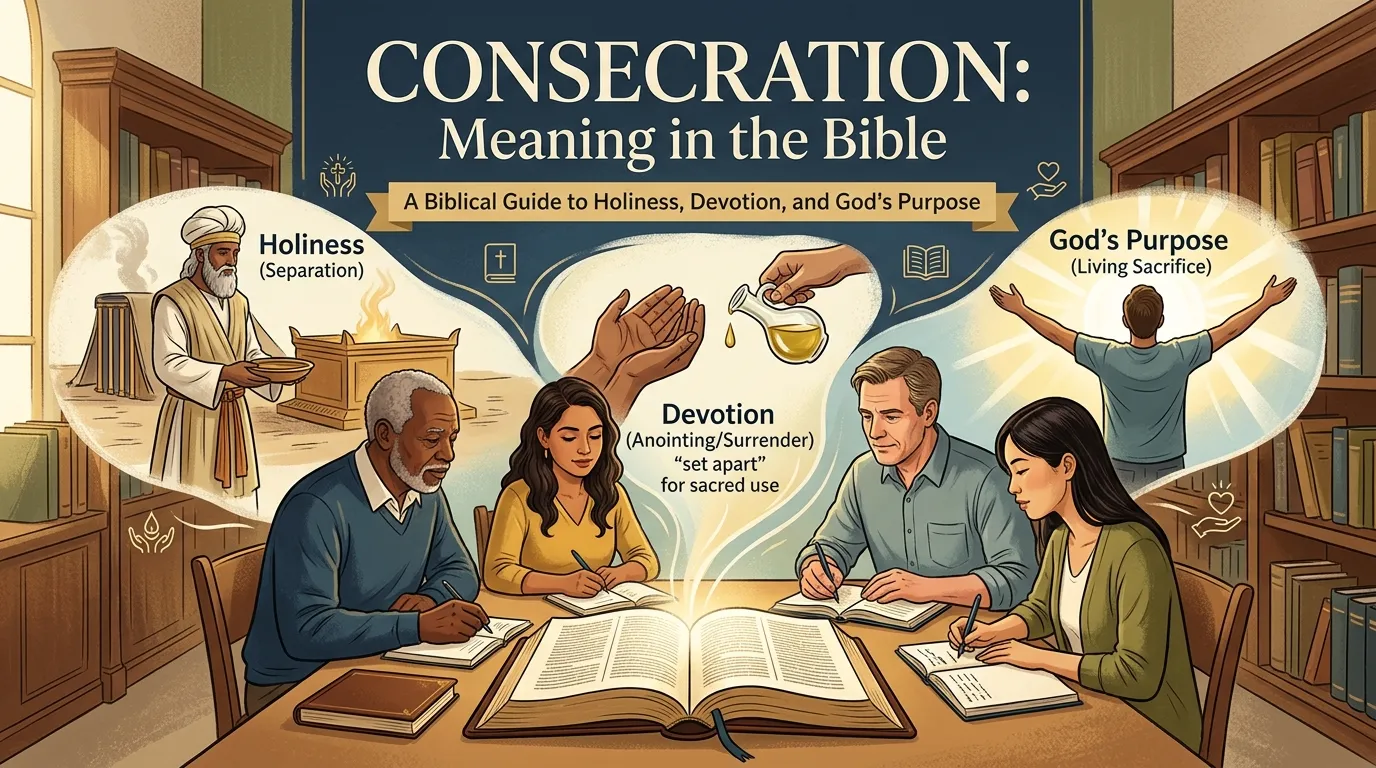
“Consecrate yourselves, for tomorrow the LORD will do wonders among you.” Joshua spoke those words on the bank of the Jordan, with the promised land finally in sight and an impassable river in the way (Joshua 3:5). Israel’s response to the command would determine whether they watched the waters part or stayed stuck on the wrong side. Consecration — the deliberate setting apart of a person or thing for God’s exclusive use — stands at the hinge of that story, and of every story where God does wonders among His people.
The Pattern in the Old Testament: Set Apart at Sinai
Consecration first appears as a national event. Before God descended on Mount Sinai, He told Moses: “Go to the people and consecrate them today and tomorrow… for on the third day the LORD will come down on Mount Sinai in the sight of all the people” (Exodus 19:10-11). The people washed their garments, abstained, and drew a boundary around the mountain. The message was unmistakable: approaching a holy God requires preparation. Consecration was how Israel got ready to meet Him.
The Hebrew word is qadash — to be holy, to set apart. It is the same root as “holy” and “sanctify.” In the Old Testament, consecration touched everything: people (the priests in Exodus 28-29, the Levites in Numbers 8, the Nazirites in Numbers 6), the firstborn (Exodus 13:2 — every firstborn male belonged to God), time (the Sabbath was consecrated, set apart from common days), objects (the tabernacle furniture, anointed and set apart in Exodus 40), and even war (Israel was told to consecrate itself before battle, as in Joshua 3).
The common thread: consecration meant withdrawal from common use for sacred purpose. A consecrated vessel was not better-made than other vessels; it was reserved. Its value lay not in its quality but in its assignment. That is the first great lesson of consecration: God is less interested in your impressiveness than in your availability.
The Nazirite: Consecration for a Season
Scripture’s most detailed portrait of personal consecration is the Nazirite vow of Numbers 6 — and it corrects a common misunderstanding. Consecration was not only for priests and not only permanent. Any Israelite, man or woman, could take the vow “to separate himself to the LORD” for a defined period (Numbers 6:2). Three marks defined the consecrated season: no wine or strong drink (even grapes and raisins — total abstinence from the fruit of the vine), no razor on the head (the uncut hair was the visible sign of the vow), and no contact with the dead (not even for father or mother — the consecrated belonged wholly to God).
The Nazirite’s consecration was voluntary, temporary, and total — and each adjective teaches. Voluntary: nobody was drafted; consecration begins in desire, not duty. The vow’s power came from its freeness — “when either a man or a woman makes a special vow.” God honors consecration He didn’t coerce. Temporary: the vow had an end date, after which the Nazirite offered sacrifices and returned to ordinary life (Numbers 6:13-21). This dignifies seasons of special devotion — a month of focused prayer, a year of simplified living, a Lent-like laying aside. Not every consecration is lifelong; some are sprints, and sprints count. Total: during the vow, the separation was absolute — no exceptions for family funerals, no trimming the edges. Half-consecration is contradiction; the vow worked because it was whole.
Samson was a lifelong Nazirite (Judges 13:5), and his tragedy illustrates consecration’s fragility: the vow’s power lay in the keeping, and when he treated it casually — touching the dead lion, drinking at feasts, finally surrendering the hair — the strength went with the symbol. Not because hair is magic, but because the hair meant the vow, and the vow meant the Lord. Consecration is a relationship formalized; break the form carelessly and you wound the relationship. But note the grace: even Samson, blinded and bound, found that consecration could be renewed — his hair grew again, and his final prayer was answered (Judges 16:28-30). The consecrated who fall are not finished; they are invited back to the vow.
The New Testament Upgrade: From Vessels to People
In Christ, consecration moves from objects to persons — from the temple’s furniture to the temple’s people. “Do you not know that you are God’s temple and that God’s Spirit dwells in you?” (1 Corinthians 3:16). The language once applied to gold and linen now applies to you. Peter gathers the old consecration vocabulary and lays it on the whole church: “you are a chosen race, a royal priesthood, a holy nation, a people for his own possession” (1 Peter 2:9). Every believer is consecrated ground.
Paul gives the New Testament’s defining consecration text: “I appeal to you therefore, brothers, by the mercies of God, to present your bodies as a living sacrifice, holy and acceptable to God, which is your spiritual worship” (Romans 12:1). Note the logic: by the mercies of God — consecration is a response to grace, not a payment for it. And note the paradox: a living sacrifice. Old Testament sacrifices died on the altar; New Testament saints live on it — daily climbing back onto the altar they keep crawling off.
Jesus Himself modeled it: “For their sake I consecrate myself, that they also may be sanctified in truth” (John 17:19). Our consecration is participation in His. We do not make ourselves holy by effort; we offer ourselves to the Holy One, and He does the sanctifying.
Consecration vs. Anointing: Keep Them Straight
These two ideas are often blurred, but Scripture keeps them distinct, and so should we. Anointing is God’s appointment of us — His marking, His empowering, His Spirit poured out for a task. The direction runs from heaven to earth: Samuel anoints David; the Spirit anoints Jesus; God anoints believers with the Holy Spirit (1 John 2:20). You receive anointing; you do not achieve it.
Consecration is our dedication to God — our setting apart of ourselves, our time, our bodies, our plans for His exclusive use. The direction runs from earth to heaven: Joshua tells Israel to consecrate themselves; Paul urges believers to present their bodies. You practice consecration; it is your response.
The relationship is beautiful: God anoints what we consecrate. The vessel set apart on the shelf is the vessel the Master reaches for (2 Timothy 2:21 — “if anyone cleanses himself… he will be a vessel for honorable use, set apart as holy, useful to the master”). Anointing without consecration is power without purity — the tragedy of Saul. Consecration without anointing is devotion without power — sincere but striving. God intends both: His empowering upon our surrender.
What Consecration Looks Like on a Tuesday
Abstract devotion changes nothing; consecration gets practical or it isn’t real. Here is what the “living sacrifice” looks like in ordinary days:
Consecrated time. The Sabbath principle survives in every deliberate rhythm of rest and worship — a morning offered before the phone, a Sunday guarded from the world’s noise. Time given to God first consecrates all the time that follows.
Consecrated body. Paul’s appeal names the body specifically, because the body is where devotion becomes visible: what we eat, how we rest, sexual purity, care for health — “you are not your own, for you were bought with a price. So glorify God in your body” (1 Corinthians 6:19-20).
Consecrated work. The farmer’s field and the accountant’s spreadsheet become altars when offered to God (Colossians 3:23). Consecration does not usually mean quitting your job for ministry; it means doing your job as ministry.
Consecrated relationships. Some influences must be set apart from: “Do not be unequally yoked with unbelievers” (2 Corinthians 6:14) is consecration language — not contempt for outsiders, but protection of the altar. And some relationships must be set apart for: marriage, friendship, and church as covenant bonds rather than conveniences.
Consecrated plans. James warns against planning “today or tomorrow we will go into such and such a town” without adding “if the Lord wills” (James 4:13-15). Consecration holds every ambition with an open hand.
Is consecration a one-time event or ongoing?
Both. Israel’s consecration at Sinai was an event; the priests’ consecration was maintained by daily practice. Likewise, many believers point to a decisive moment of surrender — and then spend a lifetime renewing it. Think of it as a wedding (the event) and a marriage (the daily renewal). Both are real; neither replaces the other.
Does consecration mean withdrawing from the world?
No — it means being in the world as God’s reserved property. Jesus prayed not that His disciples be taken out of the world but kept from evil within it (John 17:15). The consecrated life engages culture, serves neighbors, and does ordinary work — but as one who belongs to Another.
On the bank of the Jordan, consecration came before the miracle. That order has never changed: God still does wonders among a people who have set themselves apart for Him. The river is still parted for the consecrated. For how this practice has been formalized across Christian traditions, see consecration.










