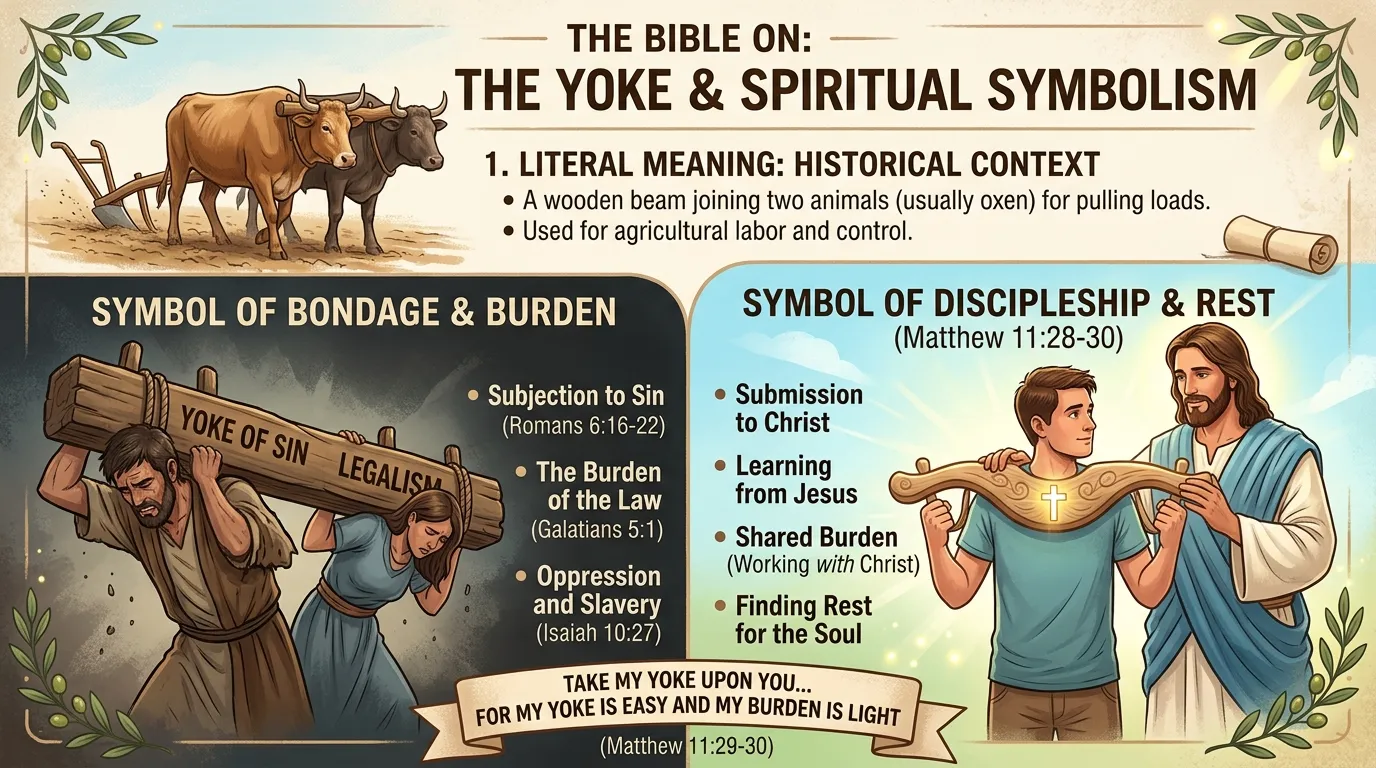
Picture two oxen in a field, a heavy wooden beam across their necks, pulling a plow in step. That beam is a yoke — and it is one of the Bible’s most versatile pictures, used for slavery and for salvation, for oppression and for rest. Jesus chose this farm implement for one of His most beloved invitations: “Take my yoke upon you… and you will find rest for your souls” (Matthew 11:29). To understand the yoke is to understand what kind of Master Jesus is — and what kind of burdens He removes and gives.
How a Yoke Actually Worked
A yoke was a wooden frame laid across the necks of two draft animals, joining them to each other and to the plow or cart. The design mattered enormously. A well-fitted yoke distributed weight evenly; a poorly fitted one chafed and wounded. Farmers paired animals carefully — and here is the detail that unlocks the metaphor: a young, inexperienced ox was often yoked beside an older, seasoned one. The veteran set the pace, kept the furrow straight, and bore the greater share of the load while the younger learned the work by walking beside strength.
Keep that image. When Jesus says “take my yoke,” He is not handing you an empty harness and pointing at a field. He is the seasoned Ox in the yoke beside you — setting the pace, carrying the weight, teaching you the furrow by His own steady steps. The yoke of Christ is not solo labor; it is shared labor with One who is infinitely stronger.
The Yoke of Bondage: When the Beam Crushes
Most of the Bible’s yokes are heavy ones. After Solomon’s death, the northern tribes begged Rehoboam: “Your father made our yoke heavy. Now therefore lighten the hard service” (1 Kings 12:4). He refused — and the kingdom split. A yoke became Scripture’s standard image for political oppression: Egypt’s slavery, Assyria’s tribute, Babylon’s captivity. “I am the LORD your God, who brought you out of the land of Egypt… and I broke the bars of your yoke” (Leviticus 26:13).
The prophets used the yoke for spiritual bondage too. Isaiah promised that the oppressor’s yoke would be broken — “the yoke of his burden… you have broken as on the day of Midian” (Isaiah 9:4), a prophecy of the Messiah who shatters every enslaving power. Jeremiah wore a wooden yoke in the streets to dramatize Babylon’s coming domination (Jeremiah 27-28). And Paul warned the Galatians not to trade gospel freedom for legalism: “do not submit again to a yoke of slavery” (Galatians 5:1). Any system — political, religious, or internal — that promises life through crushing performance is a yoke of bondage, and Christ came to break it.
The Prophets’ Yokes: Judgment, Then Hope
No prophet wore the yoke like Jeremiah. God told him to make “straps and yoke-bars, and put them on your neck” (Jeremiah 27:2) — and then wear this farm equipment through the streets of Jerusalem as a walking sermon. The message: Babylon’s domination was God’s appointed discipline, and the nations should submit to Nebuchadnezzar’s yoke rather than fight it. It was a humiliating, unpopular prophecy — submission as obedience — and a false prophet named Hananiah publicly broke the wooden yoke off Jeremiah’s neck, predicting Babylon’s fall within two years (Jeremiah 28:10).
Jeremiah’s response is one of Scripture’s most sobering moments: very well — the wooden yoke will be replaced with an iron yoke (Jeremiah 28:13). Resisting God’s appointed discipline doesn’t remove the yoke; it hardens it. The principle runs through all of Scripture: the yoke we accept in humility stays wooden; the yoke we shatter in pride returns as iron. Hananiah died within the year, as Jeremiah foretold. The story is a permanent warning against confusing rebellion with faith — sometimes the most spiritual thing you can do is submit to the hard providence rather than break the yoke.
But the prophets also promised the yoke’s breaking. Isaiah, speaking of Assyria’s oppression, declared: “his burden will depart from your shoulder, and his yoke from your neck; and the yoke will be broken because of the fatness” (Isaiah 10:27) — or, as some translations render it, “because of the anointing.” The ambiguity is beautiful: the yoke breaks either because the ox grows too strong (fatness = strength) or because of the Anointed One (the Messiah). Either way, the promise stands: every yoke of bondage has an expiration date, and the Anointed One holds the hammer. What Jeremiah’s generation had to endure, Isaiah’s vision said would one day be ended — by the coming King whose shoulders would carry the government (Isaiah 9:6) so ours wouldn’t have to carry the yoke.
Unequally Yoked: The Partnership Warning
Paul’s most quoted yoke text addresses relationships: “Do not be unequally yoked with unbelievers. For what partnership has righteousness with lawlessness?” (2 Corinthians 6:14). The farming logic is exact: yoke two animals of different strength, stride, or direction, and both suffer — the plow veers, the animals chafe, the work fails. A believer bound in life’s deepest partnerships — supremely marriage, but also business and close alliance — to one pulling toward a different master will be dragged off the furrow.
This is not contempt for unbelievers; Paul elsewhere urges kindness and witness toward them. It is realism about covenant bonds. Casual friendships can bridge any divide, but yoke-partnerships — where two lives are harnessed to pull together — require shared direction. The question is not “is this person good?” but “are we pulling the same way?” Two oxen can both be fine animals and still make a disastrous team. The church has learned this the costly way for two thousand years: the most painful conflicts are rarely between good and evil, but between two goods pulling different directions.
My Yoke Is Easy: The Invitation
Against every heavy yoke, Jesus sets His own: “Come to me, all who labor and are heavy laden, and I will give you rest. Take my yoke upon you, and learn from me, for I am gentle and lowly in heart, and you will find rest for your souls. For my yoke is easy, and my burden is light” (Matthew 11:28-30).
Every word is chosen. “Come to me” — not to a system, a ritual, or a teacher’s successor, but to a Person. “All who labor” — the invitation is for the exhausted, not the accomplished. “Take my yoke upon you” — rest comes not from dropping all harness but from taking the right one; the rest Jesus gives is rest in work, not from it. “Learn from me” — discipleship is apprenticeship, walking the furrow beside the Master. “I am gentle and lowly in heart” — the only place in the Gospels where Jesus describes His own heart, and He chooses gentleness. This is the heart of the One in the yoke beside you.
And “my yoke is easy” — the Greek word is chrestos, meaning well-fitting, kindly, good. A well-fitted yoke does not chafe. Christ’s commands fit the human soul the way a master carpenter’s yoke fit the ox: designed for the creature, not against it. His burden is light not because obedience is effortless but because He carries the weight — “learn from me,” walk beside me, and the furrow stays straight.
There is a final tenderness in the invitation that weary believers often miss: Jesus does not say “take a yoke” but “my yoke” — the one He Himself wore. He is not assigning labor He has not done. The Son who learned obedience through suffering (Hebrews 5:8) now yokes Himself to every willing learner, and the apprenticeship runs both directions: we learn His gentleness, and He sympathizes with our weakness — “we do not have a high priest who is unable to sympathize with our weaknesses” (Hebrews 4:15). The yoke is easy because the Yoke-Fellow is sympathetic; the burden is light because the Burden-Bearer is with us in it, step for step, furrow for furrow, all the way home.
What does it mean to “take” Jesus’ yoke practically?
It means submitting your decisions, ambitions, and rhythms to His lordship — praying “Your will be done” and meaning it in the small choices, not just the crises. Practically: bring Him your work before your worry, let His commands shape your ethics when it costs you, and rest in His finished work when your own falls short.
Is the “unequally yoked” command only about marriage?
Marriage is the primary application — the deepest human yoke — but the principle covers any binding partnership where shared spiritual direction matters: business partnerships, close ministry alliances. It does not forbid friendship, employment, or witness toward unbelievers; Paul assumes believers live and work among them (1 Corinthians 5:10).
Every life wears a yoke; the only question is whose. The yokes of this world — achievement, approval, addiction, anxiety — chafe and crush. Christ’s yoke, fitted by gentle hands and shared with a strong Companion, turns labor into rest. For the agricultural background behind the image, see yoke.










