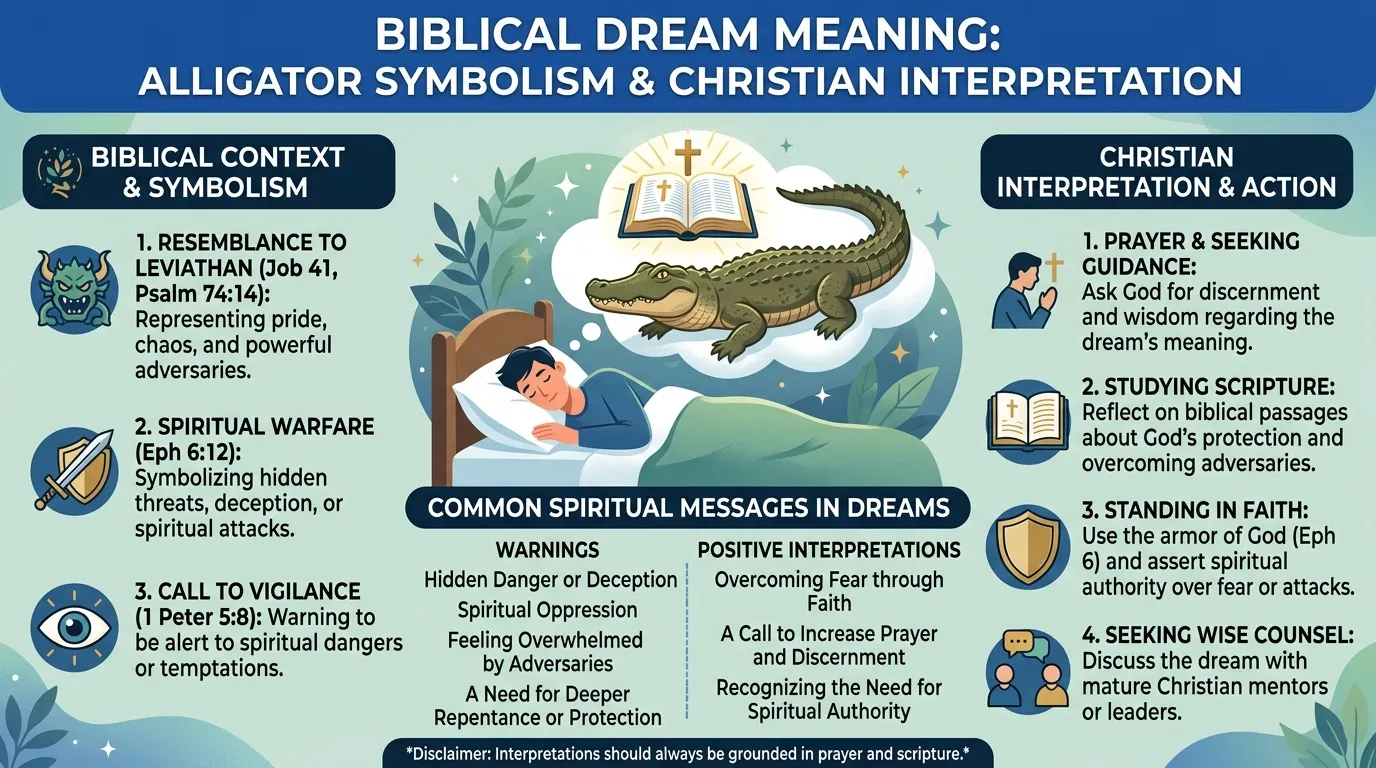
The dream clings to you after the alarm: dark water — and in it, an alligator: still, watching, armored, patient. Maybe it lunged. Maybe it only stared. Either way, the image follows you into the morning, and the question follows the image: was God saying something? Dreams of predators unsettle us because they feel like messages we cannot decode. The Bible has a great deal to say about dreams, about fear, and about the great water-beasts of Scripture — but it says those things in its own way, not in the way of internet dream dictionaries. Let’s walk through what Scripture actually offers the Christian who dreams of an alligator.
First, the Honest Starting Point: Alligators Aren’t in the Bible
Intellectual honesty matters here, because God is the God of truth. The word “alligator” appears nowhere in Scripture — the animal is native to the Americas and China, unknown to the biblical world. Anyone who tells you “the biblical meaning of dreaming about an alligator is X” is inventing, not interpreting. The Bible never assigns fixed meanings to specific modern animals in dreams, and Christians should be wary of any system that does — dream dictionaries, however spiritual their packaging, are closer to fortune-telling than to exegesis.
But the Bible does know the alligator’s cousins. The great reptiles of the Nile — the crocodile — appear in Scripture’s poetry as images of formidable, even cosmic power. Psalm 74:14 speaks of God crushing “the heads of Leviathan,” the sea-monster of Canaanite myth whom Scripture treats as a real creature embodying chaos. Isaiah 27:1 promises the day when the LORD will punish “Leviathan the fleeing serpent… the dragon that is in the sea.” Ezekiel 29:3 pictures Pharaoh himself as “the great dragon that lies in the midst of his streams.” In biblical imagination, the armored predator in the water is an emblem of threatening power that only God can master — and the consistent message is not “be terrified” but “watch God crush it.”
What the Bible Actually Teaches About Dreams
Scripture treats dreams seriously but soberly. God did speak through dreams — to Jacob at Bethel (Genesis 28), to Joseph about his future (Genesis 37), to Pharaoh about the famine (Genesis 41), to Daniel about empires (Daniel 2, 7), to Joseph the carpenter about Mary’s child and the flight to Egypt (Matthew 1-2). Dreams in the Bible are one channel of God’s communication, never the whole radio.
But Scripture also warns that dreams are a mixed channel. “For when dreams increase and words grow many, there is vanity; but God is the one you must fear” (Ecclesiastes 5:7). Jeremiah confronted prophets who claimed “I have dreamed, I have dreamed!” while speaking lies from their own imagination (Jeremiah 23:25-28). The New Testament’s rule for all spiritual impressions applies to dreams too: “test everything; hold fast what is good” (1 Thessalonians 5:21). A dream’s vividness is not proof of its source. The question is never “how real did it feel?” but “does it align with Scripture, and does it produce the fruit of the Spirit or the fog of fear?”
Here is the pastoral key: in Scripture, God-given dreams led to action, worship, or warning with a clear purpose — never to vague dread. Pharaoh’s dream came with Joseph’s interpretation and a national survival plan. The Magi’s dream came with an instruction: don’t go back to Herod. If a dream leaves you only with churning anxiety and no godly direction, that is reason to doubt it came from God — for “God gave us a spirit not of fear but of power and love and self-control” (2 Timothy 1:7).
That threefold replacement is worth memorizing: power instead of paralysis, love instead of suspicion, self-control instead of spiraling. When the alligator surfaces in your dreams, answer it with the inventory: Where do I need God’s power today? Whom can I love instead of fearing? What thought needs bringing under control? The dream becomes not an oracle but an occasion — a nighttime nudge toward daytime faithfulness.
Reading the Alligator Without Superstition
So what might a Christian wisely consider — not decree — about an alligator dream? Treat the image the way Scripture treats its reptilian cousins: as a picture of a threat your soul is registering. The alligator in the water is camouflaged danger — something in your life may feel hidden, patient, and potentially harmful: a conflict you’re avoiding, a temptation lurking, a fear you’ve submerged, a relationship where trust has eroded. The dream may simply be your God-given conscience doing at night what you haven’t had time to do by day: noticing.
Scripture’s counsel for hidden threats is not panic but watchfulness. Jesus told His disciples to be “wise as serpents and innocent as doves” (Matthew 10:16) — alert to danger without becoming dangerous. Paul urged believers to “put on the whole armor of God, that you may be able to stand against the schemes of the devil” (Ephesians 6:11). Notice: stand, not chase. The Christian response to perceived threat is steady readiness, not frantic reaction.
And crucially: the dream is not a verdict. An alligator in your dream does not mean someone is “out to get you,” does not reveal a curse, and does not predict an attack. Superstition reads every shadow as an omen; faith reads shadows as reminders to walk in the light. If the dream troubles you, the biblical response is prayer, not divination: “If any of you lacks wisdom, let him ask God, who gives generously to all without reproach, and it will be given him” (James 1:5).
When the Dream Is Really About Fear
Often, the alligator is not a message about the future but a mirror of the present: you are afraid, and your sleeping mind dressed the fear in scales. Scripture meets fear not with interpretation techniques but with presence. “Fear not, for I am with you; be not dismayed, for I am your God” (Isaiah 41:10) is spoken to people who had every reason to be afraid — and the ground of courage is not the absence of alligators but the presence of God.
If nightmares recur, the pastoral path is practical and spiritual together: pray before sleep, committing the night to God (Psalm 4:8 — “In peace I will both lie down and sleep”); examine the day for unaddressed anxieties and bring them to God rather than to bed (Philippians 4:6-7); limit the inputs that feed fear; and if distress persists, speak with a pastor or counselor — seeking help is wisdom, not weak faith. What you feed by day hunts you by night; starve the fear and feed the faith.
Two Dreams That Changed History
To calibrate our expectations, consider how God-given dreams actually functioned in Scripture — because they look very different from vague nighttime anxiety. Pharaoh’s dream (Genesis 41): seven fat cows devoured by seven thin cows; seven full grain heads swallowed by seven withered ones. Pharaoh woke troubled — and the dream came with a God-given interpreter (Joseph), a clear meaning (seven years of plenty, seven of famine), and an action plan (store grain). The dream served a mission: saving nations from starvation. It was specific, interpretable, and actionable.
Nebuchadnezzar’s dream (Daniel 2): a great statue with a head of gold, shattered by a stone “cut out by no human hand.” The king even forgot the dream — and God revealed both the dream and its meaning to Daniel: the succession of empires, culminating in God’s eternal kingdom crushing them all. Again the pattern: specific content, divinely provided interpretation, redemptive purpose — this time, humbling the most powerful man on earth and announcing that all human kingdoms fall before God’s.
Now compare the typical distressing animal dream: vivid, frightening, uninterpreted, producing only dread. The biblical pattern suggests a diagnostic: God-given dreams came with clarity and commissioning. If your dream came with neither — no clear meaning, no godly direction, only churning fear — wisdom says: treat it as your mind processing stress, not as heaven sending a telegram. Pray about the stress (that’s real), but don’t build theology on the symbols (that’s speculation).
Should I look up the “meaning” of my dream online?
Be cautious. Most dream-dictionary sites blend psychology, occult symbolism, and guesswork, and they cannot know your life, your heart, or God’s purposes. If a dream genuinely seems significant, pray over it, test it against Scripture, and discuss it with a mature believer — that is the biblical pattern (remember Daniel and Joseph interpreted for others, in community, not by search engine).
Can God still speak through dreams today?
Yes — Scripture never sets an expiration date on dreams as one way God may guide (Joel 2:28 is quoted at Pentecost as the Spirit’s ongoing work). But dreams are rare, confirmatory, and always subordinate to Scripture. No dream will ever contradict God’s Word, and no dream carries the authority of God’s Word. Hold them loosely; hold the Bible tightly.
An alligator in a dream is not a coded telegram from the spirit world. It is an invitation — to watchfulness, to prayer, to honest self-examination, and above all to the God who crushes every Leviathan and keeps His children even in dark water. For a measured overview of how dream interpretation has been understood across cultures and history, see dream interpretation.










