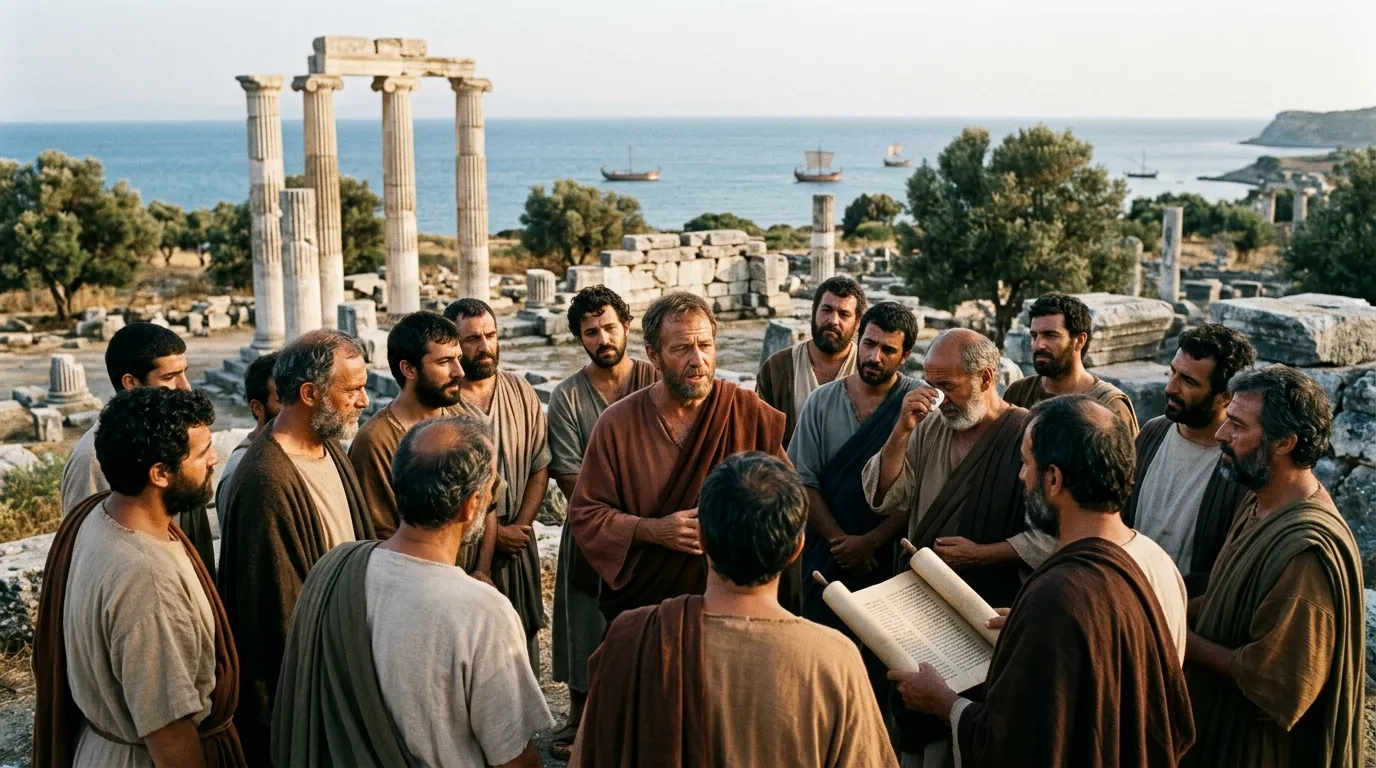
Miletus appears in the Bible mainly as the setting for a goodbye. Paul was hurrying toward Jerusalem, and rather than stopping at Ephesus and losing time, he sent for the elders of the Ephesian church to meet him at Miletus, a port city about thirty miles south. What followed, recorded in Acts 20:17-38, is one of the most personal speeches in the New Testament: a leader’s farewell to the people he had served, spoken with the knowledge that he would never see them again. Miletus matters not because of anything mystical about the place but because of what was said there about ministry, faithfulness, and parting well.
A Port City With a Long Memory
Miletus was an ancient and distinguished city on the west coast of Asia Minor, near the mouth of the Meander River. In earlier centuries it had been a great seaport, a center of philosophy and trade, and the mother city of dozens of colonies around the Black Sea and Mediterranean. By Paul’s day, its harbor was silting up, and Ephesus had overtaken it in commercial importance. But it was still a working port on the coastal route Paul was traveling, and it served his purpose exactly: close enough for the Ephesian elders to reach, far enough off his route to keep him moving toward Jerusalem.
Paul’s choice of Miletus was practical, not symbolic. He was in a hurry. Luke tells us Paul had decided to sail past Ephesus so that he would not spend time in Asia, because he was eager to reach Jerusalem by Pentecost if possible (Acts 20:16). The meeting at Miletus was a compromise between haste and love: he would not go to Ephesus, but he would not pass the region without speaking to its leaders one last time.
“You Know How I Lived”
Paul’s speech begins with an appeal to his own example. “You yourselves know how I lived among you the whole time from the first day that I set foot in Asia” (Acts 20:18). He reminds them that he served the Lord with all humility and with tears, enduring the trials that came from opposition. He taught publicly and from house to house, and he testified to Jews and Greeks alike about repentance toward God and faith in the Lord Jesus Christ (Acts 20:20-21).
This is not boasting. It is a leader handing over a pattern. Paul knew that his influence on the Ephesian church would soon be memory rather than presence. The elders would face the same pressures he had faced, and the best preparation he could give them was a clear picture of faithful ministry: humble, tearful, thorough, and centered on the same gospel for everyone. The speech is a job description written in the first person.
A Farewell Spoken in the Shadow of Suffering
The emotional center of the speech is Paul’s honesty about what lay ahead. “And now, behold, I am going to Jerusalem, constrained by the Spirit, not knowing what will happen to me there, except that the Holy Spirit testifies to me in every city that imprisonment and afflictions await me” (Acts 20:22-23). Paul did not know the details, but he knew the direction: chains and trouble.
His response has become one of the most quoted declarations in the New Testament: “But I do not account my life of any value nor as precious to myself, if only I may finish my course and the ministry that I received from the Lord Jesus, to testify to the gospel of the grace of God” (Acts 20:24). Miletus is where Paul stated his philosophy of ministry most plainly. The goal was not self-preservation, comfort, or a long career. The goal was to finish the course and deliver the message. Everything else was negotiable.
The Warning About Wolves
Paul’s farewell also contains a sober warning. He told the elders to pay careful attention to themselves and to the flock, because after his departure “fierce wolves will come in among you, not sparing the flock,” and even from among their own number men would arise speaking twisted things to draw away the disciples (Acts 20:29-30). The church’s greatest dangers, Paul said, would not come only from outside persecution. They would come from inside, from leaders who used the flock for their own ends.
His remedy was vigilance and memory: “Therefore be alert, remembering that for three years I did not cease night or day to admonish every one with tears” (Acts 20:31). The elders were to guard the church the way a shepherd guards sheep, and the standard for that guarding was the gospel Paul had preached among them. Miletus is therefore one of the New Testament’s foundational texts on church leadership: leaders are stewards of a flock that belongs to God, purchased with Christ’s own blood (Acts 20:28).
The Prayer and the Tears
The speech ends with prayer and an embrace. Paul knelt down with them all and prayed. Then, Luke says, “there was much weeping on the part of all; they embraced Paul and kissed him, being sorrowful most of all because of the word he had spoken, that they would not see his face again” (Acts 20:37-38). They accompanied him to the ship.
There is something deeply human about this scene, and the Bible does not hide it. Paul was confident in God’s plan, and the elders were grieving anyway. Faith and sorrow are not opposites in this passage. The elders believed Paul’s message, trusted God’s sovereignty, and still wept at losing him. Christian farewells can hold both truths: gratitude for what God did through a person, and genuine grief that the person is going.
Why Miletus Still Matters
Miletus offers a model for every kind of parting: a pastor leaving a congregation, a missionary finishing a term, a parent releasing a child, a friend moving away. Paul’s example shows that a good farewell does three things. It tells the truth about the past, it speaks plainly about the future, and it commends people to God rather than to oneself. Paul’s final word to the elders was not “remember me” but “I commend you to God and to the word of his grace, which is able to build you up” (Acts 20:32). The church’s future did not depend on Paul’s presence. It depended on God’s grace.
The Content of the Charge
Paul’s charge to the elders contains one of the most concentrated statements of pastoral theology in the New Testament. He told them that the Holy Spirit had made them overseers, “to care for the church of God, which he obtained with his own blood” (Acts 20:28). The phrase “his own blood” is startling. It speaks of God purchasing the church at the cost of Christ’s blood, and it sets the value of the congregation higher than any leader’s comfort or ambition. The elders were not owners. They were stewards of a people who had cost God everything.
Paul also reminded them of his own method: he had not shrunk from declaring “the whole counsel of God” (Acts 20:27). The phrase suggests a ministry that did not cherry-pick comfortable truths. Paul taught the hard parts and the comforting parts, the doctrines of grace and the warnings of judgment, the promises and the commands. The elders were to do the same. A ministry that only teaches what the congregation wants to hear is not faithfulness. It is flattery. Miletus sets the standard: the whole counsel, not the convenient portion.
Miletus and the Later Church
The speech at Miletus became a touchstone for later generations of Christian leaders. When pastors and bishops in the early church described their calling, they returned to Acts 20 again and again: the humility, the tears, the vigilance, the warning about wolves, the commendation to God’s grace. The passage shaped the church’s understanding of ordination, of pastoral care, and of the danger of leaders who exploit the flock. It also shaped the church’s understanding of farewell. Paul’s model, honest about grief, clear about the future, and anchored in God’s grace, has guided countless leaders through their own partings.
The Commendation to Grace
The most important sentence in the Miletus speech may be the last one Paul spoke before kneeling to pray: “And now I commend you to God and to the word of his grace, which is able to build you up and to give you the inheritance among all those who are sanctified” (Acts 20:32). Paul did not commend the elders to a program, a successor, or an institution. He commended them to God and to the word of grace. The church’s future did not depend on Paul’s presence, on the elders’ skill, or on any human arrangement. It depended on the grace that had saved them and the word that would build them.
That commendation is the reason the Miletus speech still matters. Every leader eventually leaves. Every congregation eventually says goodbye to the pastor who shaped it. The question at every farewell is the same one Paul answered at Miletus: to whom do we commend the people we love? Paul’s answer was God and the word of His grace. It is still the right answer.
The city itself faded. Its harbor silted up, its population shrank, and today its ruins stand miles inland from the sea. But the speech given there has outlasted the city. Leaders still read it when they take up their work, and Christians still weep over it when they say goodbye. For the history of the city, its harbor, and its ruins, see the Wikipedia article on Miletus.