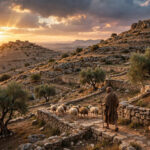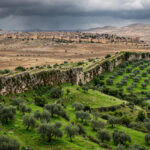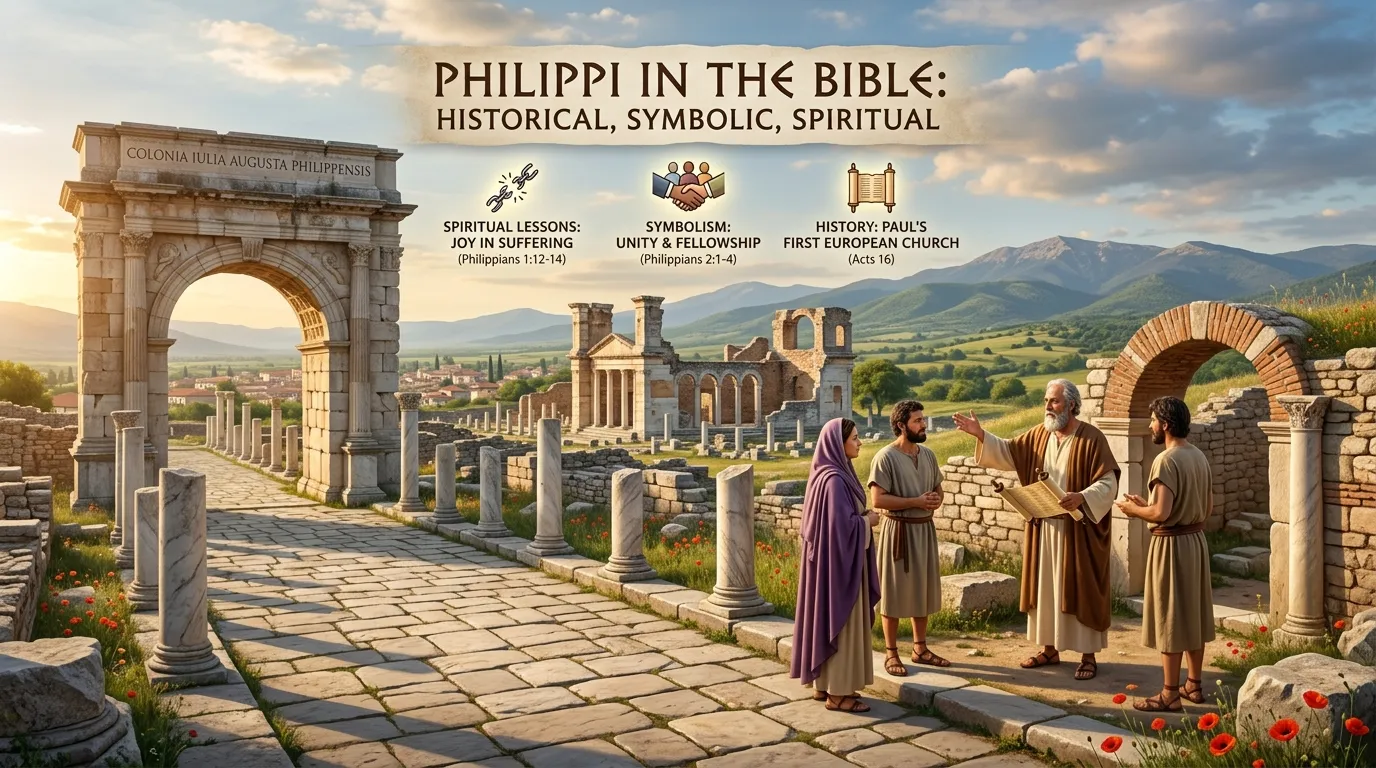
Philippi was the first place in Europe where the gospel was preached, and it began with a prayer meeting by a river. Paul had not planned to go there. He had been traveling through Asia Minor when a vision of a Macedonian man begging for help turned him west (Acts 16:9). He sailed to Neapolis, walked inland to Philippi, and on the Sabbath went outside the city gate to a riverside where he expected to find a place of prayer. The people he found there, and the church that grew from that meeting, would become one of the dearest congregations in Paul’s life. Philippi’s meaning in the Bible is the story of how the gospel crossed a continent and took root in a Roman colony through ordinary people.
A Roman City on the Via Egnatia
Philippi sat on the Via Egnatia, the great Roman highway that ran from the Adriatic coast to Byzantium. It had been refounded as a Roman colony after the Battle of Philippi in 42 BC, settled with veterans, and governed by Roman law. Its citizens took pride in their Roman status; Philippians were, in a legal sense, Romans living far from Rome. That pride helps explain a detail in Paul’s letter to the church: when he tells the Philippians that their citizenship is in heaven (Philippians 3:20), he is speaking to people who knew exactly what citizenship meant and how fiercely it was valued. He was offering them a better one.
The city was named for Philip II of Macedon, the father of Alexander the Great, who had rebuilt it centuries earlier. By Paul’s day it was a prosperous, strategically placed town, but it had no synagogue, apparently, since the Jewish community was too small to sustain one. That is why the prayer meeting happened by the river rather than in a building.
Lydia: The First European Convert
The first person Luke names in the Philippi story is Lydia, a dealer in purple cloth from Thyatira. Purple dye was expensive, and her trade suggests she was a woman of means. She was already a worshiper of God, a Gentile drawn to Jewish faith, and she had gathered with other women for prayer. Luke says something remarkable about her conversion: “The Lord opened her heart to pay attention to what was said by Paul” (Acts 16:14). The gospel came through Paul’s words, but the opening was God’s work.
Lydia’s response was immediate and practical. She was baptized along with her household, and then she opened her home. “If you have judged me to be faithful to the Lord, come to my house and stay,” she said, and Luke adds that she prevailed upon them (Acts 16:15). The first European church met in the house of a businesswoman whose heart God had opened. Her hospitality became the church’s first headquarters, and her example set a pattern: conversion in Philippi expressed itself in welcome.
The Slave Girl and the Cost of Freedom
Not every encounter in Philippi ended in welcome. As Paul and his companions went to the place of prayer, they were followed by an enslaved girl with a spirit of divination who earned money for her owners by fortune-telling. She shouted that Paul and his companions were servants of the Most High God proclaiming the way of salvation. What she said was true, but Paul, troubled, commanded the spirit to leave her in the name of Jesus Christ, and it did (Acts 16:16-18).
The girl’s freedom cost her owners their income, and they dragged Paul and Silas before the magistrates. The charge was framed as a civic one: these men were Jews disturbing the city and advocating customs unlawful for Romans. The magistrates had Paul and Silas beaten with rods and thrown into prison without trial, a violation of their rights as Roman citizens that Paul would later expose. The gospel had collided with an economy built on exploitation, and the city answered with violence.
A Church Paul Loved
Philippi became the church Paul wrote about with the most affection. His letter to the Philippians, written years later from prison, overflows with warmth: “I thank my God in all my remembrance of you” (Philippians 1:3). The Philippians had supported Paul financially again and again, sending gifts when other churches did not (Philippians 4:15-16). They sent Epaphroditus to care for him in prison. In return, Paul sent them one of the most profound passages in the New Testament, the hymn of Christ who emptied Himself and became obedient to death on a cross (Philippians 2:5-11).
That letter also shows what kind of church Philippi became: a community urged toward humility, unity, and joy in the middle of hardship. Paul’s call to rejoice in the Lord (Philippians 4:4) was not written from comfort. It was written by a prisoner to people who had watched him beaten and jailed in their own city. Their joy, like his, was rooted not in circumstances but in Christ.
What Philippi Teaches About How the Gospel Spreads
The Philippi story resists the idea that the gospel advances mainly through strategy, spectacle, or power. It advanced through a vision that redirected a plan, a conversation by a river, a woman’s opened heart, and a household’s hospitality. Even the suffering in Philippi served the mission: the beating and imprisonment led to the conversion of the jailer and his family (Acts 16:25-34) and to a church that would support Paul for the rest of his life.
Philippi also teaches that the gospel creates a new kind of community. Lydia, the jailer, and the slave girl came from entirely different stations in life: a wealthy merchant, a Roman official, and an exploited girl. In Christ, they belonged to the same church. The Roman colony prided itself on status and citizenship. The church at Philippi practiced a different citizenship, one in which the lowest and the highest stood on the same ground.
The Beating That Exposed Roman Injustice
The beating Paul and Silas received in Philippi deserves a closer look, because Paul later used it to expose the city’s injustice. Philippi was a Roman colony, and its magistrates were supposed to uphold Roman law. Roman citizens could not be beaten without a trial. Paul and Silas were citizens, but the magistrates did not ask. They ordered the beating on the word of an angry mob and a pair of slave owners who had lost their income. When the magistrates later tried to release the men quietly, Paul refused to go. “They have beaten us publicly, uncondemned, men who are Roman citizens, and have thrown us into prison; and do they now throw us out secretly? No! Let them come themselves and take us out” (Acts 16:37). The magistrates, hearing that Paul and Silas were citizens, were afraid, and they came to apologize in person.
The episode shows Paul’s shrewd use of his legal rights. He did not demand his rights to avoid suffering. He demanded them after the suffering, to protect the young church and to make the city’s leaders think twice before mistreating Christians again. The gospel’s advance in Philippi was not only a spiritual event. It was also a legal one. The church’s enemies had to reckon with the fact that persecuting Christians could carry consequences.
Euodia, Syntyche, and the Call to Unity
Paul’s letter to the Philippians also reveals that the church was not perfect. Two women, Euodia and Syntyche, had a disagreement serious enough for Paul to name them in the letter and urge them to “agree in the Lord” (Philippians 4:2). He asked a “true companion” to help them. The disagreement’s content is unknown, but the fact that Paul addressed it publicly shows how seriously he took unity. The church that had been born in persecution and hospitality could still be fractured by personal conflict.
The call to unity in Philippians is one of the letter’s great themes. Paul urges the church to be “of the same mind, having the same love, being in full accord and of one mind” (Philippians 2:2), and he grounds that unity in the humility of Christ, who emptied Himself and became obedient to death. The Philippian church’s story is therefore not a fairy tale of perfect harmony. It is the story of real people, with real disagreements, learning to live out the gospel they had received. That makes Philippi more useful as a model, not less. A church that never disagreed would have nothing to teach us. A church that disagreed and was called back to unity has everything to teach us.
Philippi’s Later Witness
Philippi’s church did not disappear after Paul left. It remained a Christian community for centuries, and its ruins today include early Christian basilicas built over the site of the ancient city. The prison where Paul sang, the river where Lydia prayed, and the forum where the magistrates apologized are all part of a landscape that Christians still visit. The church that began with a prayer meeting by a river became one of the enduring congregations of the early Christian world, a testament to the fact that small beginnings, when they are God’s beginnings, are not small at all.
For readers who want the archaeological and historical background of the city, its forum, theater, and prison remains, the Wikipedia article on Philippi offers a helpful guide to what can still be seen there today.