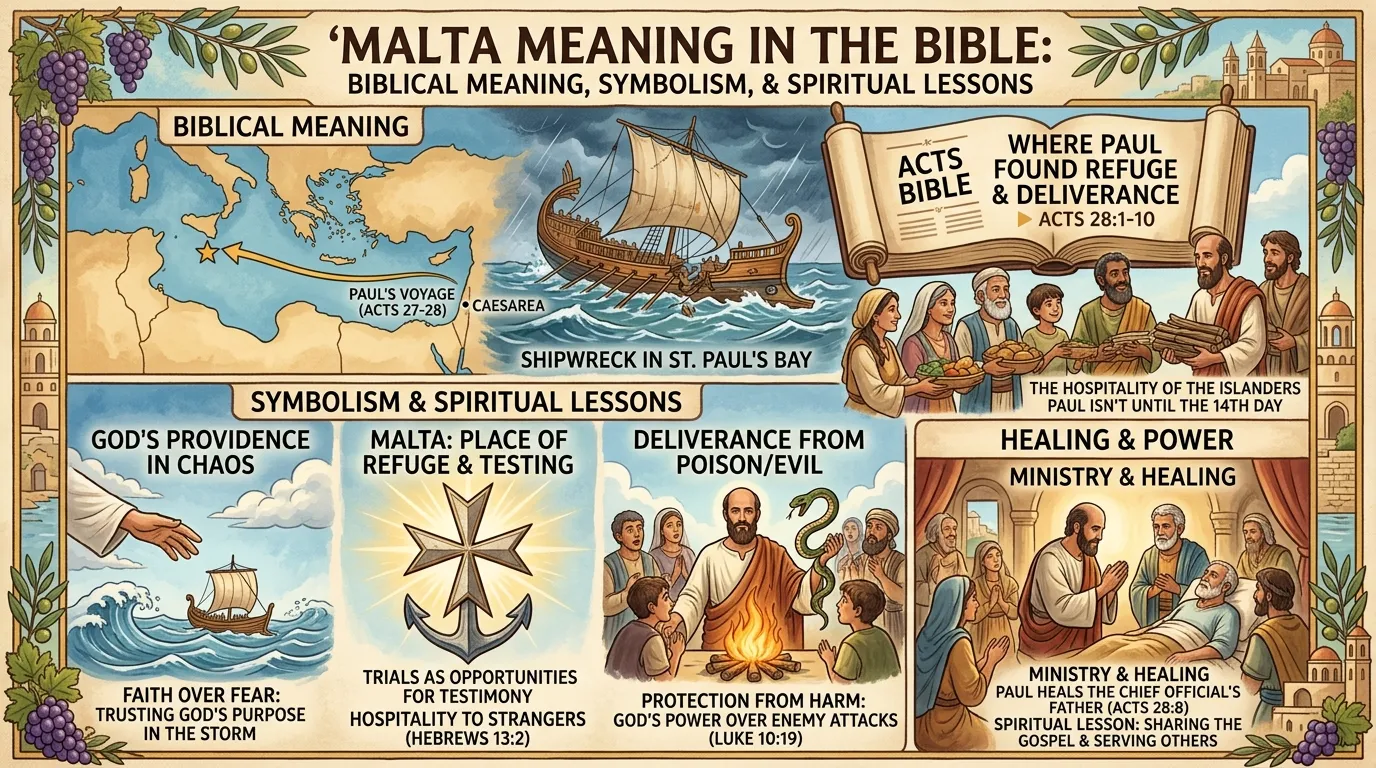
Paul reached Malta by accident. He had not planned to visit the island, had not booked passage there, and had no missionary strategy for it. He arrived clinging to wreckage after a two-week storm, one of 276 people who swam or floated ashore from a grain ship that had broken apart on a reef. And yet the island became the scene of one of the most warm-hearted chapters in Acts: a story of kindness from strangers, a snakebite that harmed no one, and healings that opened doors for the gospel. Malta’s meaning in the Bible is the story of what God does with an unplanned stop.
The Storm That Ended on a Beach
Acts 27 tells the voyage in vivid detail. Paul was traveling to Rome as a prisoner under a centurion named Julius, aboard a ship that sailed late in the season against Paul’s own warning. A violent northeaster, called the Euroclydon, caught the vessel and drove it helplessly across the Mediterranean for fourteen days. The crew threw cargo and tackle overboard. The passengers went without food. Hope of survival seemed gone.
Then Paul stood up with a message. An angel of God had told him that no life would be lost, though the ship would be wrecked, and that he must stand before Caesar (Acts 27:23-24). When the ship ran aground on a reef off Malta, every one of the 276 people aboard reached shore safely, just as God had promised. The ship was lost. The people were saved. Malta was where the promise became visible.
Unusual Kindness
Luke describes the islanders’ welcome with a phrase that has stuck in readers’ minds for two thousand years: they “showed us unusual kindness” (Acts 28:2). The people of Malta were not Romans or Jews. They spoke their own language and followed their own customs. Yet they built a fire for the soaked survivors and welcomed them in from the rain and cold. The word Luke uses for kindness is the same root from which we get “philanthropy,” love for humanity. It was practical hospitality: a fire, shelter, and a welcome for strangers who had nothing to offer in return.
Hospitality in the ancient world was a serious moral duty, but Luke’s point goes deeper. The people who showed Paul kindness were outsiders to the story. They did not know the gospel. They had no reason to care about a shipwrecked prisoner. Yet God used their decency as the first taste of grace the survivors experienced on land. Kindness from unexpected people is one of the recurring patterns of Acts: God keeps using the people His servants least expected.
The Snake and the Shifting Verdict
As Paul gathered sticks for the fire, a viper, driven out by the heat, fastened onto his hand. The islanders watched and drew the obvious conclusion: this man must be a murderer, and justice was catching up with him even though he had escaped the sea. When Paul shook the snake off into the fire and suffered no harm, they changed their minds in the opposite direction and decided he must be a god (Acts 28:3-6).
Both verdicts were wrong, and Luke seems to want us to notice. The islanders read Paul’s suffering and survival as instant moral judgments, first of guilt and then of divinity. Paul himself did not claim either. He simply went on with the work. The episode is a quiet warning against the habit of reading God’s verdict directly off someone’s circumstances. Suffering is not proof of hidden guilt, and survival is not proof of superhuman status. Paul was neither a murderer being punished nor a god to be worshiped. He was a man carrying a message, and God protected him so that the message could continue.
Healing on the Island
The leading man of the island, Publius, welcomed Paul’s party into his home for three days. Paul learned that Publius’s father lay sick with fever and dysentery. He went in, prayed, laid his hands on him, and healed him (Acts 28:8). The news spread, and other sick people on the island came to Paul and were healed as well. Luke, who was a physician, describes the illness with medical precision, a small detail that reminds us the author was paying attention.
The healings had a practical result. When the party finally left after three months, the islanders honored them and supplied everything they needed for the rest of the voyage (Acts 28:10). The shipwrecked prisoners had arrived with nothing. They left provisioned by the generosity of the people they had served. The story comes full circle: kindness received, kindness returned, provision given.
Malta and the Mission of Acts
Malta sits at a turning point in Acts. Paul is on his way to Rome, and the island is the last long stop before the capital. The episode shows that the gospel’s advance does not depend on plans and platforms. Paul did not choose Malta. He was shipwrecked there. Yet the months on the island became a ministry: healing, witness, and the building of relationships that ended in provision for the journey ahead.
There is also a larger pattern worth noticing. In Acts, the gospel keeps arriving in places through disruption: persecution scatters believers from Jerusalem, and the gospel spreads (Acts 8); a beating in Philippi leads to a jailer’s conversion; a shipwreck on Malta leads to healings. God does not waste the detours. The places His servants never intended to visit become part of the mission.
The Island After Paul
Malta’s Christian tradition traces itself back to this visit, and the island remains overwhelmingly Christian today. The bay where tradition says Paul came ashore is still called St. Paul’s Bay. Whether the traditional site is exact, the memory is real: a storm, a beach, a fire, a snake, and a season of healing left a mark on the island that has lasted two thousand years.
The Promise Before the Shipwreck
The Malta story begins before Malta, with a promise made in the middle of the storm. On the fourteenth night of the gale, when the crew had given up hope, Paul stood before the passengers and told them that an angel had stood by him and said, “Do not be afraid, Paul; you must stand before Caesar. And behold, God has granted you all those who sail with you” (Acts 27:24). The promise was specific: Paul would reach Rome, and everyone aboard would survive. The ship would be lost, but the people would be saved.
That promise reframes the whole Malta episode. The island was not a lucky accident. It was the place where God’s word came true. The survivors did not wash up on a random beach. They landed where the promise said they would land: alive, all 276 of them. Malta is the receipt for the promise, the place where the word spoken in the storm was cashed in on the shore. Christians who read the passage should notice the order: the promise came first, in the dark, before any sign of land. The fulfillment came later, on a beach they did not choose.
The Winter on Malta
Paul’s party spent three months on Malta, waiting out the winter before sailing on to Rome. Those months are easy to skip over, but they matter. The survivors did not simply pass through. They lived on the island through the cold season, built relationships, and ministered to the people. The healings Luke records were not a single afternoon’s work. They were the fruit of a winter spent among the islanders, of conversations, meals, and the slow building of trust.
The winter also shows that God’s provision is not always dramatic. The same God who calmed the fear in the storm also provided three months of shelter, food, and hospitality through ordinary islanders. The fire on the beach, the home of Publius, and the supplies for the onward journey were all ordinary provisions, and all of them were grace. The Malta story holds both kinds of provision together: the spectacular promise in the storm and the quiet hospitality of a winter.
Malta and the Journey to Rome
After three months on Malta, Paul’s party boarded a ship from Alexandria that had wintered on the island and sailed for Rome, stopping at Syracuse, Rhegium, and Puteoli (Acts 28:11-13). The islanders’ generosity followed them: they honored Paul’s party and supplied everything needed for the voyage. The journey that had begun with a storm and a shipwreck ended with provision and a welcome on the Appian Way. Malta was the hinge between the two halves of the voyage: the half defined by disaster and the half defined by welcome. The island that had received shipwrecked strangers sent them onward as honored guests.
There is a symmetry worth noticing. Paul arrived on Malta with nothing, clinging to wreckage. He left with supplies, honor, and the memory of a winter spent healing the sick. The God who had promised that no life would be lost kept His word, and He did more than keep it. He turned the detour into a ministry and the shipwreck into a season of service. Malta is the proof that God’s provision is not merely sufficient. It is abundant.
For Christians reading the passage today, Malta offers a word for the seasons that feel like shipwreck. The storm may have destroyed the plan. The island may not be the destination you chose. But the promise Paul carried applies beyond his voyage: God is present in the detour, and the detour may hold kindness, healing, and purpose you could not have planned. The island’s geography, history, and long Christian tradition are described in the Wikipedia article on Malta.










