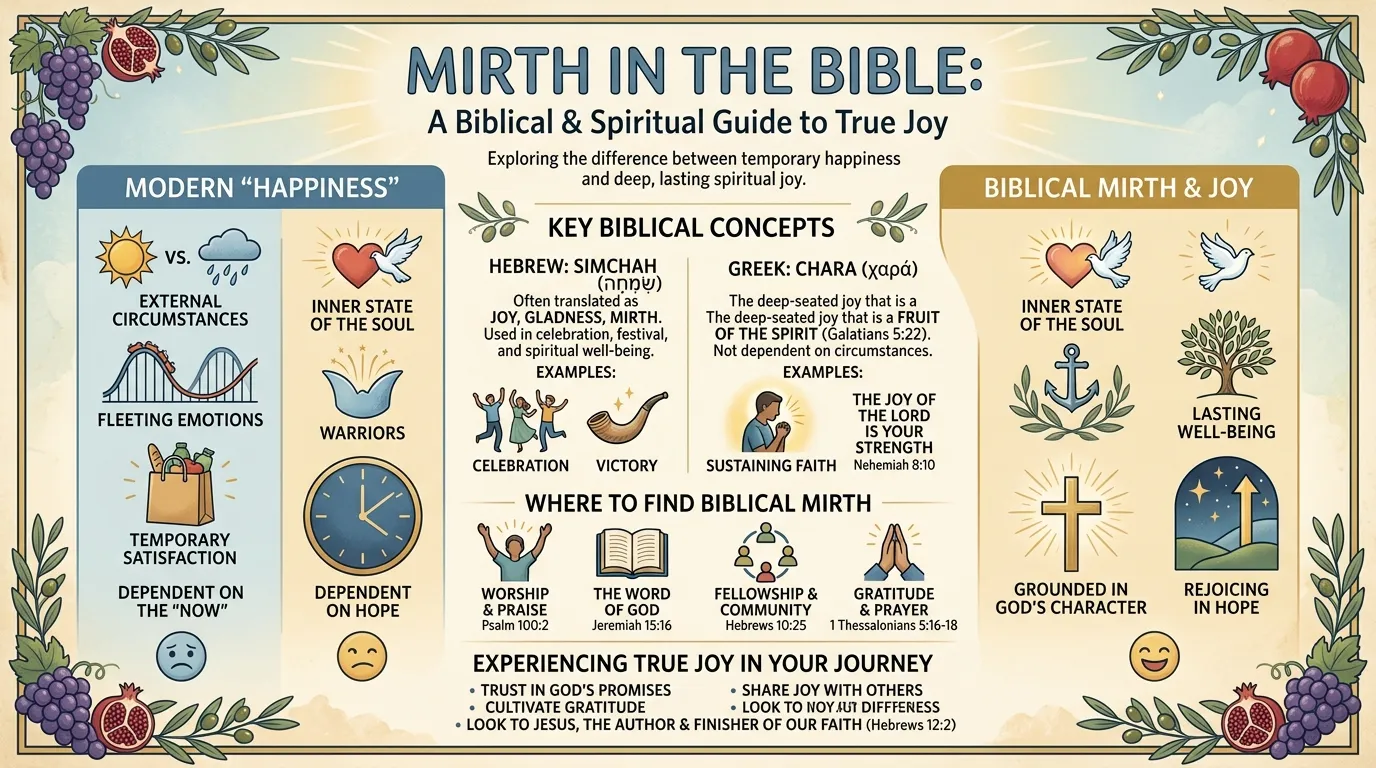
It is one of the loveliest old words in the English Bible — mirth. It sounds like laughter in a sunlit room, and that is not far off: mirth is joy made audible, gladness that bubbles over into laughter, song, and celebration. The Bible uses the concept often, though our modern translations sometimes render it as joy, gladness, or merriment. Tracing mirth through Scripture reveals something Christians urgently need: a theology of laughter — when God laughs, when His people should, and when merriment curdles into mockery.
Mirth in the Old Testament: The Sound of God’s People
The Hebrew vocabulary of joy is exuberant. Simchah (joy, gladness, mirth) appears over a hundred times, covering everything from harvest festivals to wedding feasts to worship. When the exiles returned and the foundation of the new temple was laid, the sound was unmistakable: “the people shouted with a great shout… so that the sound was heard far away” — weeping and rejoicing mingled so no one could distinguish them (Ezra 3:12-13). That mingled sound is biblical mirth: joy deep enough to weep and strong enough to shout.
Consider the festivals God commanded. The Feast of Tabernacles: “you shall rejoice before the LORD your God seven days” (Leviticus 23:40; Deuteronomy 16:14-15). Rejoicing was not optional garnish on worship; it was legislated. God ordered His people to feast, to laugh, to be merry — because joy is the appropriate response to redemption, and commanded joy trains the heart the way commanded rest trains the body. A religion with no mirth is a religion that has forgotten its rescue.
The Psalms make mirth a weapon against despair: “Then our mouth was filled with laughter, and our tongue with shouts of joy” (Psalm 126:2) — the song of returned exiles, laughing at the impossibility of their own restoration. And Isaiah’s vision of the redeemed: “everlasting joy shall be upon their heads; they shall obtain gladness and joy, and sorrow and sighing shall flee away” (Isaiah 35:10). Mirth, in the prophets, is eschatological — a down payment of the laughter of the new creation.
When God Laughs: The Bible’s Boldest Image of Mirth
Scripture dares to picture God laughing — and the contexts are instructive. Psalm 2:4: “He who sits in the heavens laughs; the Lord holds them in derision.” The nations rage, the kings plot against the LORD and His Anointed — and heaven’s response is laughter. Not anxious laughter, not cruel laughter, but the settled mirth of absolute sovereignty: the rebellion is so futile, so outmatched, that the only fitting response is a laugh. Divine mirth is the sound of evil’s impotence.
But there is another laughter of God — warmer. When Sarah, ninety years old, heard she would bear a son, “Sarah laughed” in disbelief (Genesis 18:12) — and God named the child Isaac, “he laughs.” Every time Israel said the patriarch’s name for two thousand years, they said laughter. God took Sarah’s skeptical laugh and turned it into a memorial of joy: “God has made laughter for me; everyone who hears will laugh over me” (Genesis 21:6). Divine mirth redeems human doubt — the laugh of disbelief becomes the laugh of delight.
Ecclesiastes and the Wisdom of Laughter
No book treats mirth more carefully than Ecclesiastes. “A time to weep, and a time to laugh; a time to mourn, and a time to dance” (Ecclesiastes 3:4) — laughter has its season, which means it also has its limits. The Preacher warns against the laughter of fools: “For as the crackling of thorns under a pot, so is the laughter of the fools” (Ecclesiastes 7:6) — loud, quick, producing heat but no lasting warmth. Empty merriment — the laugh that covers hollowness — is vanity.
Yet the same book commends true mirth: “I commend joy, for man has nothing better under the sun but to eat and drink and be joyful” (Ecclesiastes 8:15) — not hedonism but gratitude: receiving God’s ordinary gifts (food, work, companionship) with a merry heart as from His hand. And Proverbs adds the physiology of joy: “A joyful heart is good medicine” (Proverbs 17:22), “a cheerful heart has a continual feast” (Proverbs 15:15). Scripture knew millennia before medicine confirmed it: mirth heals.
The wisdom line is clear: laugh often, but laugh at the right things. Laugh with the redeemed (Psalm 126:2), laugh at the impossibility of grace (Genesis 21:6), laugh in the face of futile evil (Psalm 2:4) — but never laugh at the broken (that is scoffing), never laugh to escape reality (that is the fool’s crackling thorns), and never let laughter replace repentance when repentance is due.
Mirth in the New Testament: Joy as Command
The New Testament turns joy from a festival into a standing order. “Rejoice in the Lord always; again I will say, rejoice” (Philippians 4:4) — written by Paul from prison. “Always” includes chains. This is mirth as defiance: the Christian laughs not because circumstances are funny but because Christ is risen. Nehemiah’s old word still stands: “the joy of the LORD is your strength” (Nehemiah 8:10) — mirth is not the result of strength; it is the source of it.
Jesus Himself promised it: “These things I have spoken to you, that my joy may be in you, and that your joy may be full” (John 15:11). My joy in you — Christ’s own gladness, transplanted into believers. The mirth of the Christian is not manufactured cheerfulness but shared joy — the laughter of the Son echoing in the children. And at the wedding in Cana, Jesus’ first miracle protected a celebration’s mirth, turning water to wine so the feast wouldn’t end in embarrassment (John 2:1-11). The Lord who made the wine is not the enemy of merriment; He is its guardian.
Guarding the Gift: Mirth vs. Mockery
Every gift has a counterfeit, and mirth’s is mockery — laughter aimed downward at others rather than upward at grace. Scripture draws the line sharply. The “scoffer” is Proverbs’ stock villain: “A scoffer does not like to be reproved” (Proverbs 15:12); scoffers “set a city aflame” (Proverbs 29:8). The blessed person “sits not in the seat of scoffers” (Psalm 1:1) — the seat, the settled posture of cynical laughter. In the last days, Peter warns, “scoffers will come… following their own sinful desires” (2 Peter 3:3).
The test is direction: mirth laughs with; mockery laughs at. Mirth includes the outsider in the joke; mockery makes the outsider the joke. Mirth can laugh at oneself — the healthiest laughter of all, the sound of humility. Mockery cannot, because it needs a target beneath it. Guard your laughter: let it be the kind heaven joins (Psalm 2:4; Luke 15 — heaven rejoices over one sinner who repents, and rejoicing is mirth’s twin).
The Feast to Come: Mirth’s Future
Biblical mirth is not only memory and present command — it is prophecy. Jesus pictured the kingdom as a banquet: “many will come from east and west and recline at table with Abraham, Isaac, and Jacob in the kingdom of heaven” (Matthew 8:11). His parables return to the feast again and again — the great banquet with the hall filled (Luke 14:15-24), the wedding feast where the Bridegroom arrives (Matthew 25:1-13). The Bible’s final party scene is Revelation 19: the marriage supper of the Lamb, where “blessed are those who are invited” (Revelation 19:9).
This means every godly laughter now is a rehearsal. The wedding reception’s joy, the reunion’s laughter, the table’s merriment among believers — these are not distractions from the kingdom but foretastes of it. C.S. Lewis captured it: our present joys are “the scent of a flower we have not found, the echo of a tune we have not heard.” Mirth is homesickness for heaven expressed as gladness — the heart recognizing, in earthly joy, the accent of its native country.
So laugh as a confession: every genuine mirth declares “the best is yet to come.” The world laughs to forget; the Christian laughs to remember — to remember that sorrow and sighing will flee away (Isaiah 35:10), that God will wipe every tear (Revelation 21:4), and that the eternal feast is being prepared. Until then, let the rehearsals be hearty. Heaven is practicing its laughter in you.
Is it okay for Christians to laugh and have fun?
Not just okay — commanded. God legislated festivals of joy, filled mouths with laughter at restoration, and orders rejoicing “always.” Gloom is not godliness; the dour Christian misrepresents the God of Psalm 126. Fun that is clean, kind, and grateful is worship in play clothes.
What about humor that mocks others?
That’s not mirth; that’s scoffing, and Scripture condemns it (Psalm 1:1; Proverbs). The rule: punch up at folly and evil if you must punch at all — never down at the vulnerable. And the safest humor of all is self-deprecating: the laugh that says “I’m a redeemed fool, and I know it.”
Mirth is heaven’s soundtrack leaking into earth: the laugh of Sarah turned to joy, the shout of exiles home at last, the rejoicing commanded in every season. Laugh deeply, laugh gratefully, laugh with — for the God who laughs at evil’s futility invites His children to share the joke. On laughter itself, see laughter.