Babylon is the only empire in the Bible that is both a place and a symbol. It was a real city on the Euphrates, with real walls, real kings, and a real army that destroyed Jerusalem. It was also a word that the Bible uses to mean something larger: human pride, worldly power, opposition to God, and the seductive beauty of a world that forgets its Maker. No other empire in Scripture carries this double weight. To understand Babylon, we need to follow both threads — the city that exiled Judah, and the symbol that haunts the rest of the Bible, from Genesis to Revelation.
The city: Nebuchadnezzar and the Exile
Babylon was one of the oldest and greatest cities in the ancient world, situated on the Euphrates River in what is now Iraq. Under King Nebuchadnezzar II (reigned 605–562 BC), it became the capital of an empire that stretched from the Persian Gulf to the Mediterranean. Nebuchadnezzar was a builder as well as a conqueror: he rebuilt Babylon’s walls, temples, and palaces, and tradition credits him with the Hanging Gardens, one of the Seven Wonders of the Ancient World. The city’s Ishtar Gate, with its blue glazed bricks and animal reliefs, was a monument to imperial glory.
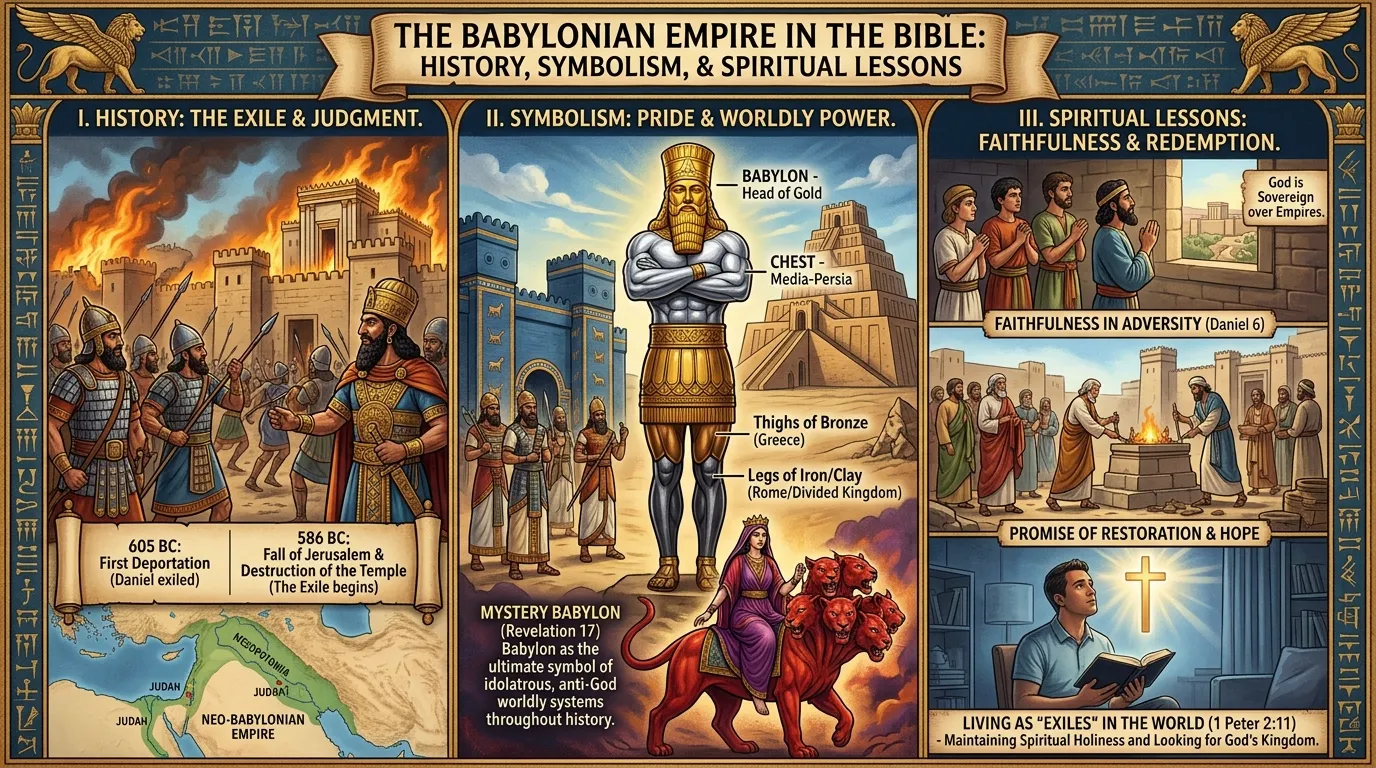
Nebuchadnezzar’s conquests brought him to Jerusalem. In 597 BC he deported King Jehoiachin and the city’s elite. In 586 BC, after a rebellion by Zedekiah, he destroyed Jerusalem, burned the temple, and deported the population to Babylon. The Exile was the most traumatic event in Israel’s history. The temple was gone. The king was gone. The land was gone. The psalmists sang, “By the rivers of Babylon we sat and wept when we remembered Zion” (Psalm 137:1). The question of the Exile was the question of faith itself: had God abandoned His people?
Daniel in Babylon: faith in the enemy’s capital
The Book of Daniel is the story of faithfulness in Babylon. Daniel and his friends — Hananiah, Mishael, and Azariah — were among the young men deported to Babylon, trained in the king’s court, and given Babylonian names. They refused to eat the king’s food, refused to worship the king’s image, and refused to stop praying to God — even when the penalty was a furnace or a lions’ den. God delivered them from both.
Daniel’s visions also interpret Babylon’s place in history. In Nebuchadnezzar’s dream, Babylon is the head of gold on a statue of successive empires (Daniel 2). In Daniel’s own vision, Babylon is a lion with eagle’s wings (Daniel 7). The images are not flattering. Babylon is glorious — gold, wings, splendor — but it is also beastly, temporary, and doomed. The statue will be smashed by a stone “cut out of a mountain, but not by human hands” (Daniel 2:34). The beasts will be judged, and the kingdom will be given to “one like a son of man” (Daniel 7:13–14). Babylon’s glory is real, but it is not eternal.
Nebuchadnezzar’s madness: the pride of kings
The most vivid Babylonian story in the Bible is Nebuchadnezzar’s madness. Walking on the roof of his palace, the king boasts, “Is not this the great Babylon I have built as the royal residence, by my mighty power and for the glory of my majesty?” (Daniel 4:30). Immediately, a voice from heaven announces his judgment. He is driven from his throne, lives like an animal, and eats grass for seven years, until he acknowledges that “the Most High is sovereign over all kingdoms on earth” (Daniel 4:32). When his sanity returns, he praises God: “His dominion is an eternal dominion; his kingdom endures from generation to generation” (Daniel 4:34).
The story is the Bible’s portrait of pride. Nebuchadnezzar’s sin was not that he built a great city. It was that he believed he had built it by himself, for himself. Pride is the original sin of Babylon — the belief that human power is self-made, self-sufficient, and self-glorifying. God’s response is not to destroy Nebuchadnezzar but to humble him, and the humbling works. The king who boasted of his glory ends by praising God’s glory. Babylon’s greatest king becomes a witness to God’s sovereignty.
The fall of Babylon: weighed and found wanting
Babylon fell in 539 BC to the Persian king Cyrus, in a single night. The Book of Daniel tells the story of Belshazzar’s feast: the king, drunk and defiant, uses the temple’s sacred vessels to toast his gods, and a hand appears and writes on the wall: “Mene, Mene, Tekel, Parsin” — numbered, weighed, divided (Daniel 5:25–28). That night, Babylon fell. The empire that had destroyed Jerusalem was itself destroyed. The city that had seemed eternal lasted less than a century as an imperial power.
The fall of Babylon became the Bible’s pattern for the fall of every proud power. The prophets used it to warn other nations. The apostles used it to encourage persecuted Christians. The message is consistent: no empire, however glorious, is permanent. God weighs the nations, and He finds them wanting.
Babylon as a symbol: from Babel to Revelation
Babylon’s symbolic career begins in Genesis 11, with the Tower of Babel — the city where humanity tried to make a name for itself by building a tower to heaven. God confused their language and scattered them. The name “Babel” sounds like the Hebrew word for “confused.” From the beginning, Babylon represents humanity’s attempt to reach heaven by its own efforts, to build a city without God.
The symbol runs through the prophets. Isaiah pronounces an oracle against Babylon. Jeremiah predicts its fall. And in Revelation, Babylon reappears as “Babylon the Great, the Mother of Prostitutes and of the Abominations of the Earth” (Revelation 17:5) — a symbol of the world’s seductive, persecuting power, drunk with the blood of the saints. John’s Babylon is widely understood as a coded reference to Rome, the empire persecuting the church. But the code works because Babylon is the archetype: every empire that opposes God is Babylon.
Revelation 18 sings a funeral song over Babylon: “Fallen! Fallen is Babylon the Great!” The merchants weep, the kings mourn, and heaven rejoices. The fall of Babylon is the Bible’s final word on human empire: it will end, and God’s kingdom will remain.
Jeremiah’s letter to the exiles: building a life in Babylon
The most practical Babylonian passage in the Bible is Jeremiah’s letter to the exiles. The people in Babylon expected a quick return. False prophets promised that the Exile would last two years. Jeremiah told them the truth: it would last seventy years — a lifetime. And he gave them astonishing instructions: “Build houses and settle down; plant gardens and eat what they produce. Marry and have sons and daughters… Also, seek the peace and prosperity of the city to which I have carried you into exile. Pray to the LORD for it, because if it prospers, you too will prosper” (Jeremiah 29:5–7). The exiles were not to withdraw, revolt, or wait passively. They were to build, plant, marry, and pray — to live faithfully in a foreign city, trusting that God had a plan for them there. The letter is the Bible’s charter for life in exile, and it applies to every Christian who lives in a culture that is not their home. Build. Plant. Pray. Seek the city’s good. And trust that God is working, even in Babylon.
Babylon also left a linguistic legacy. The exiles in Babylon learned Aramaic, the empire’s lingua franca, and Aramaic became the common language of Judea in Jesus’ day. Some of Jesus’ most famous words — “Talitha koum,” “Eloi, Eloi, lema sabachthani” — are Aramaic. The Exile shaped the language Jesus spoke. Even the empire that destroyed the temple contributed, unwillingly, to the world in which the Savior would speak.
What Babylon means for Christians
Babylon warns Christians about the seduction of success. Babylon was beautiful — wealthy, cultured, powerful, impressive. Its danger was not its ugliness but its attractiveness. The world’s power is seductive because it offers what only God can give: security, significance, and glory. Christians who chase the world’s version of these things will find, like Nebuchadnezzar, that they are grass — here today, gone tomorrow.
Babylon also comforts Christians who live in exile. The exiles in Babylon were told by Jeremiah to “seek the peace and prosperity of the city to which I have carried you into exile. Pray to the LORD for it, because if it prospers, you too will prosper” (Jeremiah 29:7). Christians are exiles in this world, living in a culture that is not their home. The call is not to withdraw or to conquer, but to seek the city’s good, to pray for it, and to trust that God is sovereign even in Babylon.
Finally, Babylon gives Christians hope. The empire that destroyed the temple is gone. The temple it destroyed was rebuilt. The people it exiled returned. And the kingdom it opposed — the kingdom of God — has outlasted it by two thousand years and will outlast every empire that follows. Babylon falls. The kingdom remains.
For the city’s archaeology, its kings, and its place in Mesopotamian history, the Wikipedia article on Babylon is a thorough resource.