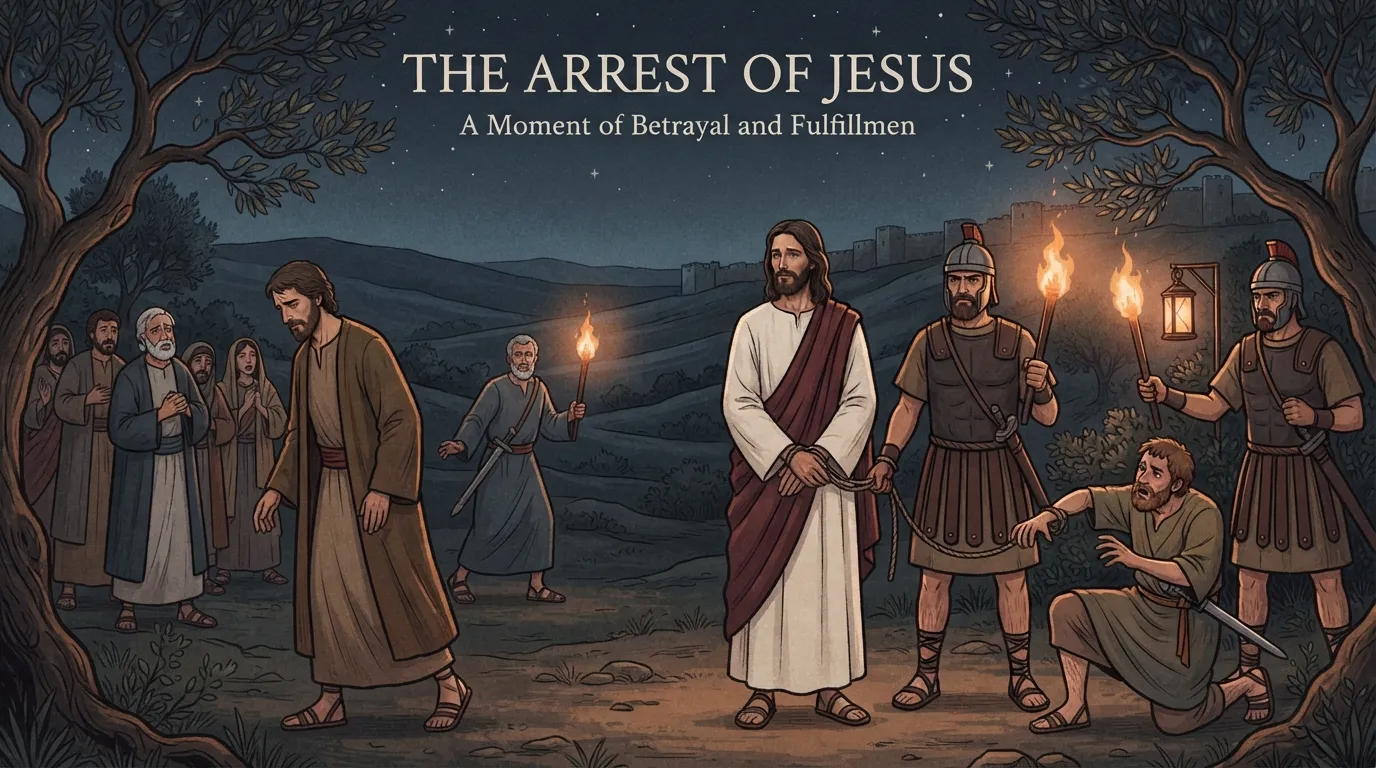
Imagine watching someone you love being taken away unfairly. You know they have done nothing wrong, yet there is nothing you can do to stop it. Fear rises. Questions fill your mind. Why is God allowing this? Where is justice? Why does a faithful person have to suffer? This emotional scene helps us understand the arrest of Jesus meaning in the Bible. Jesus was arrested in the Garden of Gethsemane, not because He had committed a crime, but as part of the events leading to His crucifixion. His arrest became a major moment in God’s plan of redemption. Matthew 26, Mark 14, Luke 22, and John 18 each describe the arrest from different perspectives. The story teaches that God can remain in control even when circumstances look completely out of control. It reveals Jesus’ willingness to surrender Himself, His love for humanity, the seriousness of sin, and the path from suffering to redemption.
Night in the Garden: Prayer Before the Arrest
Jesus’ arrest took place at Gethsemane, after He had shared the Last Supper with His disciples. Jesus knew that His enemies were coming. In Matthew 26:36–46, He went into the garden to pray. His prayer shows the depth of His human sorrow as He faced what was coming. Jesus prayed that, if possible, the cup of suffering might pass from Him. Yet He submitted Himself to the Father’s will, saying, “not as I will, but as you will” (Matthew 26:39).
The Gospel accounts show that Jesus experienced profound distress before His arrest. In Gethsemane, Matthew 26:37–38 describes Him as deeply sorrowful and troubled. Luke 22:44 describes the intensity of His anguish as He prayed. This matters because it shows that faith does not mean having no difficult emotions. Jesus’ obedience happened in the presence of sorrow. For Christians, this is deeply comforting: you can feel afraid and still pray. You can feel overwhelmed and still trust God. You can have questions and still continue walking in faith.
Gethsemane may be one of the most relatable places in the final hours of Jesus’ earthly ministry. Jesus prayed honestly. He expressed His sorrow. He brought His desire before the Father. Then He surrendered Himself to God’s will. That gives Christians a healthy pattern for prayer. You do not have to hide your feelings from God. You can tell Him that something hurts. You can ask for another outcome. You can admit that you are afraid. Then, like Jesus, you can seek the strength to trust God’s wisdom.
The Kiss: Betrayal by a Friend
Soon afterward, Judas arrived with an armed crowd. Judas identified Jesus with a kiss, giving the authorities a clear sign of whom they should arrest. Judas had spent years with Jesus as one of His disciples, yet he eventually agreed to identify Jesus to those who wanted to arrest Him. Matthew 26:14–16 describes Judas agreeing to hand Jesus over for money. Later, he identified Jesus with a kiss. The contrast is painful. A kiss normally represents affection, but Judas used it as a signal of betrayal.
This reminds Christians that closeness to religious things does not automatically produce a faithful heart. A person can attend church, know Bible stories, or appear outwardly religious while still making choices that turn away from God. At the same time, Judas’ failure should not become an excuse for Christians to live in constant suspicion of everyone around them. Instead, it encourages honest self-examination.
Betrayal can make a person question everything. A trusted friend may leave. A family member may disappoint you. Someone you supported may turn against you. Jesus understands this kind of pain. Judas was not an anonymous stranger. He was one of Jesus’ disciples. Yet Jesus did not allow Judas’ betrayal to determine His identity or stop His mission. For believers, this is an important reminder: another person’s betrayal does not cancel God’s purpose for your life. It may take time to heal, and forgiveness does not require pretending that harmful actions were acceptable. But Christians can bring betrayal to God and ask Him for wisdom about boundaries, forgiveness, and restoration.
The Sword: Peter’s Reaction
Peter responded very differently. When the crowd came to arrest Jesus, Peter drew a sword and struck the servant of the high priest, cutting off his ear (John 18:10). Jesus immediately stopped the violence. In Matthew 26:52, Jesus told Peter to put his sword away. Luke 22:51 records that Jesus healed the wounded servant.
This moment reveals something important about Jesus’ kingdom. Jesus did not establish His mission through violence. Peter wanted to defend Jesus physically, but Jesus chose obedience to the Father’s purpose. For modern Christians, this can be a powerful lesson when emotions become intense. Anger can make us want to fight, react, or prove ourselves. Jesus demonstrates another way: truth, self-control, courage, and trust in God. In John 18:11, Jesus told Peter to put away his sword and spoke of the “cup” that the Father had given Him.
The Surrender: Authority in Chains
It may seem strange to call Jesus’ arrest a demonstration of His authority, but John’s Gospel especially emphasizes this point. In John 18:4–6, Jesus asked whom they were seeking. When they answered, “Jesus of Nazareth,” Jesus identified Himself. The passage describes the group drawing back and falling to the ground. The arrest was therefore not presented as Jesus being helpless or accidentally caught. Jesus knowingly allowed Himself to be taken.
Jesus then allowed Himself to be taken. This creates a powerful biblical contrast: Jesus had authority, yet He chose humility. Philippians 2:6–8 later describes Christ’s humility, explaining that He humbled Himself and became obedient even to death on a cross. Therefore, Jesus’ arrest is not simply a story about someone losing control. It is part of the story of the Son willingly entering suffering for the sake of others. John 10:18 emphasizes that Jesus’ life was not simply taken from Him. He described Himself as laying it down willingly.
Jesus allowed Himself to be arrested because His mission was moving toward the cross. Earlier, Jesus had repeatedly spoken about His coming suffering and death. Mark 10:45 summarizes the purpose of His mission by describing the Son of Man giving His life as a ransom for many. From the Christian understanding of Scripture, the arrest was not an unexpected interruption of God’s plan. It was part of the road to crucifixion and resurrection.
Why Was He Arrested?
The immediate reason for Jesus’ arrest was the opposition of religious leaders who viewed His teaching and claims as dangerous and threatening. The Gospels show that hostility toward Jesus had been growing for some time. His teachings challenged hypocrisy, His authority drew large crowds, and His actions exposed the spiritual failures of people who claimed religious authority.
But the Bible gives a deeper explanation. Jesus’ arrest was connected to the events leading to His death on the cross, where Christians believe He gave His life for the sins of humanity. Acts 2:23 later explains that Jesus was handed over according to God’s “definite plan and foreknowledge.” This does not mean the people involved were innocent. Scripture still presents betrayal, false accusations, and injustice as morally serious actions. The biblical picture holds two truths together: human beings made sinful choices, and God was still working through those events to accomplish His redemptive purpose. This is one of the most important lessons in the arrest of Jesus.
The phrase “arrest of Jesus” does not have an original Hebrew wording in the New Testament, because the New Testament was written primarily in Greek. The Gospel writers use Greek words to describe Jesus being seized, taken into custody, or arrested. But the Hebrew Scriptures provide important background. A relevant Hebrew concept is ‘asar, a verb associated with binding, restraining, or imprisoning. The idea of being bound or taken into custody appears throughout the Hebrew Bible. This background helps connect Jesus’ arrest with the broader biblical theme of the innocent suffering under human authority. Isaiah 53 is especially important for Christian interpretation: Isaiah describes the suffering servant who is oppressed and led like a lamb to the slaughter. Christians have traditionally understood this passage as pointing forward to Jesus’ suffering and sacrificial death. The Hebrew background should not be treated as proof that every detail of Jesus’ arrest was directly encoded in one Hebrew word. The clearest meaning comes from the Gospel accounts themselves and the wider teaching of Scripture.
What the Arrest Teaches
One of the clearest meanings of Jesus’ arrest is willing surrender to God’s will. Jesus knew what awaited Him. He understood that arrest would lead toward suffering and death. Yet He did not run away. Luke 22:42 records His prayer: “Not my will, but yours, be done.” This does not show weakness. It shows obedience. Jesus’ surrender teaches Christians that faith does not always mean understanding everything that happens. Sometimes faith means trusting God while walking through something painful. The lesson is not that Christians should accept every harmful situation without wisdom. Rather, the story shows the value of trusting God while remaining faithful to what is right.
Beyond the historical event, Christians often see several spiritual lessons. Jesus chose obedience: He did not enjoy suffering, and His prayer in Gethsemane makes that clear — yet He remained obedient. Obedience can exist alongside fear and sorrow; being afraid does not automatically mean a person lacks faith. Jesus faced injustice without abandoning His mission: He was treated unfairly, yet He continued toward the cross. The Bible does not promise that every wrong will immediately be corrected, but Scripture repeatedly points believers toward God’s ultimate justice. Jesus shows the meaning of sacrificial love: His arrest was the beginning of the final events leading to His crucifixion, and His arrest belongs to the larger Christian message of sacrificial love and redemption. And God can work through dark seasons: the disciples probably did not understand everything happening that night, yet what looked like defeat became part of the path toward resurrection. That gives Christians reason to maintain hope when they cannot yet see the outcome of a difficult season.
The arrest of Jesus contains practical lessons for everyday faith. Pray before reacting: Jesus prayed in Gethsemane before the arrest. Prayer did not remove the difficult situation, but it strengthened His submission to God’s will. Do not let fear control your choices: Jesus experienced deep distress but remained faithful. Avoid revenge: Jesus stopped Peter from responding violently and even healed the wounded servant. Remember that appearances can be misleading: the arrest looked like Jesus’ defeat, yet the Christian Gospel understands it as part of God’s redemptive plan. Trust God’s character: when circumstances are confusing, Christians can return to what Scripture clearly reveals about God’s goodness, justice, mercy, and faithfulness.
The story can also speak to situations that do not involve dreams or courts. Perhaps you have watched someone innocent receive blame. Maybe a friend was betrayed. Perhaps you have felt powerless while someone you love went through suffering. In such moments, the arrest of Jesus reminds Christians that God sees injustice and suffering. Jesus understands betrayal. He understands fear. He understands what it means to be falsely accused and treated unjustly. This does not mean every painful experience has exactly the same purpose as Jesus’ suffering — Jesus’ death has a unique place in Christian salvation history. But His experience can still encourage believers to bring their pain honestly before God.
The arrest of Jesus reaches far beyond the moment soldiers came to Gethsemane. It reveals a Savior who faced betrayal, fear, injustice, and suffering while remaining obedient to the Father. The disciples saw a terrible night. Yet God was working through events they could not fully understand. That truth can encourage you today. When your circumstances feel confusing, remember that God’s silence does not mean God’s absence. When you face unfair treatment, remember that Jesus understands suffering. When fear rises, follow His example of bringing your heart honestly to God in prayer. The arrest of Jesus ultimately points toward the cross and resurrection, where the Christian message of redemption, grace, forgiveness, and hope becomes clear. You may not know what God is doing in every season of your life. But you can continue to seek Him, read His Word, pray for wisdom, and trust His character. What looks like the end may not be the end. Keep walking with God, even when you cannot yet see where the road leads. For a fuller account of that night in Gethsemane — the Gospel narratives, their differences, and their place in the Passion story — the Wikipedia article on the arrest of Jesus gathers the evidence in one place.










