The Bible tells many family stories. Some show faith, while others show the pain caused by sin. The genealogy of Cain is one of the most striking family records in Genesis. It begins after Cain killed his brother Abel and was sent away from the presence of the Lord.
At first, a list of names may seem hard to understand. Why did the Bible preserve these names? What does Cain’s family line teach us about God, sin, human choices, and spiritual growth?
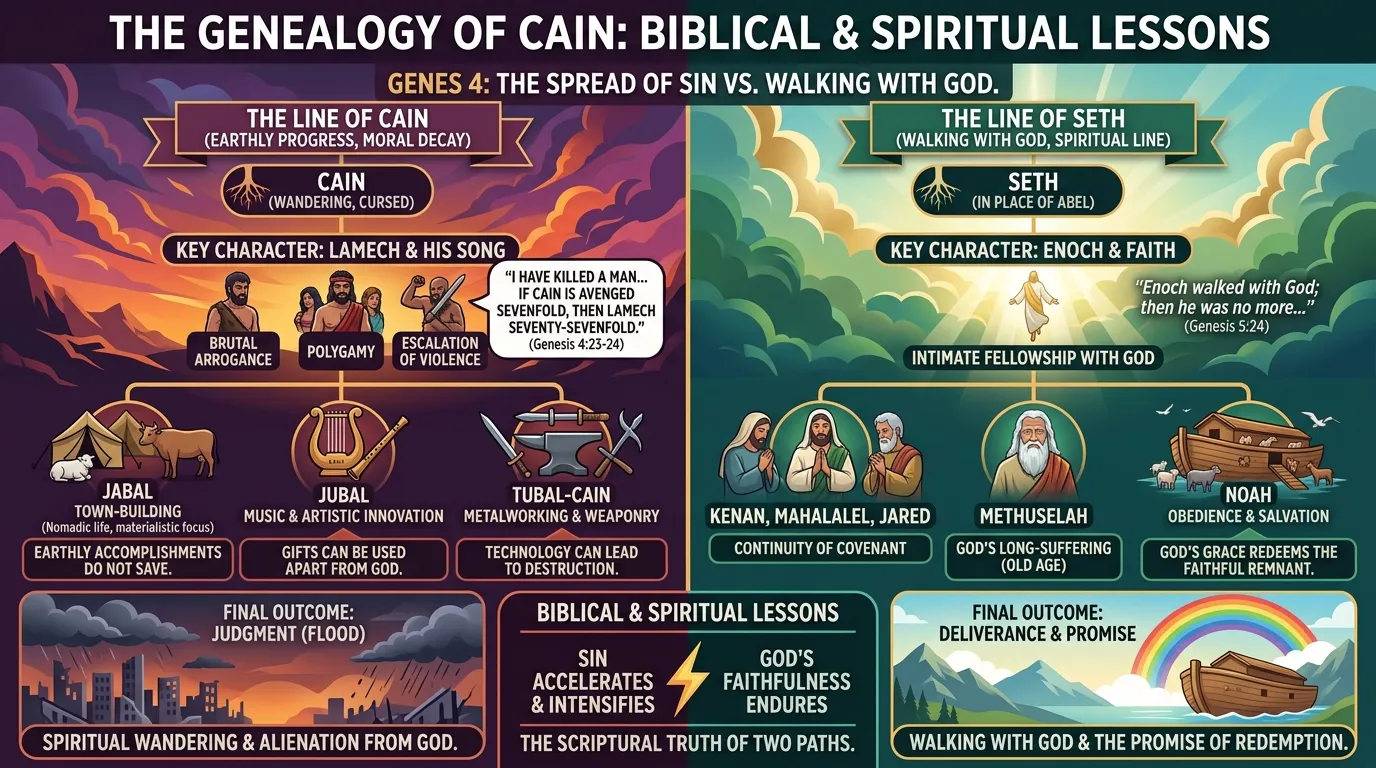
The Genealogy of Cain meaning in the Bible is not simply a list of people. It gives us a picture of human life developing in a world deeply affected by sin. Cain’s descendants built cities, raised families, created tools, and developed music and farming. Yet the story also shows how violence and pride can grow when people move away from God.
This does not mean that every descendant of Cain was personally evil. The passage does not say that. Instead, the genealogy helps us see both human creativity and human brokenness.
Genesis 4 gives us this family line, while Genesis 5 gives another genealogy through Adam’s son Seth. When we read both chapters together, an important biblical message becomes clear: human achievement cannot replace fellowship with God.
Let us look closely at what Scripture teaches.
Biblical Meaning of the Genealogy of Cain
The genealogy of Cain appears mainly in Genesis 4:17–24. It begins with Cain and continues through several generations:
Cain → Enoch → Irad → Mehujael → Methushael → Lamech
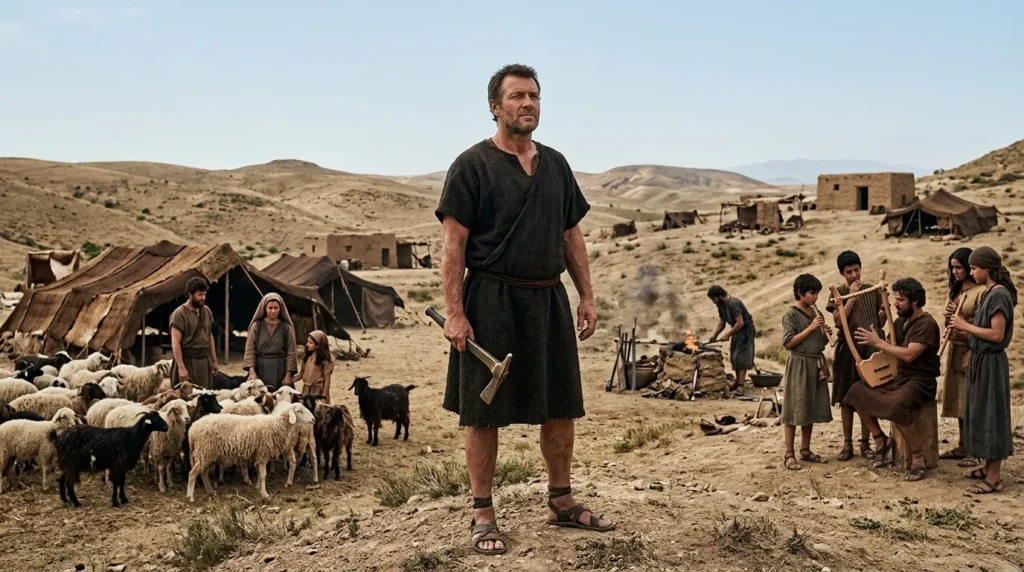
The genealogy then gives information about Lamech’s family. Lamech had two wives, Adah and Zillah. His children included Jabal, Jubal, Tubal Cain, and a daughter named Naamah.
Cain’s Family Line Shows the Spread of Human Life
Cain was the first son of Adam and Eve mentioned in Scripture. Genesis 4:1 says Eve named him Cain because she had received a son with the Lord’s help.
Later, Cain killed Abel because of jealousy and anger. God judged Cain, and Cain went away from the Lord’s presence.
Yet Cain continued to live. He had a son named Enoch and built a city named after him.
This teaches us something important. God’s judgment did not mean that human life stopped. Cain’s family continued to grow.
The genealogy shows families, cities, work, music, farming, and metalworking. Human beings continued to develop even in a fallen world.
Human Creativity Is Part of the Story
Genesis 4:20–22 mentions several important developments.
Jabal became associated with those who lived in tents and raised livestock. Jubal became associated with those who played the lyre and pipe. Tubal Cain became skilled in working bronze and iron.
These verses show that people had skills, creativity, work, and culture.
The Bible does not say that music, farming, building, or technology were evil. Instead, the passage reminds us that human ability can exist even in a world damaged by sin.
A person can be talented and still need God.
A society can become advanced and still have a deep spiritual problem.
That is one of the strongest lessons in the genealogy.
Lamech Shows the Danger of Violence
The final part of Cain’s genealogy becomes darker.
Lamech tells his wives that he killed a man who wounded him. He then boasts about his revenge in Genesis 4:23–24.
This is important because Lamech’s words show an increase in violence.
Cain killed Abel. Lamech speaks proudly about killing someone who hurt him.
The passage therefore shows how sin can grow when it is not confronted.
Anger can become revenge.
Revenge can become violence.
Pride can make violence seem like strength.
The genealogy does not present this as something to admire. It presents it as a warning.
The Genealogy Is Not a Teaching That Cain’s Descendants Were All Evil
It is important to avoid a common misunderstanding.
The Bible does not say that every person descended from Cain was personally wicked. It also does not teach that a person’s family background automatically determines his or her spiritual condition.
The genealogy records a particular family line and highlights certain developments and events. The focus is on what happened in Cain’s line and how the story of Genesis continues.
The biblical meaning of the genealogy of Cain is therefore best understood as a lesson about humanity after the Fall, not as a statement that every descendant of Cain was condemned because of his ancestry.
Cain’s Hebrew Meaning in the Bible
The name Cain comes from the Hebrew קַיִן (Qayin).
Genesis 4:1 connects Cain’s name with the Hebrew verb קָנָה (qanah), which can carry the sense of acquiring, getting, or obtaining. Eve says that she has obtained a man with the help of the Lord.
The exact relationship between the name Cain and the verb in Genesis involves Hebrew wordplay. It should not be turned into a simple spiritual formula.
Cain’s name is therefore connected in the biblical text with the idea of getting or acquiring.
The word does not mean “evil” by itself.
This distinction matters.
Cain became known for the murder of Abel, but the Hebrew meaning of his name should not be confused with the later actions of his life.
The genealogy also contains several Hebrew names, including Enoch, Irad, Mehujael, Methushael, and Lamech. Their individual name meanings can be interesting to study, but the Bible does not give a special spiritual message for every name in the genealogy.
The central message comes from the story and context, not from trying to create hidden meanings from every name.
Genesis 4 should therefore be read as a historical and theological account that shows what happened to humanity after sin entered the world.
Spiritual Significance and Symbolism
The spiritual meaning of the genealogy of Cain is found in the lessons it gives about human life, sin, pride, work, and the need for God.
Human Success Does Not Equal Spiritual Success
Cain’s descendants built a city and developed useful skills.
They worked with animals.
They created music.
They worked with metal.
These achievements show human intelligence and creativity.
But none of these things healed the spiritual problem introduced by sin.
This is still true today.
A person may have a good career, a beautiful home, education, money, or talent and still feel far from God.
The genealogy reminds Christians that earthly achievement is not the same as spiritual transformation.
Sin Can Grow Through Generations
Genesis 4 shows a pattern.
Cain allowed jealousy and anger to lead him to murder. Later, Lamech speaks openly about revenge.
The story warns us not to treat sinful habits as small things.
A bitter heart can become an angry heart.
An angry heart can become a violent heart.
That is why Scripture repeatedly calls people to repentance, forgiveness, humility, and self-control.
God Still Works in a Broken World
There is also a quieter message of hope.
Even after Cain’s terrible sin, human life continued. People built, worked, created, and formed families.
This does not erase the seriousness of sin. But it shows that God’s world did not become meaningless.
Human beings still had abilities and responsibilities.
The larger story of Genesis also shows that God continued His purposes through Adam’s family, especially through Seth. Genesis 4:26 says that during the days of Seth’s son Enosh, people began to call on the name of the Lord.
That creates an important contrast.
One family line highlights human development in the presence of sin.
Another part of the story emphasizes people calling on God.
The message for Christian faith is clear: we need more than human ability. We need God’s presence.
Biblical Interpretations in Dreams or Real Life
Some people search for the Genealogy of Cain meaning in the Bible because they saw Cain, his family line, or names from Genesis in a dream.
The Bible does contain examples of dreams that carried meaning, but it does not teach that every dream is a divine message.
If you dream about Cain or his genealogy, it is wise to begin with Scripture rather than fear.
Such a dream might personally remind you of themes such as anger, family patterns, jealousy, consequences, repentance, or the need for reconciliation. But these are possible reflections, not guaranteed biblical interpretations.
For example, seeing Cain in a dream does not automatically mean that something bad will happen.
Seeing a family line does not prove that a curse is following your family.
Instead, bring the dream to God in prayer. Ask for wisdom and examine your life in light of Scripture.
James 1:5 teaches believers to ask God for wisdom. Psalm 139:23–24 also gives us a helpful model of asking God to search our hearts and lead us in His way.
Dream interpretation should never replace Scripture, prayer, or wise Christian counsel.
Practical Lessons and Faith Insights
The genealogy of Cain gives us several simple lessons.
Do not confuse success with spiritual health.
Do not allow anger to control your choices.
Do not carry revenge in your heart.
Remember that family history does not have to control your future.
Bring painful patterns to God through prayer and repentance.
Read Genesis 4 slowly. Notice the choices people make. Ask God to show you where you need wisdom, forgiveness, humility, and transformation.
Most importantly, remember that your hope is not found in human achievement. Your hope is found in God.
What Does the Genealogy of Cain Teach Christians Today?
The genealogy speaks to modern life in many ways.
We live in a world filled with remarkable technology. People create music, build cities, develop businesses, and discover new things. These abilities can be good gifts.
But progress does not automatically produce peace.
A society can become more advanced while people still struggle with hatred, anger, greed, pride, and violence.
Genesis 4 helps us understand this tension.
Human civilization can grow while the human heart still needs redemption.
That is why Christians are called to seek both responsible work and spiritual growth.
We can use our talents while remaining humble before God.
We can build without becoming proud.
We can succeed without forgetting the One who gives us life.
We can reject revenge and choose forgiveness.
We can recognize unhealthy family patterns without believing that our past controls our future.
Through Christ, the Christian message ultimately points toward redemption and transformation.
Bible Verses Connected to Cain and His Genealogy
Several passages are especially helpful when studying the genealogy and story of Cain.
Genesis 4:1 introduces Cain and connects his name with Eve’s words about receiving a son.
Genesis 4:8 records Cain’s murder of Abel and shows the terrible result of unchecked jealousy and anger.
Genesis 4:17–22 gives the genealogy of Cain and describes the development of Cain’s family and culture.
Genesis 4:23–24 records Lamech’s words about violence and revenge.
Genesis 4:25–26 introduces Seth and points again toward people calling on the name of the Lord.
1 John 3:12 uses Cain as a warning about hatred and evil choices.
Hebrews 11:4 contrasts Abel’s offering with Cain’s and highlights Abel’s faith.
Jude 1:11 refers to “the way of Cain” as a warning against sinful rebellion.
Together, these passages help us see that Cain’s story is more than an ancient family record. It is a spiritual warning about the human heart and a reminder of the need for faith and obedience to God.
Frequently Asked Questions
What is the genealogy of Cain in the Bible?
The genealogy of Cain is recorded mainly in Genesis 4:17–24. It traces Cain through Enoch, Irad, Mehujael, Methushael, and Lamech. The passage also describes Lamech’s children and their roles in early human culture.
What is the spiritual meaning of Cain’s genealogy?
The genealogy can teach about human creativity, sin, violence, pride, and the need for God. It shows that human civilization can develop even while humanity remains affected by sin.
What does Cain mean in Hebrew?
Cain is written קַיִן (Qayin) in Hebrew. Genesis 4:1 connects his name with qanah, a Hebrew verb associated with acquiring, getting, or obtaining.
Does the Bible say Cain’s descendants were all evil?
No. Scripture does not say that every descendant of Cain was personally evil. The genealogy records a particular family line and highlights certain events, skills, and behaviors. It should not be used to judge people solely by ancestry.
What does Cain symbolize in Christianity?
Cain is often used as a warning against jealousy, hatred, disobedience, and violence. His story also reminds believers that sinful choices can have serious consequences.
What does Cain mean in a dream?
There is no single biblical dream interpretation for seeing Cain. A dream may personally bring themes such as anger, family conflict, guilt, revenge, or the need for repentance to mind. Such impressions should be tested against Scripture and prayer rather than treated as certain divine messages.
Conclusion
The Genealogy of Cain meaning in the Bible is a powerful lesson about humanity after the Fall. Cain’s family line shows human creativity, work, family life, and cultural growth, but it also reveals the danger of sin, pride, anger, and revenge.
The genealogy reminds us that success cannot replace God. Our family history does not have to define our future. Through faith, prayer, Scripture, repentance, and God’s grace, we can choose a different path.
When you study Cain’s story, do not only look at the warning. Look also toward the hope of God’s guidance and transformation. His presence remains the greatest source of peace.