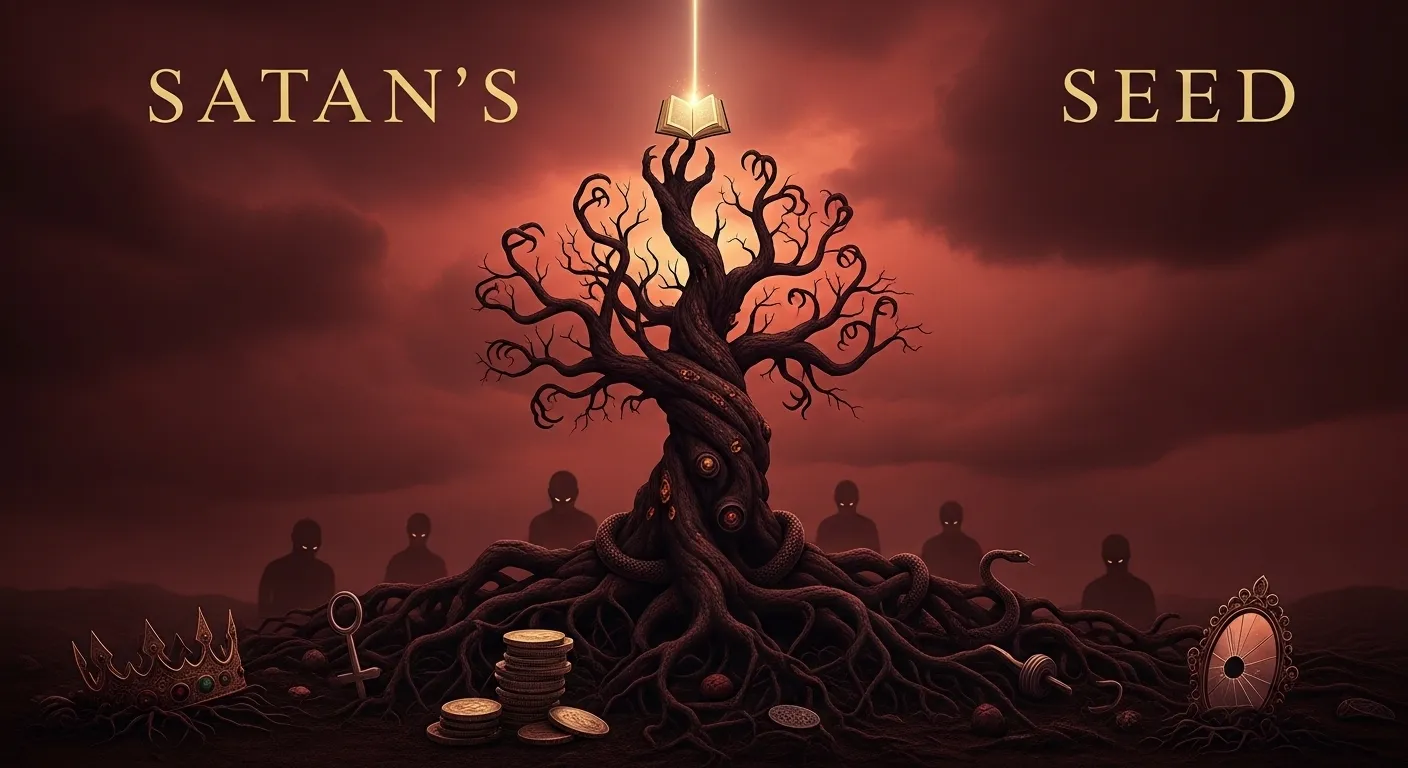
“Satan’s seed” is a phrase that sounds like it comes from a horror film, and it has frightened more than a few Bible readers. It also has a history — some of it ugly. Before this article says anything else, hear the warning clearly: there is a doctrine called “serpent seed” or “two-seedline” teaching which claims that certain people are literally, biologically the offspring of Satan — and it has been used to justify racism, antisemitism, and hatred. That doctrine is false, unbiblical, and evil, and this article rejects it entirely. What Scripture actually means by Satan’s “seed” is something else altogether — and understanding it correctly matters, because the wrong reading has done real damage.
The Bible uses the word “seed” the way a farmer does: it means offspring, but it also means kind — what something grows into, what it produces, whose nature it carries. An apple seed is not just a future tree; it is apple-ness in miniature. When Scripture speaks of the serpent’s seed, it is speaking of Satan’s kind: those who share his nature, do his works, and spread his influence. Not a bloodline. An allegiance. Three passages carry the weight of this idea, and each one clarifies the others.
The First Seed: Enmity in Eden
The phrase originates in God’s judgment on the serpent in Genesis 3:15: “And I will put enmity between you and the woman, and between your offspring [seed] and hers; he will crush your head, and you will strike his heel.”
This is the first gospel sermon ever preached — theologians call it the protevangelium, the first announcement of good news — and it is structured around two seeds in conflict. The serpent’s seed and the woman’s seed are set in permanent enmity: not a skirmish but a war, not a misunderstanding but a God-ordained hostility between two kinds.
Notice the grammar’s direction. The woman’s “seed” narrows as Scripture unfolds: Paul identifies it explicitly — “The promises were spoken to Abraham and to his seed. Scripture does not say ‘and to seeds,’ meaning many people, but ‘and to your seed,’ meaning one person, who is Christ” (Galatians 3:16). The woman’s seed is ultimately singular: the Messiah, who would be struck (the cross — the heel wounded) and who would crush (the resurrection — the head crushed). The serpent’s seed, correspondingly, is everyone aligned against that Seed: the ongoing opposition to Christ and His people, in every generation, under every empire.
Genesis 3:15 therefore defines “Satan’s seed” functionally, not biologically: it is whoever and whatever stands in enmity against the woman’s Seed. Pharaoh ordering Hebrew infants drowned (Exodus 1). Herod slaughtering Bethlehem’s boys (Matthew 2). The crowd crying “crucify him.” Every ideology, system, and heart that opposes Christ belongs to the serpent’s seed — not by birth but by position. And the verse’s promise is that this seed loses: the crushing is certain; only the timing was undisclosed.
The Second Seed: “You Are of Your Father the Devil”
Jesus uses the seed language most sharply in John 8:44, speaking to religious leaders who claimed Abraham as father while plotting murder: “You belong to your father, the devil, and you want to carry out your father’s desires. He was a murderer from the beginning, not holding to the truth, for there is no truth in him.”
The context demolishes every biological reading. These men were, by blood, Abraham’s physical descendants — Jesus concedes the genealogy (John 8:37: “I know that you are Abraham’s descendants”). Their problem was not their bloodline but their behavior: “If you were Abraham’s children, then you would do what Abraham did” (8:39). Sonship, Jesus insists, is proven by resemblance. Abraham believed God; they plotted murder. Abraham welcomed divine visitors; they rejected the divine Son. Their father was not determined by their DNA but by their deeds — and their deeds resembled the devil’s: murder and lying, the two traits Jesus names as Satan’s native language.
John’s first epistle makes the diagnostic explicit: “This is how we know who the children of God are and who the children of the devil are: Anyone who does not do what is right is not God’s child, nor is anyone who does not love their brother and sister” (1 John 3:10). The test is righteousness and love — practiced, observable, moral. Not ancestry, not ethnicity, not tribe, not nation. The serpent-seed heresy reads John 8:44 as a biology textbook; John himself reads it as a behavior report. The children of the devil are those who do the devil’s works. Full stop.
This reading also guards the doctrine’s pastoral use. “Satan’s seed” is not a label to apply to other people — especially not to ethnic groups, which is how the heresy has always worked. It is a mirror: whose works do I resemble? Where there is lying, there is the devil’s native tongue. Where there is murder — of reputation, of the vulnerable, of truth — there is his family trait. The phrase is meant for self-examination, not for sorting humanity.
The Third Seed: Wheat and Tares
Jesus’ parable of the wheat and the weeds (Matthew 13:24-30) gives the seed language its fullest narrative form. A man sows good seed; an enemy sows weeds among the wheat at night. When the servants ask to pull the weeds, the master refuses: “because while you are pulling the weeds, you may uproot the wheat with them. Let both grow together until the harvest.”
Jesus’ own interpretation (13:36-43) is unambiguous: “The one who sowed the good seed is the Son of Man. The field is the world, and the good seed stands for the people of the kingdom. The weeds are the people of the evil one, and the enemy who sows them is the devil.” Here is “Satan’s seed” in parable form: the weeds, sown by the devil, growing alongside the wheat in the same field.
Two details in the parable correct two perennial errors. First, the servants are forbidden to do the sorting. The impulse to identify, label, and uproot the “weeds” — the serpent-seed hunters of every age, certain they can spot Satan’s offspring — is explicitly denied. “Let both grow together until the harvest” (13:30). The sorting belongs to the angels at the end of the age (13:41), not to us now. Every movement that has claimed to identify Satan’s literal seed has disobeyed this verse.
Second, the weeds look like wheat. Tares (zizania, likely darnel) are nearly indistinguishable from wheat until the ear forms. The parable assumes deception: the devil’s seed does not arrive labeled. This is why the sorting is deferred — premature judgment uproots wheat with weeds. Humility about our ability to discern hearts is not moral cowardice; it is obedience to the parable.
The Doctrine to Reject
The “serpent seed” heresy deserves direct refutation because it continues to circulate. In its common form, it teaches that Eve’s sin involved a literal sexual union with the serpent, making Cain — and by extension certain peoples — the biological children of Satan. Some versions identify the “seed” with specific ethnic groups, usually Jews or non-white peoples, and have been used to justify hatred and violence.
Scripture refutes it at every point. Genesis 4:1 states plainly that Adam fathered Cain: “Adam made love to his wife Eve, and she became pregnant and gave birth to Cain.” The text leaves no room for serpent paternity. Acts 17:26 declares that God “from one man… made all the nations” — one blood, one human family, no separate satanic lineage. And as shown above, every “seed of the devil” passage in Scripture defines the category morally (works, allegiance, resemblance), never biologically.
The heresy’s real function has always been permission: permission to hate while claiming biblical warrant. It takes the Bible’s language of spiritual warfare and aims it at human beings — precisely what Ephesians 6:12 forbids: “our struggle is not against flesh and blood.” Any teaching that identifies Satan’s seed with a people group has crossed from exegesis into bigotry, and no Christian should touch it.
Resisting the Real Enemy
With the counterfeit rejected, the real teaching stands — and it is practical. The devil’s “seed” in the biblical sense means his influence, his works, his kind spreading in the world: lies, murder, accusation, division, temptation. Believers are not called to identify it in others but to resist it in themselves and stand against it in the world.
The armor is given: “Put on the full armor of God, so that you can take your stand against the devil’s schemes” (Ephesians 6:11) — truth, righteousness, the gospel of peace, faith, salvation, the Word of God, and prayer. The promise is given: “Resist the devil, and he will flee from you” (James 4:7) — resistance offered in submission to God is never futile. The alternative crop is described: “the fruit of the Spirit is love, joy, peace, forbearance, kindness, goodness, faithfulness, gentleness and self-control” (Galatians 5:22-23) — the visible proof of which seed is growing in a life. And the mental discipline is prescribed: “whatever is true, whatever is noble, whatever is right… think about these things” (Philippians 4:8) — because the devil’s seed is often sown in the thought life first.
The war of the two seeds, announced in Eden, is still being fought — and Genesis 3:15 already announced its outcome. The serpent’s head will be crushed. In the meantime, the children of God grow like wheat among the weeds, bearing the Spirit’s fruit, wearing the armor, resisting the devil, and leaving the final sorting to the angels. That is what “Satan’s seed” means in the Bible: not a bloodline to hunt, but an allegiance to flee — and a victory already promised.
The history of the serpent-seed doctrine — its origins, its variants, and its use by extremist movements — is documented in Wikipedia’s article on the serpent seed teaching, worth reading precisely so the error can be recognized and rejected. Scripture’s own teaching needs no supplement: two seeds, one war, works not bloodlines, resistance not hatred, and a crushed serpent at the end of the story.










