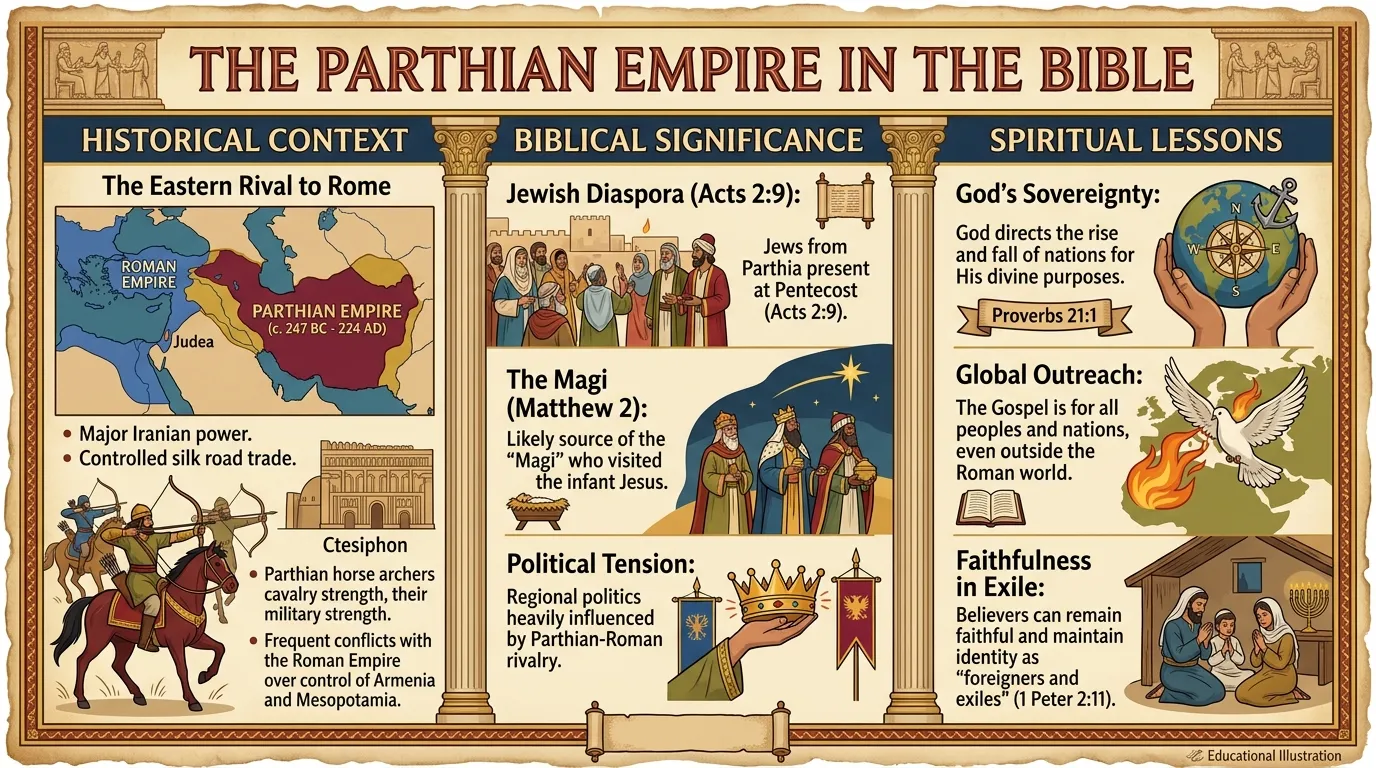
Of all the empires that touched the biblical world, the Parthian Empire is the one most readers have never heard of. It had no prophet, no apostle, and no book named after it. It never conquered Jerusalem or exiled Israel. Yet for nearly three centuries it stood as Rome’s great rival in the east, controlling the lands between the Euphrates and India, and its shadow falls across the edges of the New Testament story. The Parthian Empire’s meaning in the Bible is not a secret code or a prophecy. It is the reminder that God’s story unfolded in a world of real, competing powers, and that none of them, not even the ones Scripture barely mentions, stood outside His sovereignty.
The Empire Rome Could Not Conquer
The Parthians emerged from the region of Parthia, in the area of modern-day Iran and Turkmenistan, and by the middle of the third century BC they were building an empire. At their height they ruled a vast territory stretching from Mesopotamia to Central Asia, controlling the Silk Road trade routes that carried goods between China and the Mediterranean. Their armies were built around heavy cavalry and mounted archers, whose famous tactic of shooting backward while retreating gave the English language the phrase “Parthian shot.”
Rome tried repeatedly to defeat them and failed. Crassus, the wealthy member of the First Triumvirate, led a Roman army into Parthian territory in 53 BC and was killed at the Battle of Carrhae, along with most of his legions. Later emperors fared little better. The Euphrates became a rough boundary between the two empires, and for generations the Roman east lived with the knowledge that another superpower stood across the river. That rivalry shaped the politics of every small kingdom caught between them, including the Jewish world.
Parthians at Pentecost
The Parthians appear by name exactly once in the Bible, and the context is surprising. In Acts 2, Luke lists the peoples present in Jerusalem on the day of Pentecost, when the Holy Spirit fell on the disciples and the church was born. The list begins: “Parthians and Medes and Elamites and residents of Mesopotamia” (Acts 2:9). These were Jews and converts from across the eastern world, people who had traveled to Jerusalem for the festival and now heard the gospel in their own languages.
That single mention carries more weight than it appears to. The first crowd to hear the gospel after Pentecost included people from the empire Rome could not conquer. The gospel’s first audience was not limited to Roman subjects. It reached across the frontier into the Parthian world on the very first day. The list in Acts 2 reads like a map of the known world, and Parthia sits at the top of it, a sign that the message of Jesus was not a Roman religion or a local sect but a word for all nations.
The Magi and the East
Some readers also wonder whether the wise men who visited the infant Jesus (Matthew 2:1-12) came from Parthian territory. Matthew says they came “from the east,” which in that period could have meant Arabia, Babylon, Persia, or Parthia. The Bible does not specify their homeland, and Christians should not claim more than the text says. What can be said is that the east in Matthew’s day was largely Parthian country, and that the visit of eastern sages to a newborn king in Bethlehem fits a world in which travelers, scholars, and traders moved across the Parthian-Roman frontier. The wise men remain anonymous, but their journey points in the same direction as Pentecost: the news of Jesus drew people from beyond Israel’s borders.
A Kingdom Between the Testaments
The Parthian Empire matters for another reason: it fills a gap in the biblical timeline that readers often miss. The Old Testament ends with Persia in power. The New Testament opens with Rome in power. Between those two moments, the Near East changed hands repeatedly: Alexander conquered Persia, his empire broke apart, and the Parthians rose in the east while Rome rose in the west. Jewish history in this period, the centuries recorded in books like 1 Maccabees, unfolded in a world where Parthia and Rome were the two great poles of power.
That history helps explain the political pressures on Judea. The rulers of Judea, from the Hasmoneans to Herod, had to navigate between these giants. Herod the Great built his kingdom with Roman backing partly because Parthian backing of a rival had threatened his throne. The world Jesus was born into was not simply “Roman.” It was a world shaped by the rivalry between Rome and Parthia, even in places neither empire directly ruled.
What Parthia Teaches About God’s Sovereignty
Because Scripture never assigns Parthia a symbolic meaning, the lessons of Parthia are general rather than specific, but they are real. The first is that God is not limited to the powers Scripture names most often. The Bible concentrates on Israel, Babylon, Persia, Greece, and Rome because those empires touched Israel’s story directly. But the God of that story ruled Parthia too, and the Parthians at Pentecost are a quiet proof of it.
The second lesson is that empires rise and fall. Parthia lasted nearly five centuries, longer than many empires that seem more famous. Yet it eventually fell to the Sassanians in the third century AD, just as Rome would later fall in the west. Daniel’s vision of kingdoms rising and being replaced (Daniel 2) describes the pattern Parthia followed. Human power, however durable it looks, is temporary.
The third lesson is that the gospel crosses frontiers. The Parthians stood across the Euphrates from the Roman world, on the far side of the empire’s eastern border. The gospel reached them anyway, on the day the church was born. No political boundary, no rival empire, no “far side” of the map lies beyond the reach of the message. The list in Acts 2 is a promise: the Spirit’s work is not confined to one nation or one empire.
Reading Parthia Without Inventing Meanings
Christians should be cautious about claims that Parthia appears in prophecy under a code name, or that the Parthians were secretly one of the lost tribes, or that some modern nation is Parthia reborn. The Bible does not support such claims. Its single explicit mention of Parthians is historical, not prophetic. The strength of the Parthian story is not that it hides a secret but that it widens the frame: the biblical world was bigger than Israel and Rome, and God’s purposes were bigger than both.
The Rivalry That Shaped the Eastern Frontier
The rivalry between Rome and Parthia was not a distant abstraction. It shaped the daily lives of everyone on the eastern frontier. The buffer kingdoms between the two empires, Armenia above all, changed hands repeatedly as each power tried to install a friendly king. Trade routes shifted with the fortunes of war. Cities on the frontier were fortified, besieged, and rebuilt. For the Jewish people, the rivalry had a particular edge: the memory of Parthian intervention in Judea was still alive in the first century. In 40 BC, a Parthian-backed claimant had seized Jerusalem and installed himself as king, forcing Herod to flee to Rome. Herod’s later reign was built on Roman support precisely because the Parthian alternative had been tried and had failed. The world Jesus was born into was a world in which the eastern frontier was always contested, and the contest was always between Rome and Parthia.
Parthian Religion and Culture
The Parthians were not merely a military power. Their empire was a meeting place of cultures: Persian, Greek, Mesopotamian, and Central Asian. Their religion was broadly Zoroastrian, with a strong emphasis on the cosmic struggle between truth and falsehood, light and darkness. Their art blended Greek and Iranian styles. Their court was famous for its wealth and its tolerance of different peoples and faiths. The Jews of the Parthian Empire, a large and ancient community descended from the Babylonian exile, lived under Parthian rule in relative freedom, and their scholars traveled between the academies of Mesopotamia and Jerusalem. When Luke lists Parthians among the crowd at Pentecost, he is naming people from a world that had its own Jewish communities, its own synagogues, and its own long history of faithfulness far from Jerusalem.
The Parthians and the End of the Story
The Parthian Empire ended as all empires end: not with a single dramatic collapse but with a slow loss of authority, internal revolt, and replacement by a new power, the Sassanians, in AD 224. The Roman Empire that had fought Parthia for centuries would itself fall in the west two centuries later. Both empires are now subjects for historians. The gospel that was preached to Parthians at Pentecost outlasted them both. That is the final lesson of Parthia: the powers that seem permanent are not, and the message that seemed fragile proved durable.
Parthia reminds us that much of God’s work happens in places Scripture mentions only in passing, or not at all. The Parthians at Pentecost went home carrying a story, and we know nothing of what happened next. That silence is itself a kind of teaching. The Bible does not record every corner of God’s work. It records enough to show us that His work has no corners. For the historical outline of this empire, its wars with Rome, and its eventual fall, see the Wikipedia article on the Parthian Empire.