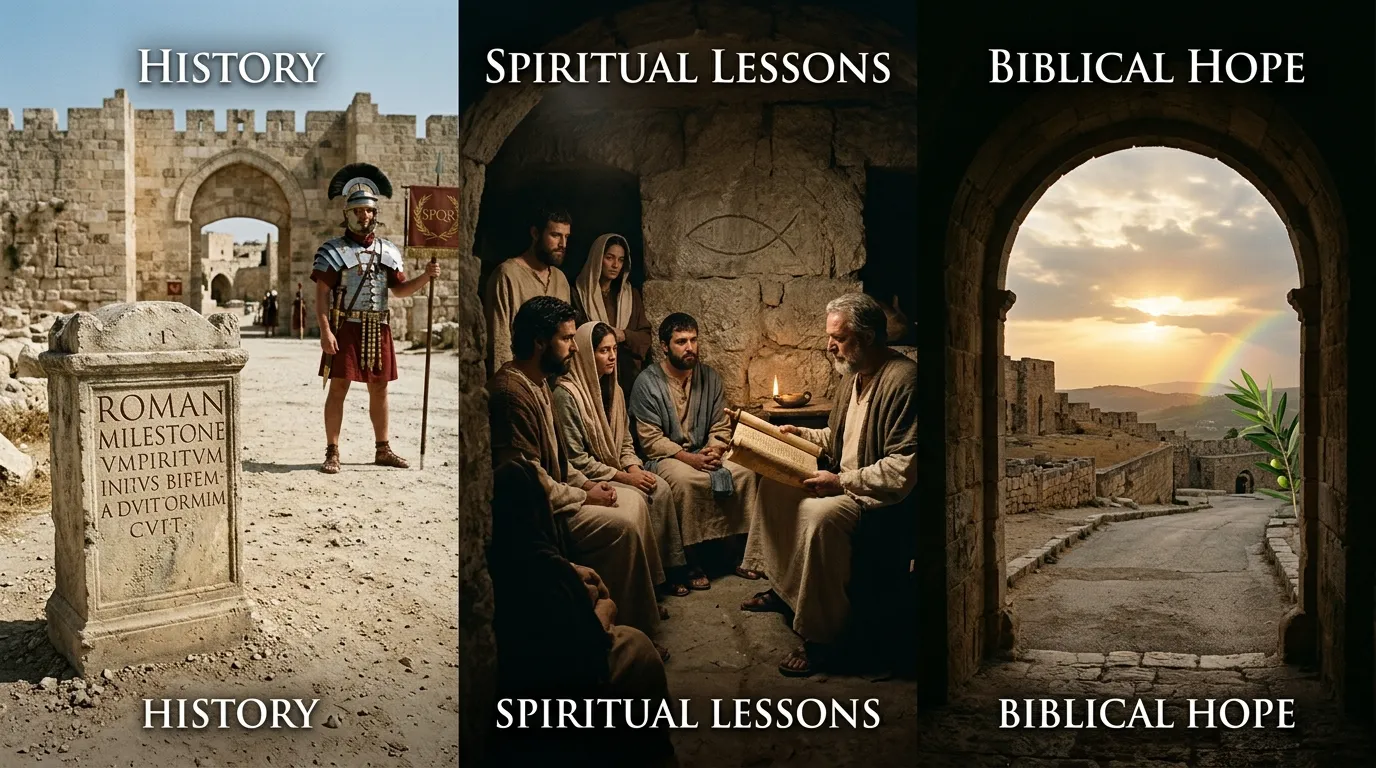
Imagine living in the first century. You walk through a busy city, and Roman soldiers stand nearby. Roman laws shape daily life. Taxes support a powerful government. Roads connect distant lands, while Roman rulers seem to hold enormous power.
This was the world in which Jesus was born and the early church began to grow.
The Roman Empire meaning in the Bible is closely connected with power, government, persecution, human authority, and the historical setting of the New Testament. Rome was not simply a background detail. Its rule shaped many events recorded in Scripture, from Jesus’ birth and crucifixion to Paul’s missionary journeys.
At the same time, the Bible does not teach that Rome was the center of God’s plan. God remained sovereign even when Rome appeared powerful. The Roman Empire could rule cities and nations, but it could not stop the gospel.
Understanding Rome can therefore help Christians read the New Testament with greater clarity. It can also remind us that God works through history, even during times of political pressure, injustice, and uncertainty.
What Was the Roman Empire in the Bible?
The Roman Empire was the great political power that controlled much of the Mediterranean world during the time of Jesus and the early Christian church.
Rome controlled Judea when Jesus was born. Roman authority also remained in place during Jesus’ ministry and death.
The Bible often mentions Roman officials, soldiers, laws, and political structures without giving a complete history of Rome. Instead, these details help explain what was happening around God’s redemptive work.
For example, Luke 2:1 says that Caesar Augustus issued a decree requiring people to be registered. Joseph and Mary traveled to Bethlehem because of this decree. This event connects directly with Jesus’ birth in Bethlehem, fulfilling the setting associated with the Messiah’s birth in Scripture.
The Roman Empire therefore appears in the Bible as part of the historical world in which God’s promises were being fulfilled.
Roman Empire Meaning in the Bible
The Bible does not give one simple symbolic definition of the Roman Empire. However, Rome can be understood through several important biblical themes.
Rome Represents Human Political Power
Rome was one of the strongest political powers of the ancient world. Its armies, laws, leaders, and systems affected millions of people.
Yet Scripture repeatedly teaches that human rulers are ultimately under God’s authority.
Romans 13:1 teaches that governing authorities exist under God’s sovereign permission. Paul wrote these words while living in a world ruled by Rome.
This does not mean that every action of a government is morally right. The Bible contains many examples of rulers acting unjustly. Rather, the passage reminds Christians that God remains higher than every earthly authority.
Rome looked powerful, but Rome was never greater than God.
Rome Shows the Limits of Earthly Power
The Roman Empire could imprison people, impose taxes, and execute criminals. Yet it could not defeat God’s purposes.
Jesus was crucified under Roman authority. From a human viewpoint, His death appeared to be a terrible defeat.
But the resurrection changed everything.
Acts 2:23–24 explains that Jesus was delivered to death according to God’s purpose, yet God raised Him from the dead.
This gives an important spiritual lesson: what looks like defeat to human eyes may become part of God’s redemptive work.
Rome Provides a Setting for the Growth of Christianity
The early church began and expanded while Rome controlled large areas of the known world.
Paul traveled through many Roman territories. The book of Acts records his journeys through cities such as Philippi, Corinth, Ephesus, and Rome.
The Roman road system and widespread use of common languages helped people, goods, and ideas move across the empire. These historical conditions formed part of the world in which the gospel spread.
However, Christians should be careful not to say that Rome existed simply for Christianity. Scripture does not make that claim.
What we can say is that God used real historical circumstances to advance His purposes.
Roman Empire Meaning in the Bible Hebrew Meaning
The phrase Roman Empire does not have a special Hebrew word that carries a hidden spiritual meaning in Scripture. The Bible’s Old Testament was written mainly in Hebrew, while the New Testament was written in Greek.
The Latin name associated with Rome is connected with the city of Rome and its people. In Hebrew discussions, Rome may be referred to as רומי (Romi), meaning Rome or Roman, while related forms can describe something Roman.
It is important not to create a spiritual meaning from the Hebrew spelling alone.
The Bible does not teach that the letters or numerical value of the Hebrew word for Rome reveal a secret message. Sound biblical interpretation comes from Scripture’s context, not from assigning hidden meanings to words.
This distinction matters because Christians sometimes encounter online claims about secret codes, numerology, or special meanings connected to Rome. Such claims should be tested carefully against Scripture.
Rome and the Birth of Jesus
One of the clearest connections between Rome and the Bible appears in the story of Jesus’ birth.
Luke 2:1–7 tells us that Caesar Augustus ordered a registration. Joseph traveled from Nazareth to Bethlehem because he belonged to the family line of David.
While Rome was making an imperial decision, God was fulfilling His larger purpose.
Jesus was born in Bethlehem, a detail connected with the Old Testament prophecy in Micah 5:2.
This is a beautiful reminder that God can work through events controlled by earthly rulers without surrendering His sovereignty to them.
Caesar thought he was making an administrative decision.
Yet God’s plan was moving forward.
Rome and the Crucifixion of Jesus
The Roman Empire is also connected with the death of Jesus.
Pontius Pilate served as the Roman governor of Judea. The Gospel accounts show that Pilate questioned Jesus and eventually allowed Him to be crucified.
John 19:10–11 records Jesus telling Pilate that his authority was given from above.
Jesus did not treat Roman authority as ultimate authority.
His words point to a greater truth: earthly power has limits because God is sovereign over history.
The cross also teaches Christians not to measure God’s work only by appearances.
The crucifixion looked like the triumph of evil.
The resurrection revealed God’s victory.
Rome in the Book of Acts
After Jesus’ resurrection and ascension, the gospel began spreading across the Roman world.
The book of Acts records how the Holy Spirit empowered the apostles and other believers to proclaim Christ.
Paul’s ministry brought him into contact with Roman officials and institutions.
In Acts 16, Paul and Silas were imprisoned in Philippi. In Acts 22, Paul used his Roman citizenship when facing legal danger. In Acts 25, Paul appealed to Caesar.
These accounts show something important about Christian life.
Believers can live faithfully within human systems while placing their ultimate trust in God.
Paul did not worship the Roman system. He also did not ignore lawful protections available to him.
He used wisdom while continuing to serve Christ.
Paul and His Roman Citizenship
Paul’s Roman citizenship appears several times in Acts.
In Acts 22:25–29, Paul revealed that he was a Roman citizen after soldiers were preparing to question him by flogging.
His citizenship provided certain legal protections.
This is a useful example of biblical wisdom. Paul trusted God, but he also made responsible decisions.
Christian faith does not require us to reject wisdom, lawful protection, or practical action.
Instead, believers can pray for wisdom and use appropriate means while trusting God with the outcome.
Rome and the Book of Revelation
One of the most discussed connections between Rome and biblical prophecy appears in Revelation.
Revelation 17 describes a symbolic woman called “Babylon” sitting on seven mountains. Because Rome was famously associated with seven hills, many Christians and biblical scholars have understood this imagery as having a connection to Rome.
However, interpretation requires care.
Revelation uses highly symbolic language. The passage should not be reduced to the statement that every reference to Babylon simply means Rome.
In Revelation’s larger message, Babylon represents a powerful system of human pride, corruption, wealth, and opposition to God. Rome may have been an important historical expression of that reality, especially for the first readers of Revelation.
The central message is not fear of a particular empire.
It is confidence that God will ultimately judge evil and establish His righteous kingdom.
Does the Bible Say Rome Is the Antichrist?
The Bible does not explicitly say, “The Roman Empire is the Antichrist.”
Some Christian traditions have connected Rome, the Roman Empire, or later Roman institutions with passages about the beast, Babylon, or the Antichrist.
These interpretations differ among Christians.
Therefore, it is wise to distinguish between what Scripture clearly says and what particular interpretations suggest.
Scripture clearly teaches that evil powers oppose God, deceive people, and seek authority that belongs to God.
Scripture also clearly teaches that Christ will ultimately triumph.
But Christians should avoid claiming certainty about interpretations that faithful believers have debated for centuries.
The Spiritual Symbolism of Rome
Although the Bible does not assign one universal spiritual symbol to Rome, its story can point Christians toward several biblical lessons.
Human Power Cannot Replace God
Rome had armies, wealth, laws, and political influence.
Yet Rome could not stop Christ’s resurrection or prevent the gospel from spreading.
This teaches us that human strength is temporary, but God’s kingdom is lasting.
Earthly Kingdoms Rise and Fall
The Roman Empire eventually declined.
This fits a wider biblical pattern. Human kingdoms do not last forever.
Daniel 2:21 says that God changes times and seasons and removes kings and establishes kings.
That truth can comfort believers living through political or social uncertainty.
Christians Should Not Put Their Hope in Government
Government has a legitimate place in society, but it cannot become a Christian’s ultimate hope.
Psalm 146:3 warns against putting ultimate trust in rulers.
Our deepest hope belongs to God.
This does not mean Christians should avoid civic responsibility. It means political power must never replace faith in Christ.
God Can Work During Difficult Times
The early church grew during a complicated and often dangerous period.
Some Christians suffered greatly.
Yet the gospel continued moving forward.
This can encourage believers who feel that their own circumstances are too difficult for God to use.
God is not limited by difficult environments.
What Does the Roman Empire Mean Spiritually Today?
For Christians today, the Roman Empire can serve as a reminder to examine where we place our trust.
Imagine a Christian who feels anxious about political changes, economic problems, or social conflict.
Studying Rome reminds us that God’s people have lived through powerful empires before.
Political circumstances change.
Leaders change.
Systems change.
God does not change.
Malachi 3:6 emphasizes God’s unchanging character, while Hebrews 13:8 reminds Christians that Jesus Christ is the same yesterday, today, and forever.
That truth gives believers a firm foundation.
What Does Rome Teach Christians About Persecution?
The Roman period also reminds us that following Christ may sometimes involve suffering.
Many early Christians faced opposition because they refused to give ultimate loyalty to anyone other than God.
Jesus never promised that His followers would have an easy life.
In John 16:33, Jesus told His disciples that they would face trouble in the world, but He also pointed them toward His victory.
The lesson is not that Christians should expect persecution everywhere.
Rather, believers can remember that faithfulness to Christ is more important than comfort or social approval.
What Does Rome Mean in a Dream?
Some people may dream about Rome, Roman soldiers, Roman buildings, or the Roman Empire and wonder whether the dream has a spiritual meaning.
The Bible does contain dreams that God used in specific situations. Joseph, Daniel, and others received important dreams in Scripture.
However, not every dream is a message from God.
Ecclesiastes 5:3 connects dreams with the activity and concerns of the mind. Therefore, Christians should not automatically treat every dream as prophecy.
If you dream about the Roman Empire, possible personal themes might include:
- authority or leadership
- pressure from powerful people
- fear of losing control
- questions about history or faith
- endurance during difficulty
- concern about political events
- a desire for security
These are possibilities, not guaranteed biblical interpretations.
The safest approach is to test every spiritual impression against Scripture rather than allowing a dream to control your decisions.
God’s written Word remains the standard.
Roman Soldiers in a Dream or Real-Life Experience
A Roman soldier may symbolize authority, discipline, conflict, or fear in a personal dream.
For example, someone facing a difficult workplace situation might dream about soldiers guarding a gate.
That dream does not automatically mean God is predicting a future event.
It may reflect feelings about authority or pressure.
A Christian can pray about the experience and ask, “What does Scripture teach me about fear, authority, courage, and trust?”
This keeps the focus on biblical truth rather than speculation.
Practical Faith Lessons From the Roman Empire
The story of Rome gives Christians several practical lessons for everyday life.
Trust God When Powerful Things Feel Bigger Than You
A difficult boss, government decision, financial problem, or family conflict can make you feel powerless.
Remember that God’s authority is greater than every human authority.
Pray before reacting.
Use Wisdom Without Losing Faith
Paul used his legal rights as a Roman citizen.
Likewise, Christians can seek wise counsel, use lawful protections, make plans, and ask for help while still trusting God.
Faith and wisdom belong together.
Do Not Confuse Temporary Power With Permanent Victory
Rome looked unstoppable.
It was not.
The same principle applies today. Circumstances that seem permanent can change quickly.
God’s promises are more dependable than human circumstances.
Keep Your Eyes on Christ
The early church lived in a world filled with political power and social pressure.
Yet its message remained centered on Jesus.
Christians today also need to guard their hearts from allowing politics, fear, money, or social conflict to become more important than Christ.
Frequently Asked Questions About Roman Empire Meaning in the Bible
What is the Roman Empire meaning in the Bible?
The Roman Empire was the major political power during the time of Jesus and the early church. Biblically, Rome provides the historical setting for events such as Jesus’ birth, crucifixion, Paul’s ministry, and the spread of Christianity. It can also remind Christians that God remains sovereign over earthly powers.
Why was Rome important in the Bible?
Rome was important because Judea and many surrounding regions were under Roman control during the New Testament period. Roman officials appear in the Gospel accounts, and Roman roads, laws, citizenship, and political structures affected the ministry of early Christians.
Does Rome represent evil in the Bible?
Not every biblical reference to Rome means evil. Rome was a real government and historical empire. However, Revelation uses symbolic images of oppressive and corrupt power that many interpreters connect in part with Rome. Christians should avoid treating every reference to Rome as a symbol of evil.
Is Rome the Babylon mentioned in Revelation?
Many Christians and scholars understand Babylon in Revelation as having a significant connection to Rome, especially because of the historical setting and imagery involving seven mountains. However, Babylon also carries a broader symbolic meaning involving human pride, corruption, and opposition to God. The interpretation should therefore be handled carefully.
Does the Bible say the Roman Empire was the Antichrist?
No. Scripture does not directly identify the Roman Empire as the Antichrist. Some interpretations connect Rome or Roman power with passages about the beast or other end-times figures, but these interpretations should not be presented as explicit biblical statements.
What does Rome symbolize spiritually?
Rome can remind Christians of the temporary nature of earthly power, the dangers of human pride, the reality of persecution, and God’s sovereignty over history. These are biblical lessons drawn from Rome’s place in Scripture rather than a single official symbolic definition.
What should I do if I dream about the Roman Empire?
Do not assume the dream is a prophecy. Pray about it, examine your feelings and circumstances, and compare any spiritual interpretation with Scripture. No dream should override God’s Word or become the foundation for major decisions.
Final Thoughts: Trust God Above Every Empire
The Roman Empire meaning in the Bible becomes clearer when we look beyond Rome’s military strength and political influence.
Rome was powerful, but Rome was temporary.
Caesars ruled, but they did not rule forever.
Roman soldiers could guard prisons and execute criminals, but they could not keep Jesus in the grave.
The gospel continued to spread.
The church continued to grow.
And God’s purposes continued to unfold.
That is one of the most encouraging lessons Christians can take from Rome.
If life feels controlled by forces bigger than you, remember that God has never lost His authority. If the world feels uncertain, remember that earthly kingdoms change, but Christ remains faithful.
Pray for wisdom. Study Scripture carefully. Do not build your faith on speculation or fear. Instead, place your confidence in the God who worked through history, remained faithful through suffering, and raised Jesus Christ from the dead.
No empire is greater than God’s kingdom, and no earthly power can cancel God’s promises.
So when you think about Rome, do not let its ancient power create fear. Let its story point you back to the One whose kingdom will never end.
Trust God.
Follow Christ.
Stay faithful.
And remember that even when the world seems uncertain, God is still at work.