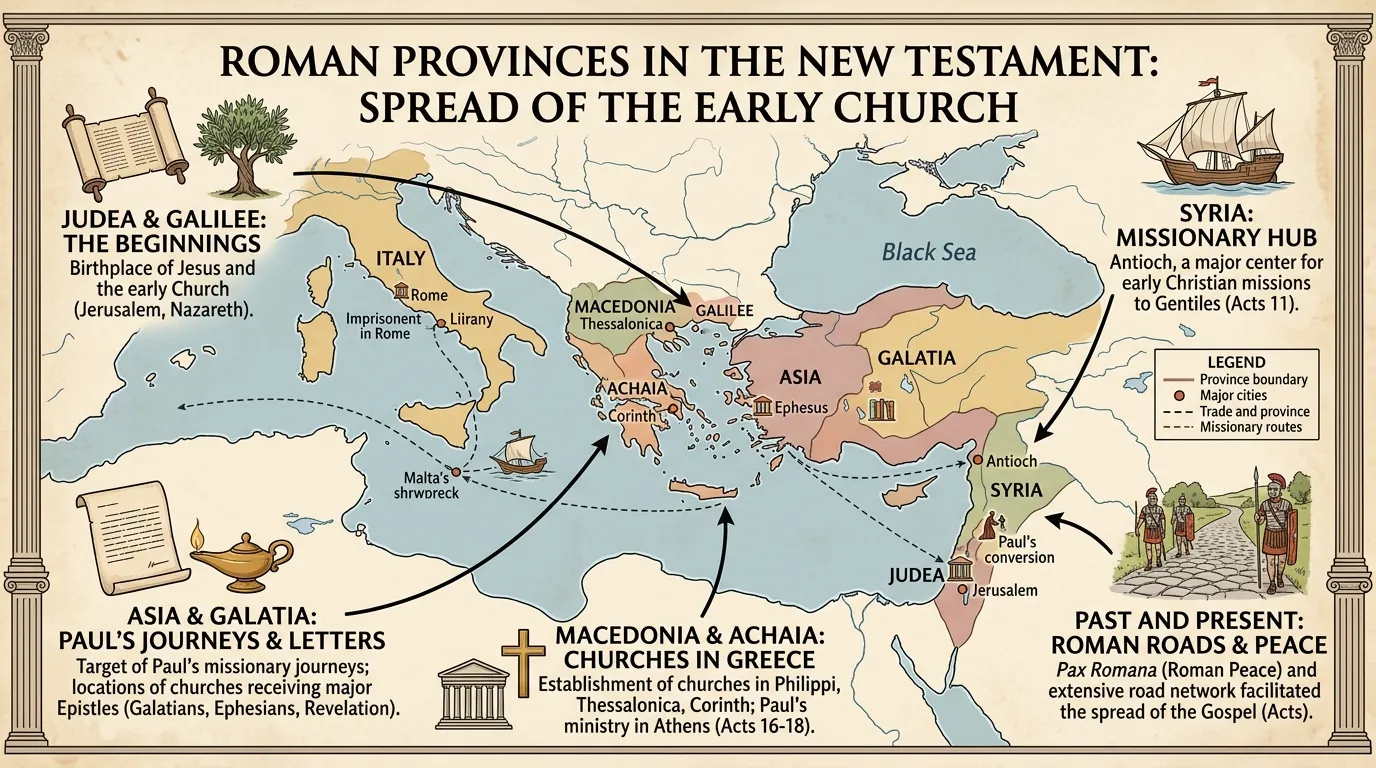
Open a map of the New Testament world and the names start to pile up: Judea, Galilee, Samaria, Syria, Cilicia, Asia, Macedonia, Achaia, Cyprus, Crete. To a modern reader they can feel like decorative background, the kind of detail you skim past to get to the story. But those names are the Roman provinces and territories through which the gospel actually traveled. They were not scenery. They were the administrative grid of an empire, and the first Christians lived, preached, suffered, and died inside it. Understanding the provinces makes the New Testament feel less like a collection of timeless sayings and more like a story that happened in real places under real government.
What a Province Actually Was
A Roman province was a territory outside Italy governed by Rome under Roman law. Some provinces were administered by the Senate through proconsuls; others, especially frontier or politically sensitive ones, were governed by the emperor’s own appointees. Judea, for example, was governed by a prefect under the authority of the emperor, which is why Pontius Pilate, a prefect, could try Jesus. Achaia, by contrast, was a senatorial province governed by a proconsul, which is why Gallio’s refusal to judge Paul in Corinth (Acts 18:12-17) fits the administrative pattern of the time.
Provinces were not uniform. They differed in language, religion, wealth, and degree of Romanization. A city like Philippi was a Roman colony, settled by veterans and run on Roman law, while Jerusalem lived under a complicated arrangement involving the temple, the high priest, and the Roman prefect. Paul could appeal to his Roman citizenship in one setting and argue from the Hebrew Scriptures in another, because the empire he moved through was a patchwork, not a monolith.
The Census That Brought Joseph to Bethlehem
The provinces enter the gospel story almost immediately. Luke opens his account of Jesus’ birth with a decree from Caesar Augustus that all the world should be registered (Luke 2:1). That registration was an imperial act, carried out province by province, and it sent Joseph and Mary from Nazareth in Galilee to Bethlehem in Judea. The Roman administrative machine, designed for taxation and control, became the vehicle that placed Jesus’ birth in the town the prophet Micah had named centuries earlier (Micah 5:2). Luke does not treat the census as a coincidence. It is part of the story of a God who works through the machinery of empire without being controlled by it.
Judea, Galilee, and Samaria: The Homeland Provinces
The Gospels move mainly through the provinces and regions of the Jewish homeland. Judea held Jerusalem and the temple, the center of Jewish worship and the place of Jesus’ crucifixion and resurrection. Galilee, to the north, was Jesus’ home region, where He grew up and carried out much of His ministry. Samaria lay between them, and the tension between Jews and Samaritans gives the parable of the Good Samaritan and the story of the woman at the well much of their edge.
These regions were not all provinces in the strict sense at every moment. Galilee was governed at times by Herodian rulers who answered to Rome, and Judea’s status changed over the decades. But for the ordinary person, the difference mattered less than the fact of Roman oversight: taxes were collected, soldiers were present, and the final power of life and death in a capital case rested with a Roman official.
Syria, Cilicia, and the Road Outward
Once the church begins to spread in Acts, the provinces widen. Antioch in Syria became the sending base for Paul’s missionary journeys. Damascus, also in the Syrian sphere, was where Saul the persecutor met Jesus and became Paul the apostle. Cilicia, Paul’s home region, contained Tarsus, the city of his birth and citizenship. Cyprus, an island province, was the first stop on the first missionary journey, where Paul and Barnabas preached in the synagogues at Salamis and confronted the magician Elymas before the proconsul Sergius Paulus (Acts 13).
Each of these places carried its own political texture. A proconsul like Sergius Paulus could hear the gospel in his own residence. A city like Antioch, the third-largest city in the empire, could sustain a large and diverse church where believers were first called Christians (Acts 11:26). The gospel did not spread in a vacuum; it spread along the roads and shipping lanes that connected the provinces.
Asia, Macedonia, and Achaia: Paul’s Working Map
Paul’s letters are addressed to churches located in specific provinces, and the provincial setting often explains the letter’s concerns. Ephesus stood in Asia, a wealthy senatorial province on the west coast of modern Turkey, where the silversmiths’ riot over Artemis showed how deeply the gospel threatened the local economy (Acts 19). Philippi and Thessalonica stood in Macedonia, where Paul’s churches faced persecution and where the generosity of the Macedonians, despite their poverty, became a model Paul held up to Corinth (2 Corinthians 8:1-5).
Achaia, the province covering southern Greece, held Corinth and Athens. Corinth’s position on the isthmus made it a commercial crossroads and a city of notorious moral license, which helps explain why Paul’s letters to the Corinthians deal so heavily with sexual ethics, lawsuits, and the abuse of Christian freedom. Athens, though no longer the power it had once been, still prided itself on philosophy, which is why Paul’s sermon on the Areopagus engaged Stoic and Epicurean ideas directly (Acts 17:16-34).
Why the Provincial Grid Mattered for the Gospel
The provincial system helped the gospel spread in at least three practical ways. First, the Roman roads and sea lanes that connected the provinces gave missionaries routes to travel. Paul’s journeys follow those routes almost exactly. Second, the relative stability of Roman law gave travelers a measure of protection; Paul’s citizenship, for instance, repeatedly saved him from summary punishment. Third, the common Greek language across the eastern provinces meant that a letter written in one city could be read and understood in another.
None of this means Rome created Christianity or that the empire was God’s chosen instrument in any simple sense. The same empire that built the roads also crucified Jesus and later persecuted His followers. The New Testament holds both truths: God used the provincial world as the setting for the gospel, and the gospel judged the empire that provided the setting. That tension runs through the whole story, from the census at Bethlehem to Paul’s appeal to Caesar.
Reading Place Names as Part of the Story
When a New Testament passage names a province, it is usually doing more than filling in the backdrop. It is telling you something about the people who heard the gospel there: their rulers, their gods, their economy, their laws, and the pressures they faced. A letter to Philippi sounds different when you know it was a Roman colony proud of its citizenship. A letter to Rome sounds different when you know the church there lived under the emperor’s nose. The provinces are not trivia for specialists. They are part of how the story works.
How the Provinces Shaped Paul’s Strategy
Paul’s missionary journeys make more sense when read against the provincial map. He did not wander randomly. He moved from one provincial capital to another, planting churches in cities where the gospel could spread outward along the roads. Antioch in Syria, Ephesus in Asia, Philippi and Thessalonica in Macedonia, Corinth in Achaia: each was a hub, and each hub sat inside a provincial system that connected it to smaller towns and villages. Paul’s plan, stated in Romans 15, was to work his way across the provinces until the gospel had been preached from Jerusalem to Illyricum, and then to move on to Spain.
The provincial structure also shaped how the churches related to one another. The collection Paul organized for the poor in Jerusalem drew contributions from the churches of Macedonia and Achaia (Romans 15:26; 2 Corinthians 8-9). The provinces that had received the gospel were now sending help back to the province where it began. The administrative map of the empire became, in Paul’s hands, a network of generosity.
Provincial Identity in the Letters
The provinces also appear in the letters as markers of identity and pride. When Paul wrote to the Galatians, he was writing to people in a province whose name carried the memory of Celtic settlers, the Galatians, who had migrated there centuries earlier. When he wrote to the Philippians, he was writing to people whose Roman colony status was a point of civic pride, which is why his line about heavenly citizenship would have stung and thrilled them. When John wrote to the seven churches of Revelation, he was writing to seven cities in the single province of Asia, and each message fits its city’s character: the wealthy complacency of Laodicea, the persecution in Smyrna, the doctrinal vigilance of Ephesus.
Reading the provinces this way turns the New Testament from a book of abstract doctrines into a collection of letters to real places. The gospel did not arrive as a philosophy. It arrived as news, carried into provinces with their own governors, gods, economies, and cultures, and it took root differently in each one. The same Lord, the same message, and a different local shape in every province.
For readers who want the administrative details of how Rome organized and governed these territories, the Wikipedia overview of the Roman province system gives a clear picture of the structure behind the names.