The Bible tells us an enormous amount about the apostle Paul: his hometown, his education, his conversion, his missionary journeys, his imprisonments, his theology, even his health problems and his cloak left behind in Troas. But on one ordinary question — was he married? — Scripture is silent. It never says he had a wife. It never says he never had one. And that silence has produced centuries of speculation. The right way to handle the question is to examine what the Bible does say, weigh the theories honestly, and learn to be comfortable with “we do not know” — because the Bible’s silence on Paul’s marriage is itself a lesson about what matters most.
The Key Text: 1 Corinthians 7
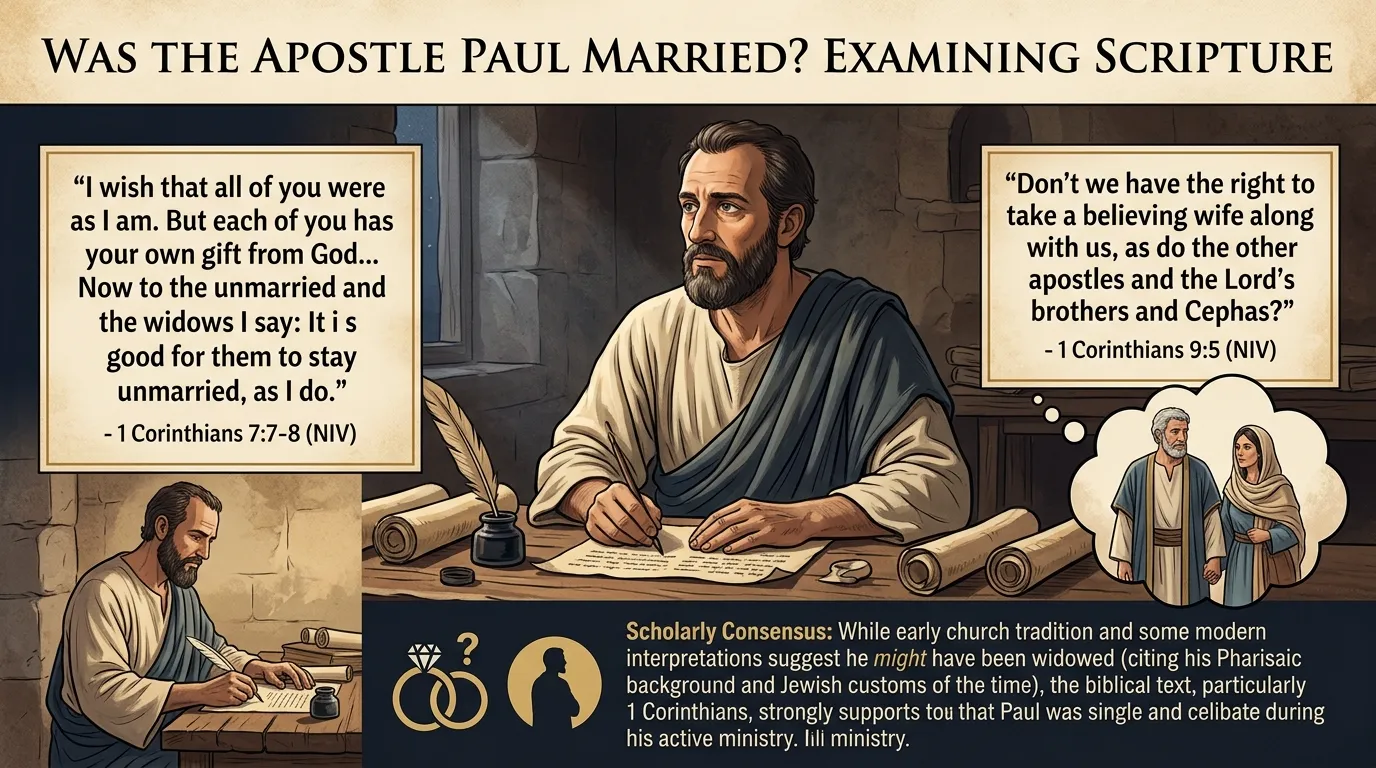
The most important passage is 1 Corinthians 7:7–8, where Paul writes: “I wish that all were as I myself am. But each has his own gift from God, one of one kind and one of another. To the unmarried and the widows I say that it is good for them to remain single, as I am.”
The plain reading is that when Paul wrote 1 Corinthians — in the mid-50s AD, during his Ephesian ministry — he was unmarried. He groups himself with “the unmarried and the widows,” and he presents his own singleness as a model worth imitating. He is not ashamed of it, and he does not treat it as a defect. In a culture where marriage was the overwhelming norm and singleness was often viewed with suspicion, Paul speaks of singleness as a gift — a charisma, the same word used for spiritual gifts. Some people are gifted for marriage; others are gifted for singleness. Both are callings from God. Neither is superior.
Paul goes on to explain the advantage of singleness for ministry: the unmarried person is “anxious about the things of the Lord, how to please the Lord,” while the married person is divided, anxious also about the things of the world and how to please a spouse (1 Corinthians 7:32–34). This is not a criticism of marriage — Paul elsewhere calls marriage honorable and defends it vigorously against those who forbade it. It is a practical observation about focus. Paul’s life — constant travel, imprisonment, beatings, shipwrecks — would have been extraordinarily hard on a wife and family. His singleness freed him for a ministry that marriage would have complicated enormously.
The Argument That He Was Married Earlier
Some scholars have argued that Paul was probably married before his conversion, and that he was likely a widower by the time he wrote 1 Corinthians. The argument runs like this. Paul was a rising star in Judaism — educated under Gamaliel, zealous beyond his peers, entrusted with authority from the chief priests. In the Jewish world of the first century, marriage was considered a religious duty for a man, and rabbinic tradition held that a man who was unmarried at twenty had transgressed. A Pharisee of Paul’s standing, moving in the circles he moved in, would almost certainly have been married.
There is a second thread to the argument. Paul says in Acts 26:10 that when Christians were put to death, he “cast his vote against them” — which, if it implies membership in the Sanhedrin, may suggest he held a position for which marriage was expected. If Paul was a member of the council, and if the council required married members, then Paul was married at that time. Both “ifs” are uncertain, and the second is debated among scholars. But the argument is not frivolous; it rests on real features of first-century Jewish life.
A third thread is 1 Corinthians 9:5, where Paul asks, “Do we not have the right to take along a believing wife, as do the other apostles and the brothers of the Lord and Cephas?” Some have read this as evidence that Paul had a wife he chose not to bring. But the verse actually proves the opposite: Paul is claiming a right he is not exercising. He is saying that if he had a wife, he could bring her, just as Peter did. The verse tells us Peter was married. It tells us nothing about Paul’s own marital history.
If Paul was married before his conversion, what happened to his wife? Scripture does not say. She may have died. She may have left him when he became a Christian — a real possibility, given that his conversion turned his life upside down and made him a hunted man. She may have remained in Judaism while he followed Christ. All of these are guesses. The Bible gives us no answer, and honesty requires saying so.
The Argument That He Was Never Married
The other possibility is simpler: Paul was never married. He may have been one of the exceptions to the cultural norm — a man who, from his youth, was so consumed by his studies and his zeal that he never married, and who after his conversion saw his singleness as a gift for the mission God gave him. The fact that Paul speaks of singleness as a gift “from God” in 1 Corinthians 7:7 could describe a lifelong gift, not merely a post-widowhood state.
There is also a detail in Philippians 4:2–3 that is sometimes dragged into this debate: Paul addresses a “true companion” and asks him to help Euodia and Syntyche. Some have speculated that this “companion” was Paul’s wife. The Greek word, however, is masculine, and the context is about ministry partnership, not marriage. There is no responsible basis for identifying the companion as a wife.
Why the Silence Matters
The Bible’s silence on Paul’s marriage is not an oversight. It is a reminder of what Scripture considers important. The Bible gives us Paul’s theology, his mission, his sufferings, and his character. It does not give us his marital history, because his marital history is not the point. The point is that God used a man — married or single, widowed or never married — whose life was entirely given to Christ.
That is also the pastoral lesson of the question. Paul’s life demolishes the idea that marriage is required for a complete or useful life. He also demolishes the opposite idea, that singleness is spiritually superior. He honored marriage, defended it, and taught that it pictures Christ and the church (Ephesians 5). He also honored singleness, lived it, and taught that it is a gift. Both paths are honorable. Both are callings. A person’s worth before God is not measured by a ring on the finger or the absence of one.
So was Paul married? When he wrote 1 Corinthians, no. Before that, we do not know — and the Bible, which tells us so much else about him, has chosen not to tell us. The wise reader will accept the silence, resist building doctrine on it, and take from Paul’s life what the Bible actually offers: a man whose singleness freed him to give everything to the gospel, and whose teaching frees every Christian — married or single — to do the same.
Marriage and Singleness in Paul’s Teaching
Paul’s teaching on marriage, in 1 Corinthians 7 and Ephesians 5, is the most balanced in the New Testament, and it is worth reading in full because both extremes — the exaltation of marriage and the exaltation of singleness — distort it. In 1 Corinthians 7, Paul says marriage is a gift, singleness is a gift, and each person should live in the calling God has given. He does not rank them. He does not say one is holier. He says both are good, and each has its own advantages and its own pressures.
In Ephesians 5, Paul gives marriage its highest dignity: it is a picture of Christ and the church. The husband’s love for his wife is to mirror Christ’s love for the church — a love that gave itself up, that sanctifies, that nourishes. The wife’s submission is to mirror the church’s response to Christ. The passage has been misused to justify domination, but its actual logic is the opposite: the husband’s role is defined by self-sacrifice, not by power. A husband who does not love his wife as Christ loved the church has missed the entire point.
Paul’s teaching on marriage and singleness, taken together, demolishes two modern idolatries. The first is the idolatry of marriage — the idea that a person is incomplete without a spouse, that singleness is a waiting room, that the married life is the only fully human life. Paul’s own life refutes it. He was single, and his life was as full as any life has ever been. The second is the idolatry of singleness — the idea that marriage is a compromise, a lesser path for the less spiritual. Paul’s teaching on marriage refutes it. Marriage is honorable, holy, and a picture of the gospel itself. The church needs both gifts, and it dishonors God when it honors one at the expense of the other.
The Gift of Focus
Paul’s singleness gave him something specific that he names directly: undivided attention. “I want you to be free from anxieties,” he writes. “The unmarried man is anxious about the things of the Lord, how to please the Lord. But the married man is anxious about worldly things, how to please his wife” (1 Corinthians 7:32–33). Paul is not saying married people are second-class. He is describing a trade-off. Marriage divides attention — necessarily, rightly, and by God’s design. A husband should care about pleasing his wife. A wife should care about pleasing her husband. That is not a flaw. It is faithfulness.
But singleness, for those called to it, offers a different kind of faithfulness: the freedom to give undivided attention to the Lord’s work. Paul used that freedom to travel the world, to endure dangers no family man should face, to write letters from prison, and to give his life entirely to the mission. His singleness was not an accident. It was a gift — and he used it the way every gift should be used: for the glory of God and the good of the church. Whether married or single, the question is the same: what has God given you, and are you giving it back to Him?
For the broader life and ministry of the apostle behind this question, see the article on Paul the Apostle.










