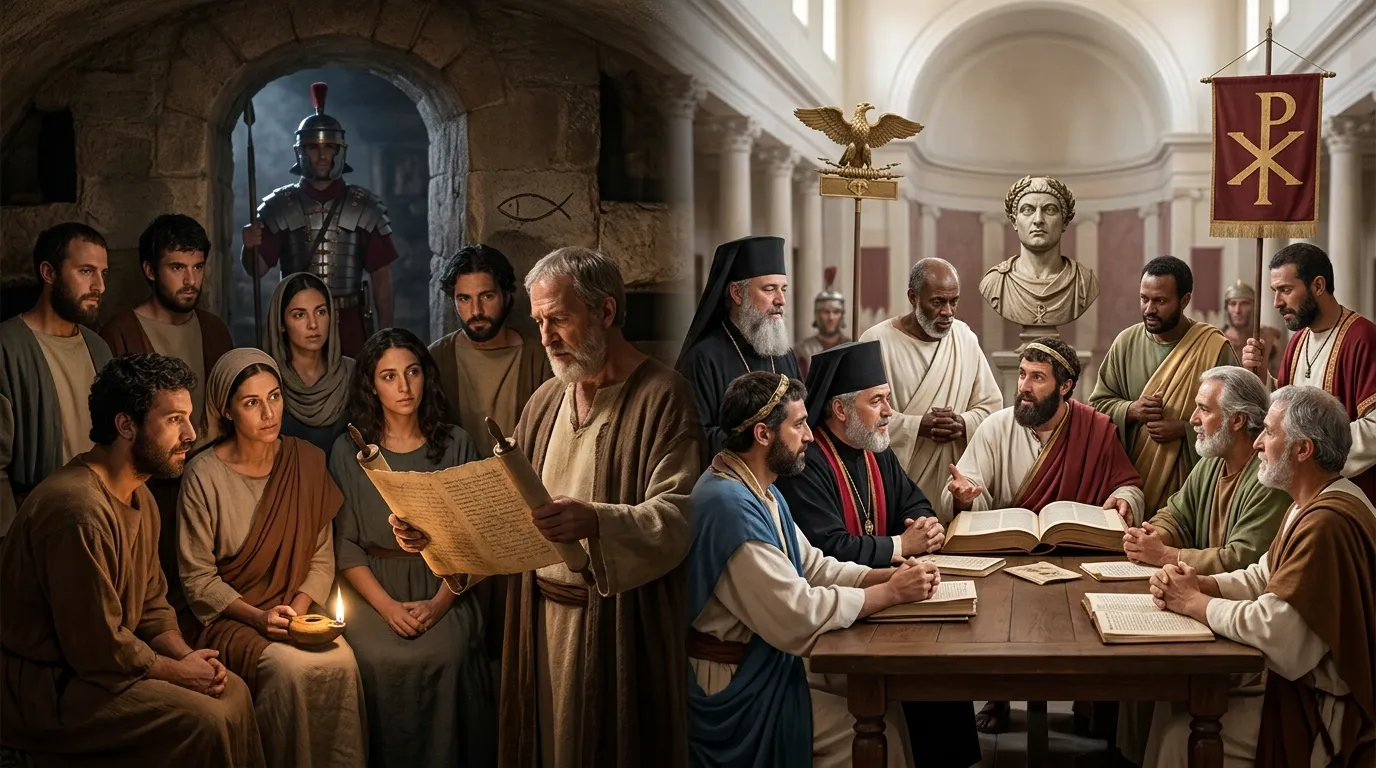
Constantine the Great never appears in the Bible. That single fact should shape everything Christians say about him. He was born after the New Testament was written, came to power in the early fourth century, and died in AD 337. Yet his reign changed the public position of Christianity more dramatically than any event since Pentecost. Christians who want to understand Constantine biblically therefore face an interesting task: Scripture cannot tell us what to think of the man himself, but it gives us the principles by which to weigh what his reign meant, both the relief it brought and the complications that came with it.
From Persecuted Minority to Imperial Favor
For its first three centuries, Christianity existed in the Roman Empire under varying degrees of suspicion and hostility. Believers were sometimes tolerated and sometimes targeted. The Great Persecution under Diocletian, beginning in AD 303, was the most systematic attempt to destroy the church: Scriptures were seized, meeting places were demolished, and clergy were arrested. Christians who lived through it carried the memory for generations.
Constantine’s rise changed that landscape. After his victory at the Milvian Bridge in AD 312, a battle he later associated with a vision of the cross, he moved toward open support of the church. In AD 313, he and his co-emperor Licinius issued what is commonly called the Edict of Milan, which granted religious toleration across the empire and ordered the return of confiscated Christian property. For believers who had worshiped in fear, this was an extraordinary reversal: the faith that had been a crime was now protected by imperial law.
Nicaea and the Emperor in the Church’s Business
Constantine’s involvement did not stop at toleration. In AD 325 he convened the Council of Nicaea, bringing bishops from across the empire together to settle the Arian controversy over the nature of Christ. The council affirmed that the Son is of the same substance as the Father, a confession that still anchors Christian orthodoxy. Constantine provided the setting, the travel, and the pressure for agreement, but the theological work belonged to the bishops.
This is where the story gets complicated, and where biblical principles become essential. An emperor can call a council, but an emperor cannot make doctrine true. The authority of Nicaea rests on its faithfulness to Scripture, not on the fact that Constantine endorsed it. Christians can be grateful for the council’s outcome while recognizing that imperial involvement in church affairs carries real dangers. Power that can protect a faith can also try to manage it.
What Scripture Says About Rulers
Since the Bible never names Constantine, Christians must reason from what it does say about government and power. Romans 13 teaches that governing authorities are instituted by God and serve as instruments of order, restraining evil and rewarding good. That passage helps explain why a season of toleration could be received as a genuine mercy: a government doing its proper work can make room for the church to live and worship in peace, and Paul himself urges prayer for rulers so that believers may lead quiet and peaceable lives (1 Timothy 2:1-2).
But Scripture also draws a sharp line around ultimate allegiance. Jesus taught His followers to render to Caesar what is Caesar’s and to God what is God’s (Matthew 22:21), a distinction that refuses to hand the whole of life to any emperor. Revelation, written under Roman persecution, pictures earthly power as a beast that demands worship and crushes dissent (Revelation 13). Daniel’s visions had already taught the same lesson: kingdoms rise and fall, and only God’s kingdom endures (Daniel 2:44). The New Testament therefore holds two truths together: government can be God’s servant for order, and government can become an idol that demands what belongs to God alone.
The Mixed Legacy of Imperial Christianity
Constantine’s reign illustrates both sides of that tension. On the one hand, the end of persecution was an unmixed good. Christians could worship openly, build meeting places, care for the poor, and speak publicly without fear of arrest. Bishops who had survived torture could now debate theology in the open. The church grew rapidly, and the gospel reached people it had never reached before.
On the other hand, imperial favor brought new temptations. When Christianity became advantageous, people joined for reasons that had little to do with faith. Church leadership began to carry political weight. Disputes that had once been settled by persuasion and Scripture could now be settled by appealing to the emperor. Over the centuries, the alliance between church and empire would produce great achievements and grievous failures, from the spread of missions to the coercion of dissenters. Constantine did not cause all of that, but his reign opened the door.
Was Constantine a Christian?
Historians still debate the sincerity and depth of Constantine’s faith. He delayed baptism until his deathbed, which was a common practice at the time among people who believed baptism washed away sins and wanted to postpone it as long as possible. He continued to use some imperial imagery with pagan associations, and his political decisions were often ruthless, including the execution of members of his own family. At the same time, he wrote letters expressing Christian convictions, built churches, supported bishops, and presented himself as a servant of God.
Christians should resist both easy answers here. Declaring him a saint ignores the violence and political calculation of his reign. Declaring him a fraud ignores the genuine changes his policies brought and the possibility of real, if imperfect, faith. Scripture itself warns against judging the heart from the outside; only God sees it fully. What believers can judge is the fruit of policies and the faithfulness of the church’s response to them.
Lessons for Christians Living Under Power
The Constantine story offers several lessons that outlive the fourth century. First, religious freedom is a genuine blessing worth gratitude and prayer, not something to take for granted. Christians who live in tolerant societies should recognize it as a mercy, the way the first recipients of the Edict of Milan surely did.
Second, favor is not the same as faithfulness. A church that is protected can grow lazy, confusing cultural influence with spiritual health. The health of the church is measured by its fidelity to Christ, its love for neighbors, and its willingness to speak truth even when it costs something, not by its access to power.
Third, the kingdom of God does not rise or fall with any emperor. The church survived Diocletian’s persecution, and it survived Constantine’s patronage. It has survived both hostility and favor in every century since. That survival is not a tribute to political skill. It is a testimony to the promise that Christ builds His church, and that no political arrangement, friendly or hostile, gets the final word.
Constantine’s Own Words and Actions
What did Constantine himself believe? His letters and public statements show a man who spoke of God as the giver of his victories and who presented his reign as service to the divine. He credited his success to the God of the Christians, built churches in Rome, Constantinople, and the Holy Land, and exempted Christian clergy from certain civic duties. He also kept the title of pontifex maximus, the traditional head of Roman state religion, and his coinage for years continued to carry familiar pagan imagery alongside Christian symbols. Historians read this mixture in different ways: some see a gradual, genuine conversion; others see a shrewd politician hedging his bets; still others see a man whose faith was real but shaped by the assumptions of a Roman emperor.
Christians should be slow to settle the question of his heart, and quick to learn from his policies. The policies are public record: toleration, restoration of property, support for the church, and involvement in its disputes. The heart is known to God alone. What the church can evaluate is the fruit: the end of persecution was mercy; the entanglement of church and state that followed was a temptation the church is still learning to navigate.
The Donatist Controversy: A Test Case
One early test of imperial involvement came from North Africa. After the Great Persecution, the church there split over whether clergy who had handed over Scriptures under pressure could still serve. The Donatists said no; the larger church said the sacraments did not depend on the minister’s purity. Both sides appealed to Constantine. He convened councils, heard the case, and ruled against the Donatists. The Donatists refused to accept the verdict and accused the emperor of interfering in church affairs.
The controversy is instructive. Constantine’s intervention did not settle the dispute. It deepened it, and the Donatist schism lasted for centuries. The episode shows a limit of imperial power: an emperor can compel attendance, fund buildings, and enforce rulings, but he cannot produce unity of heart. The church’s unity comes from the Spirit and the truth, not from the throne. When the church outsources its disputes to political power, it gains a verdict and loses something more valuable: the hard work of persuasion, repentance, and reconciliation.
Constantine’s reign therefore belongs to church history, not to biblical prophecy, and Christians do best to keep that distinction clear. Scripture gives us the lens; history gives us the case study. Readers who want the historical record of his life, reign, and conversion debate can consult the Wikipedia article on Constantine the Great.