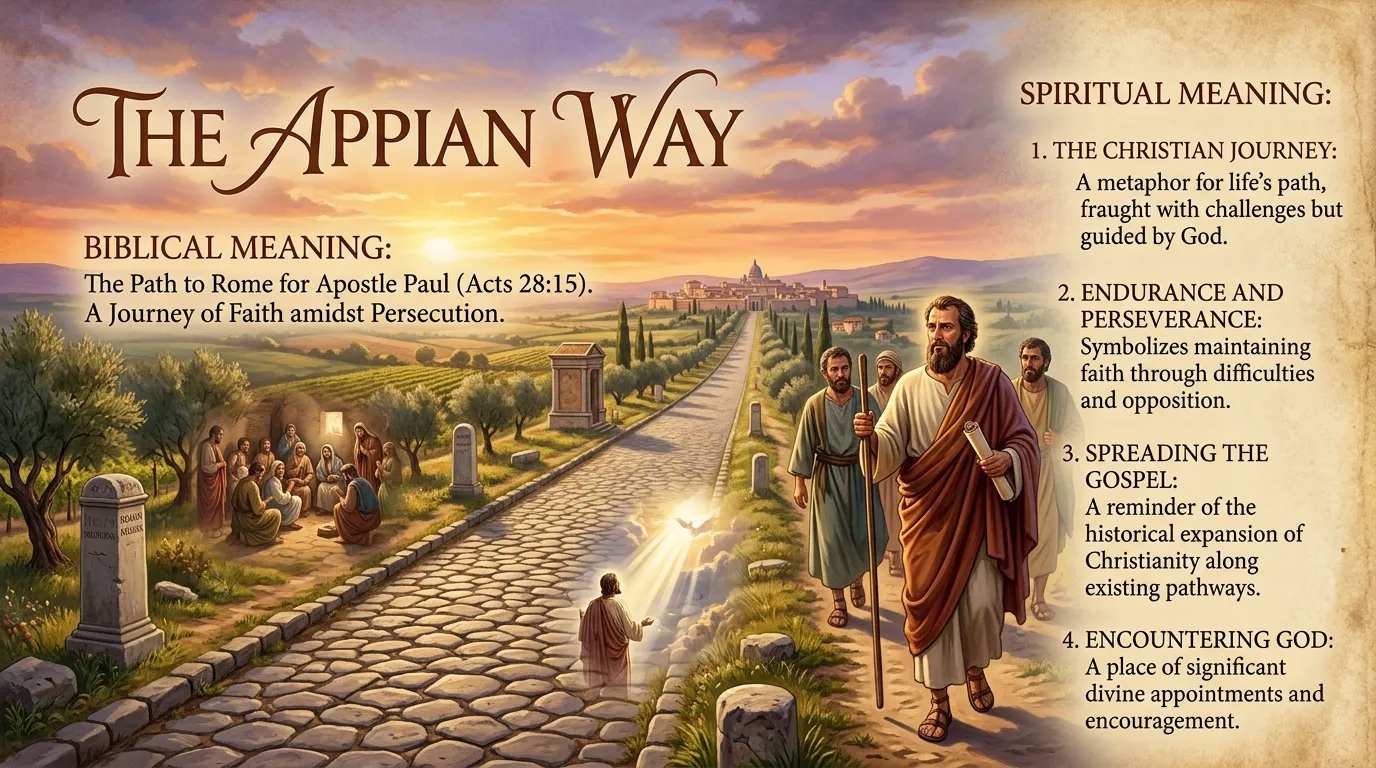
Paul did not walk into Rome alone. He arrived as a prisoner, worn down by shipwreck, a winter stranded on Malta, and months of slow travel under guard. Yet before he reached the city, something happened on an old road that changed the color of the whole journey. Believers from Rome came out to meet him. Luke records the moment in a single, warm sentence: when Paul saw them, he thanked God and took courage (Acts 28:15). The Appian Way is the road where that meeting took place, and its meaning in the Bible is bound up with that encouragement, not with any hidden code in the paving stones.
The Appian Way was one of the great roads of the Roman world. Begun in the fourth century BC and named for the censor Appius Claudius Caecus, it ran south from Rome toward Capua and eventually to the port of Brundisium. Roman engineers built it straight and solid, with fitted stone slabs meant to carry legions, officials, merchants, and mail in all weather. By Paul’s day it had carried armies and ambassadors for centuries, and ordinary travelers knew it as the main route into the capital from the south. When Paul’s party left the ship at Puteoli and set out overland, this was the road that brought them home to Rome.
Two Stops on the Road to Rome
Acts 28:15 names two meeting points: the Forum of Appius and the Three Taverns. The Forum of Appius lay about forty-three miles south of Rome, a market town where travelers rested and changed horses. The Three Taverns stood about ten miles closer to the city, roughly thirty-three miles out. Some believers walked all the way to the farther stop; others met Paul at the nearer one. Either way, they walked a long distance out of the city to greet a prisoner they had never met in person, simply because he belonged to the same Lord.
That detail matters more than it first appears. Paul had written to the Roman Christians years earlier, telling them he longed to visit them (Romans 1:11). He had not been able to come on his own terms. He came in chains, appealing to Caesar, after two years of detention in Caesarea and a storm that nearly killed everyone aboard his ship. The Roman believers could have waited politely inside the city for his arrival. Instead, they went out to the road. Their welcome turned a prisoner’s march into a homecoming.
Why Luke Bothered to Name the Road
Luke, the writer of Acts, is careful with travel details throughout the book, and this passage is no exception. He names the ship, the ports, the island, and the road because he is writing history, not allegory. The Appian Way has no secret spiritual meaning assigned to it in Scripture. No verse treats it as a symbol of heaven, judgment, or the Christian life in general. What the passage does show is how God sustains His servants through other people at the hardest points of the journey.
Consider what Paul had already endured. He had been arrested in Jerusalem, held in Caesarea, shipwrecked off Malta, bitten by a snake, and delayed by winter. He was sailing toward a trial before the emperor with an uncertain outcome. Luke tells us that the sight of fellow believers gave him courage. The Greek word behind “took courage” suggests a man gathering his strength again, the way a traveler straightens up when companions appear on the path. God had promised Paul in a vision that he would stand before Caesar (Acts 27:24). That promise held. But God also gave him the human gift of brothers and sisters on the road.
Encouragement as Part of God’s Provision
Scripture often pairs God’s promises with God’s people. Elijah, exhausted and ready to give up, was met by an angel with food and then by the quiet assurance that thousands in Israel had not bowed to Baal (1 Kings 19). David, hiding from Saul, was strengthened by Jonathan’s visit in the wilderness (1 Samuel 23:16). Paul himself had been encouraged in Corinth by a night vision and in Jerusalem by the Lord standing near him (Acts 18:9-10; 23:11). The meeting on the Appian Way belongs in that same pattern: God carries His servants through presence, promise, and people.
There is also something instructive in the direction of the journey. The believers walked outward, toward Paul, before Paul reached them. Encouragement often works that way. It is not a passive sympathy offered from a safe distance; it is movement toward someone who is struggling. The Roman Christians did not know exactly what Paul needed. They knew he was coming, that he was in chains, and that he belonged to them in Christ. That was enough to put them on the road.
What the Road Cannot Teach Us
It is worth being honest about the limits of this passage. Some readers want every biblical road to stand for the road of life, and every journey to encode a step-by-step map of spiritual progress. The Appian Way does not support that kind of reading. The Bible never uses it as a metaphor, and Paul never refers to it again. If we turn the road into a mystical symbol, we actually shrink the passage, replacing a real moment of fellowship with an invented puzzle.
The stronger reading is simpler. God is at work in ordinary geography: in ports and market towns, on highways built by an empire that did not know Him, in the decision of a few Christians to walk a long way to welcome a prisoner. The road itself was built for Rome’s power. On that particular day, it carried something Rome could not build: the fellowship of people united by the gospel.
Three Days Later, Rome
Paul’s story does not end on the road. Three days after arriving in Rome, he called together the local Jewish leaders and explained his situation (Acts 28:17). He was allowed to live by himself with a soldier guarding him, and there he preached the kingdom of God and taught about the Lord Jesus Christ openly and without hindrance (Acts 28:30-31). The book of Acts closes on that note of unhindered witness. The courage Paul found on the Appian Way was not a fleeting emotion; it carried into two years of steady ministry under house arrest.
That arc gives the passage its lasting weight. The same man who needed encouragement on the road became, in Rome, a source of encouragement to others. He wrote letters from prison that still steady Christians today, including Philippians, with its repeated call to rejoice in the Lord. The welcome he received became part of the strength he later gave away.
Reading the Passage Today
For a Christian reader today, the Appian Way passage offers a quiet, practical word. Long journeys of faith rarely end in a single dramatic rescue. They are carried forward by small provisions along the way: a letter, a visit, a friend who walks out to meet you before you arrive. Paul’s courage did not come from the road, but from the God who met him on it through His people.
The Welcome Party Paul Did Not Arrange
One detail of the Appian Way meeting deserves a closer look: Paul did not send for these believers. He had no phone, no messenger service, and no way to announce his arrival date with precision. The Roman Christians had to be watching for him. They knew he was coming because his letter had said so, and because news traveled along the same road he was walking. When word reached Rome that Paul’s party had landed at Puteoli, some of them set out immediately, walking a full day south to meet him at the Forum of Appius. Others went as far as the Three Taverns. Their welcome was not organized by Paul. It was organized by affection.
That kind of welcome cannot be manufactured by the person receiving it. It is the fruit of a relationship built long before the meeting. Paul had invested in the Roman church through his letter, through his prayers for them, and through friends like Priscilla and Aquila who had carried his greetings. The believers on the road were returning what he had given. Encouragement is often like that: it looks spontaneous in the moment, but it grows out of years of faithful investment in people.
A Road Built for Empire, Used for Fellowship
The Appian Way was built for Rome’s purposes. It carried legions to war, tax collectors to the provinces, and officials to their posts. Its straight lines and stone surface were monuments to imperial order. On the day Paul walked it, the road was doing something its builders never intended: carrying the fellowship of the gospel into the capital of the empire. The same stones that had carried armies now carried a prisoner and the brothers who had come to meet him.
This is a pattern that repeats throughout Acts. The empire’s roads carried the gospel. The empire’s ships carried the apostles. The empire’s law protected the missionaries. The empire’s capital became the mission’s headquarters. God did not need Rome’s infrastructure, but He used it, and He turned the instruments of imperial power into the instruments of a very different kingdom. The Appian Way is a small, concrete instance of that larger irony: a road built for Caesar became a road where the servants of Christ encouraged one another.
It also offers a challenge. Someone in your life is on a hard stretch of road right now, perhaps a stretch you cannot fix. The Roman believers could not free Paul, argue his case, or shorten his trial. They could walk toward him. That is often what encouragement looks like: showing up, being seen, and letting a weary traveler know he is not walking alone. If you want background on the road itself, its construction, and its route through Italy, the Wikipedia entry on the Appian Way is a useful place to start: Appian Way.










