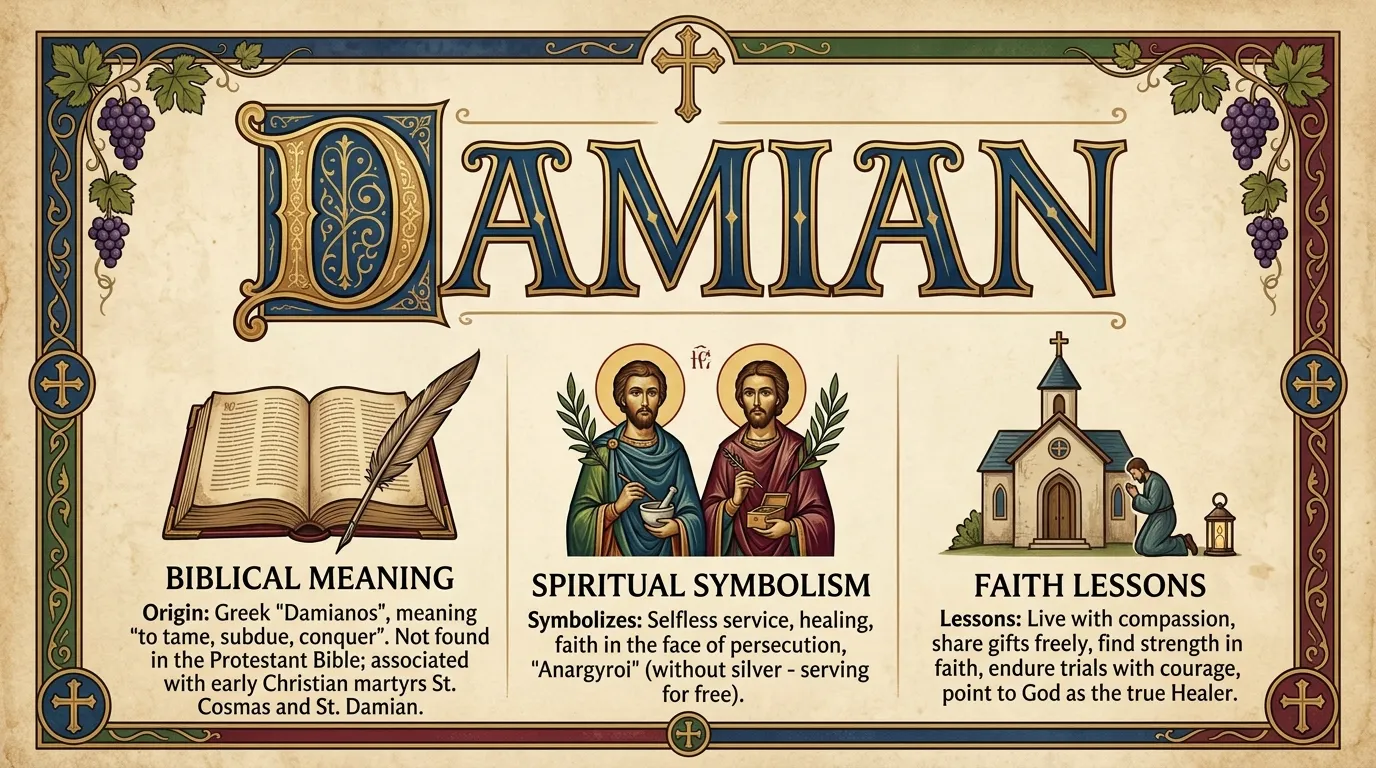
Some names arrive with a question attached. Damian is one of them. Parents considering it for a son wonder what it would mean for him to carry it. Adults named Damian wonder what story their name has been telling all these years. And because the name sounds vaguely ancient, many assume it must come from the Bible. Let us start with the fact that clears the ground for everything else: the name Damian does not appear in Scripture. Not once, in any book, in any translation.
Clearing the Ground: What Damian Is Not
Honesty first. Damian is not a biblical name. There is no Damian among the apostles, no Damian among the patriarchs, no town or tribe by that name. If you are looking for a verse that mentions Damian, you will not find one, and anyone who claims otherwise is mistaken.
This matters because the question behind the question is usually about legitimacy. Is this a “Christian” name? Can I give it to my child with a clear conscience? Does it carry some hidden meaning I should know about? The Bible’s silence is itself an answer: the name carries no biblical baggage, good or bad. It is a name from history, not from Scripture, and it stands or falls on what its bearers make of it.
But the Bible is not silent about everything connected to the name. Damian comes from the Greek Damianos, rooted in a verb meaning “to tame” or “to subdue.” And taming, it turns out, is one of Scripture’s great themes. The name may not be biblical, but the idea inside it runs through the Bible like a river.
The Wildest Thing: The Tongue
James gives us the Bible’s most vivid picture of an untamed thing, and it lives in our mouths. “The tongue is a small part of the body, but it makes great boasts. Consider what a great forest is set on fire by a small spark” (James 3:5). He goes further: “No human being can tame the tongue. It is a restless evil, full of deadly poison” (James 3:8).
Read that as a diagnosis of the human condition. We can tame lions and train falcons, land spacecraft and split atoms, but the three inches of muscle behind our teeth defeats us daily. Gossip, slander, cruelty dressed as honesty, promises made and broken, the tongue is the last wilderness, and every one of us lives with it untamed.
This is where the gospel does its deepest taming work. The Holy Spirit does not merely restrain the tongue; He transforms the heart that drives it. “Out of the overflow of the heart the mouth speaks” (Luke 6:45). Taming the tongue is really about taming the heart, and that is work only God can do. A name meaning “tamer” becomes, for the Christian, a lifelong prayer: Lord, tame my tongue.
Self-Control: The Taming of the Whole Person
The New Testament names the Spirit’s taming work directly: self-control. It appears in the fruit of the Spirit (Galatians 5:23), in Peter’s ladder of virtues (2 Peter 1:6), and in Paul’s charge to Titus that believers in every season of life should be self-controlled (Titus 2:2-6). The Greek word is enkrateia, literally strength turned inward, power under control.
Notice what self-control is not. It is not the absence of passion. The self-controlled person feels anger, desire, ambition, and appetite as strongly as anyone. The difference is mastery. Like a tamed horse, the energy remains, but it now serves the rider instead of throwing him. Paul describes his own body as something he disciplines, “I strike a blow to my body and make it my slave” (1 Corinthians 9:27), the language of taming applied to himself.
This reframes the name’s meaning beautifully. To be a “tamer” in the biblical sense is not to dominate others. It is to master yourself. The strong man in Scripture is not the one who subdues nations but the one who rules his own spirit: “Better a patient person than a warrior, one with self-control than one who takes a city” (Proverbs 16:32). True taming begins at home, in the heart.
Gentleness: Taming Without Breaking
There is a kind of taming that breaks the thing it tames, and there is a kind that preserves it. Scripture is clear about which kind God practices. “A bruised reed he will not break, and a smoldering wick he will not snuff out” (Isaiah 42:3). When God tames us, He does not crush us. He gentles us.
Jesus is the model. He called Himself “gentle and humble in heart” (Matthew 11:29), and yet He is the one before whom every knee will bow. His gentleness was not weakness; it was power under perfect control, the ultimate taming. He could have called legions of angels; He chose the cross. Strength restrained by love is the highest form of mastery.
This corrects a common misunderstanding of the name’s root. “Subduer” can sound harsh, even violent. But biblical taming, at its best, looks like the shepherd with the sheep, the father with the child, the Savior with the sinner. It is power exercised for the good of the one being tamed. Anyone named Damian has, in the root of his name, an invitation to this kind of strength: firm, but never cruel.
The Passions That Need Taming
Scripture is specific about what in us needs taming, and the list is uncomfortably practical. Anger: “Everyone should be quick to listen, slow to speak and slow to become angry” (James 1:19). Appetite: Paul warns that for some, “their god is their stomach” (Philippians 3:19). The love of money, the hunger for approval, the restless scroll of envy, each is a wild thing demanding to be master.
The Bible’s strategy for taming these is not mere willpower. It is replacement. “Walk by the Spirit, and you will not gratify the desires of the flesh” (Galatians 5:16). You do not tame the flesh by fighting it on its own terms; you tame it by feeding the Spirit until the Spirit is stronger. Starve the wild thing, feed the tame one, and watch which grows.
This is slow work, and Scripture is honest about that. Sanctification is a lifetime of small tamings: the sharp word swallowed, the purchase declined, the grudge released, the prayer prayed when distraction beckons. Nobody masters themselves in a day. But the direction matters more than the speed, and grace covers the stumbles.
Tamed by Trials: How God Does the Taming
How does God actually tame us? Often, through the very things we would never choose. Hebrews 12 describes God’s discipline as the training of a father who loves his children: “No discipline seems pleasant at the time, but painful. Later on, however, it produces a harvest of righteousness and peace for those who have been trained by it” (Hebrews 12:11). The Greek word for “trained” is athletic, the word for an athlete drilled into shape. Taming, in God’s hands, is training.
Think of how a wild horse is gentled. Not by breaking its spirit in a day, but by patient, repeated, firm handling until trust replaces fear. God works the same way with us. The disappointment that taught you patience. The delay that taught you trust. The failure that taught you humility. None of it felt like taming at the time. All of it was.
This reframes suffering for the believer. The trial you are in right now may be God’s taming work, not His punishment. He is not breaking you; He is gentling you, making you fit for the saddle of His purposes. A tamed horse can be ridden into battle. A tamed heart can be trusted with God’s assignments.
Carrying the Name Well
So what should someone named Damian do with all this? Wear the root meaning as a calling. Let “tamer” remind you, every time you hear your name, of the work God is doing in you and the work He wants to do through you. Be the person whose tongue builds up rather than tears down. Be the one whose passions serve his purposes rather than sabotaging them.
And if you are a parent considering the name, consider it with confidence. The Bible gives no reason to avoid it, and its root meaning points toward one of the noblest biblical ideals: a person under God’s control, gentle and strong. Pray over your son that he would grow into the best version of what his name suggests, not a dominator of others, but a master of himself, tamed by grace.
Names do not determine destinies, but they can declare aspirations. Every “Damian” is a small sermon on self-control, preached every time the name is spoken, a reminder that the wildest things in us were made to be mastered by grace. May it be true. For the history of the name itself, its saints, and its spread across cultures, the Wikipedia entry on Damian as a given name gives a helpful overview of the tradition behind it.










