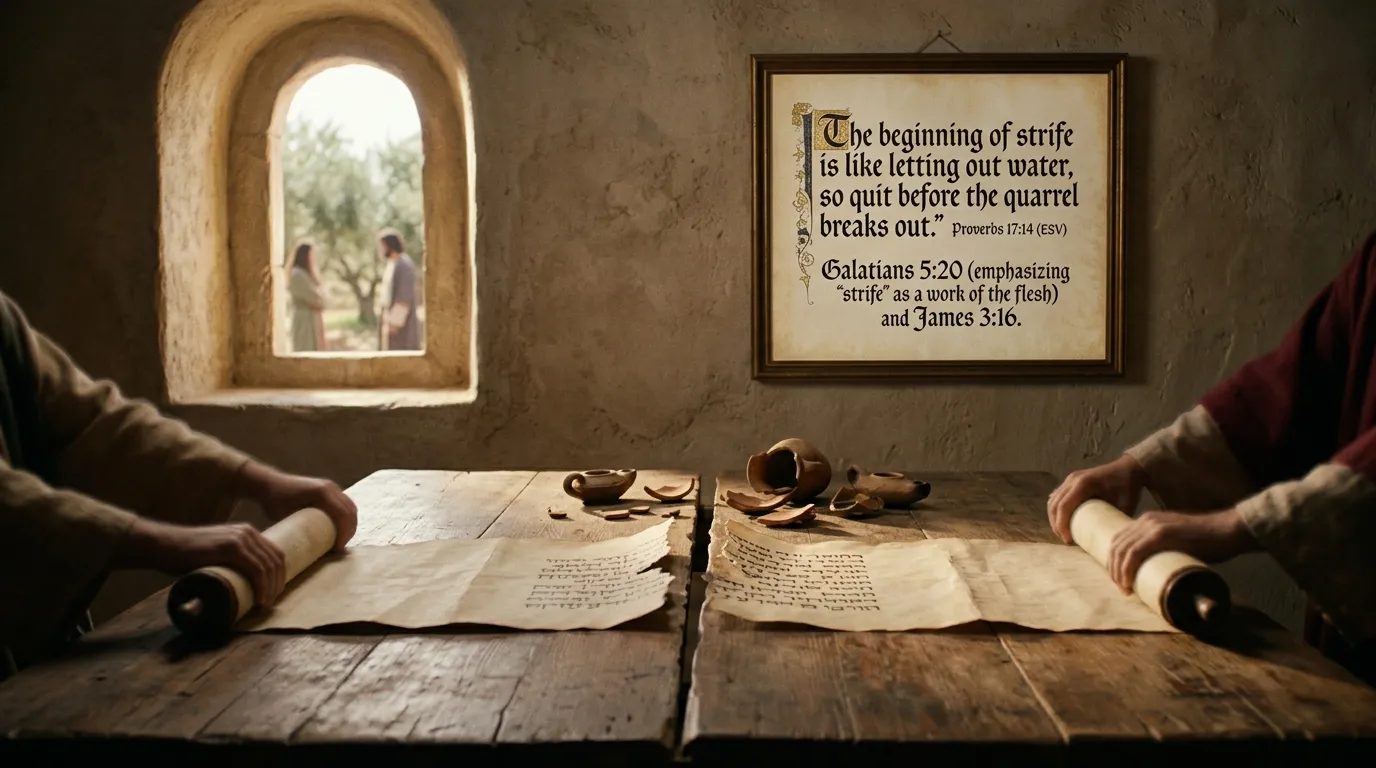
“Better is a dry morsel with quiet than a house full of feasting with strife.” That is Proverbs 17:1, and it is one of the most quietly radical sentences in Scripture. A poor meal eaten in peace beats a banquet eaten in the middle of a fight. The Bible treats strife not as a minor annoyance but as a spiritual poison, something that can sour a home, split a church, and rot a heart from the inside. Yet most of us have lived with strife so long we barely notice it, like a smell we have gone nose-blind to. Scripture refuses to let us stay numb.
The biblical word most often translated as strife comes from Hebrew roots like rib, a legal quarrel or dispute, and madon, contention. In the New Testament, the Greek eris appears in lists of the works of the flesh alongside jealousy, anger, and selfish ambition (Galatians 5:20). Notice the company strife keeps. It is not listed with mistakes or weaknesses. It is listed with sins, deliberate choices of the heart. Strife, in the Bible’s eyes, is what happens when pride, selfishness, or unforgiveness is given a voice and a room to echo in.
Where Strife Is Born
James asks the question most of us avoid: “What causes quarrels and what causes fights among you? Is it not this, that your passions are at war within you?” (James 4:1). Strife does not start between two people. It starts inside one person, in the war between what we want and what we are willing to surrender. The argument at the dinner table is just the smoke; the fire is the unmet desire underneath.
Proverbs maps the fuel sources of strife with the precision of a fire investigator. “A hot-tempered man stirs up strife, but he who is slow to anger quiets contention” (Proverbs 15:18). “An arrogant man stirs up strife” is the diagnosis of Proverbs 28:25. Hatred stirs up strife, but love covers all offenses (Proverbs 10:12). Gossip is listed as kindling too: “For lack of wood the fire goes out, and where there is no whisperer, quarreling ceases” (Proverbs 26:20). Every one of these traces the conflict back to a heart condition, anger, pride, hatred, or a loose tongue, rather than to the other person’s behavior.
This is why strife is so hard to solve by changing circumstances. You can separate the people, change the church, quit the job, or move to a new city, and the strife follows you, because you carried its seed in your own chest. Until the heart is addressed, the quarrels just find new stages.
Portraits of Strife in Scripture
The Bible does not deal in abstractions. It shows strife in living color, and some of its portraits are uncomfortably familiar.
Abraham and Lot. Their herdsmen quarreled over grazing land, and the strife threatened to poison the family (Genesis 13:5-9). Abraham’s response is a masterclass. He did not pull rank as the elder and the one God had called. He gave Lot first choice of the land. Peacemaking, Abraham understood, sometimes means surrendering your rights to protect the relationship. Lot chose the lush Jordan valley, which looked like wisdom and turned out to be Sodom’s doorstep, while Abraham received God’s renewed promise. The peacemaker lost the negotiation and won the blessing.
Paul and Barnabas. Even apostles were not immune. Their sharp disagreement over whether to take John Mark on the missionary journey split the most effective ministry team in the early church (Acts 15:36-41). Scripture does not hide this. It records that the contention was so sharp they parted ways. Yet God, in His sovereignty, multiplied the mission through the split, and years later Paul would ask for Mark, calling him useful (2 Timothy 4:11). Strife between godly people is real, painful, and still not beyond God’s redemption, but notice it was never presented as ideal. It was a fracture God worked around, not a model He commended.
Corinth. Paul’s letters to the Corinthians read like intervention notes for a church drowning in strife. Factions formed around favorite leaders. Members sued each other in pagan courts. The Lord’s Supper became an occasion for division. Paul’s diagnosis cut deep: their quarreling proved they were still thinking like spiritual infants (1 Corinthians 3:3). A church can have correct doctrine, spiritual gifts, and apostolic founders, and still be carnal if strife runs the meetings.
Haman and Mordecai. The book of Esther shows strife metastasizing into something demonic. Haman’s personal hatred of one man grew into a plot to exterminate an entire people (Esther 3). Unchecked strife does not stay personal. It expands until it consumes the innocent, and it ends, as it did for Haman, on the gallows built for someone else.
The True Cost of Contention
Scripture is blunt about what strife costs. It costs wisdom: “Whoever is slow to anger has great understanding, but he who has a hasty temper exalts folly” (Proverbs 14:29). It costs spiritual vitality: Paul warns that biting and devouring one another leads to being consumed by one another (Galatians 5:15). It costs our witness: Jesus said the world would know His disciples by their love (John 13:35), which means a quarreling church preaches a sermon of contradiction every Sunday.
Most sobering, strife costs our fellowship with God. “If anyone says, ‘I love God,’ and hates his brother, he is a liar” (1 John 4:20). Jesus taught that if you remember your brother has something against you, you leave your gift at the altar and go be reconciled first (Matthew 5:23-24). Worship offered over unresolved strife is worship God asks us to pause. The vertical relationship cannot stay healthy while the horizontal ones are bleeding.
Proverbs even suggests a startling hierarchy of evils. “It is better to live in a corner of the housetop than in a house shared with a quarrelsome wife” (Proverbs 25:24), and the same is said of a quarrelsome husband by implication elsewhere. The point is not about gender. It is about how unbearable chronic strife makes the most intimate spaces. A palace becomes a prison when contention lives in it.
Becoming a Peacemaker
The Bible never tells us to become conflict-avoiders. It tells us to become peacemakers, and those are entirely different things. Avoidance buries strife alive; peacemaking kills it properly. Jesus said, “Blessed are the peacemakers, for they shall be called sons of God” (Matthew 5:9). Peacemaking is so godlike that it becomes a family resemblance.
What does it look like in practice? First, be slow. “Let every person be quick to hear, slow to speak, slow to anger” (James 1:19). Most strife escalates because someone spoke at the speed of feeling instead of the speed of wisdom. Second, answer softly. “A soft answer turns away wrath, but a harsh word stirs up anger” (Proverbs 15:1). Tone is theology in action. Third, overlook when you can. “Good sense makes one slow to anger, and it is his glory to overlook an offense” (Proverbs 19:11). Not every wound needs a trial. Some need only the dignity of being left unavenged.
Fourth, confront when you must, and do it God’s way. Jesus gave a clear pattern in Matthew 18: go privately first, bring witnesses only if needed, involve the church only as a last resort. Most strife festers because people skip the first step and start with the audience. Fifth, forgive as you have been forgiven. The parable of the unforgiving servant (Matthew 18:21-35) remains the most terrifying passage about strife in the New Testament. A man forgiven an unpayable debt strangled a fellow servant over pocket change, and the master revoked the mercy. Refusing to forgive after receiving forgiveness is, in Jesus’ telling, the one thing that can forfeit grace.
Finally, pursue peace actively. “Strive for peace with everyone, and for the holiness without which no one will see the Lord” (Hebrews 12:14). Peace is not the absence of conflict. It is the presence of reconciling love, pursued on purpose, even when it costs.
Strife at Home: Where the Battle Hits Closest
Strife does its worst damage not in boardrooms but in living rooms. The Bible is realistic about this. Proverbs warns about the quarrelsome spouse, but it also gives the positive pattern for the home. “Husbands, love your wives, and do not be harsh with them” (Colossians 3:19). Harshness is strife’s seedbed in marriage. Paul tells fathers not to provoke their children, lest they become discouraged (Colossians 3:21), because a provoked child becomes either a rebel or a people-pleaser, and both carry strife into the next generation.
The household rules for killing strife are the same as everywhere else, but they require more humility because home is where we are least guarded. Listen before speaking. Apologize specifically rather than generally. (“I’m sorry you feel that way” is not an apology; “I was wrong to speak to you like that” is.) Keep short accounts. And pray together, because it is remarkably hard to stay furious at someone while holding their hand and thanking God for them. A home without strife is not a home without disagreement. It is a home where disagreement is handled by people who have decided the relationship matters more than winning.
Strife will always be with us this side of heaven, because pride will always be with us. But it does not have to rule our homes, our churches, or our hearts. The same book that diagnoses strife so ruthlessly also promises that the God of peace will be with the peacemaker (Philippians 4:9). For a deeper look at how the concept of strife has been understood across history and literature, the Wikipedia article on conflict offers useful background, but Scripture remains the final authority: where strife once reigned, the Prince of Peace intends to reign instead.










