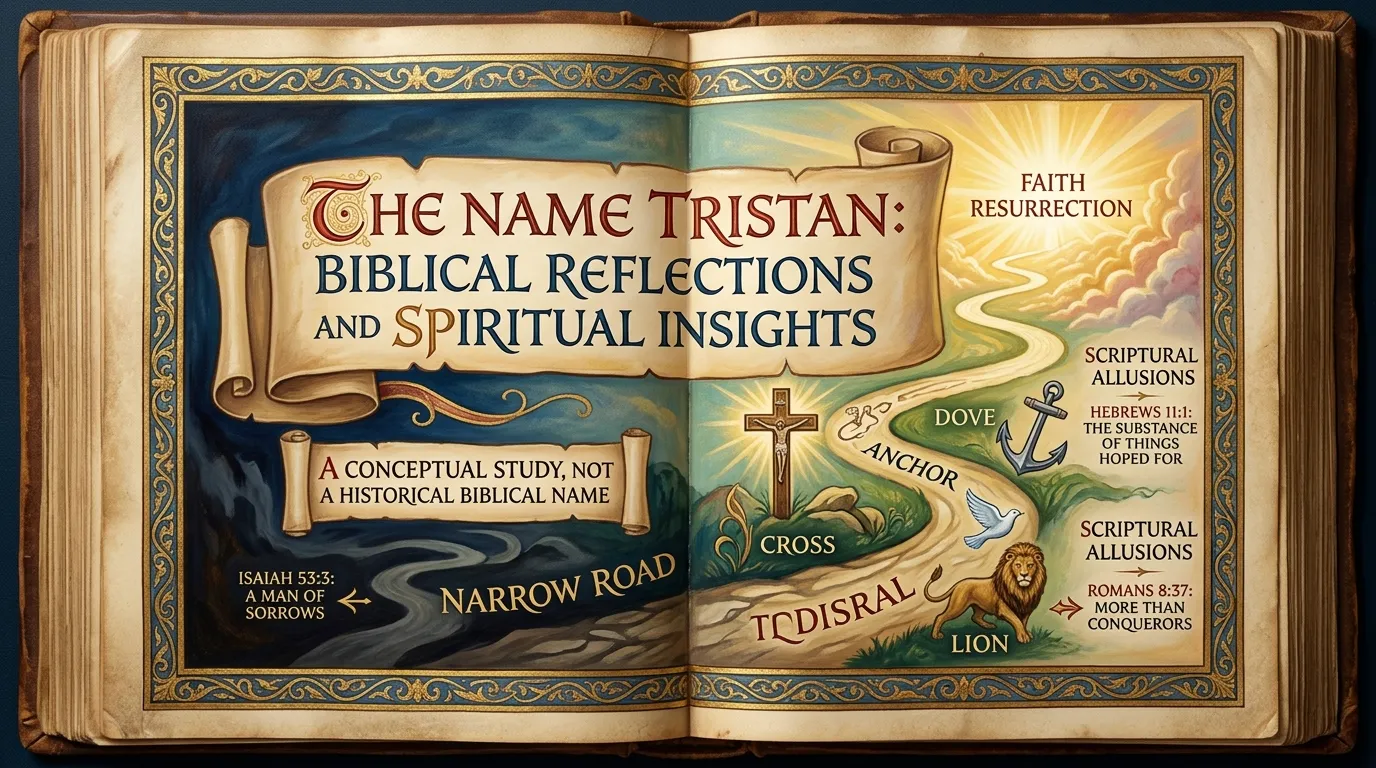
Picture a knight standing on a cliff above a grey sea, a broken sword in his hand and a sorrow in his chest that no victory could heal. That image belongs to the legend of Tristan, the tragic hero of medieval romance, whose very name seems to sigh. For centuries, storytellers have told of Tristan and Isolde, lovers caught between loyalty and longing, and the name Tristan has carried that shadow of beautiful sadness ever since. So when someone searches for the meaning of Tristan in the Bible, they are usually asking a deeper question: can a name born of sorrow have any hope in it at all?
Here is the honest answer, and it matters more than a polished one. The name Tristan does not appear anywhere in Scripture. It is not Hebrew, not Greek, not Aramaic. It comes from Celtic and medieval French roots, and its most common meaning is sorrow or sadness, likely connected to the French word triste, meaning sad. Some name traditions also link it to bravery and endurance through hardship, the kind of courage that keeps walking when the road is dark. There is no verse that mentions Tristan, no genealogy that includes him, no prophet who spoke his name.
That honesty is important, because the Bible has strong words for people who invent spiritual authority where none exists. But honesty does not end the conversation. It begins it. The Bible may not contain the name Tristan, but it is full of the very experience the name describes: sorrow carried by people God loved, and comfort given by a God who never looked away from tears. If your name is Tristan, or you love someone who bears it, Scripture has more to say to that sorrow than any legend ever did.
The Legend Behind the Name
To understand why Tristan sounds the way it does, you have to visit the old stories. In the medieval tale of Tristan and Isolde, Tristan is a Cornish knight sent to escort the Irish princess Isolde to marry his uncle, King Mark. On the voyage they accidentally drink a love potion meant for the wedding, and fall hopelessly in love. What follows is a story of torn loyalties, secret meetings, exile, and finally death, with the lovers buried in graves from which a vine and a rose grow toward each other.
Earlier versions of the name appear as Tristram or Drystan, and scholars debate the exact root. The most widely repeated explanation connects it to the idea of sorrow, noise, or tumult, the sound of sadness itself. Whether the sorrow came first and the legend grew around it, or the legend deepened the sorrow in the name, the association stuck. Parents who choose Tristan today usually love its sound, its strength, its romantic history, not its sadness. But the meaning lingers underneath like a minor key in music.
The Bible understands minor keys. It does not flinch from sorrow, and it never treats sadness as a failure of faith. That is where the real conversation between this name and Scripture begins.
A Man of Sorrows, Not a Stranger to Grief
The prophet Isaiah, writing centuries before Christ, gave the coming Messiah a title that echoes the very meaning of Tristan: “a man of sorrows and acquainted with grief” (Isaiah 53:3). Read that slowly. The central figure of the Christian faith is not described as a stranger to sadness but as someone intimately familiar with it. Jesus wept at the tomb of His friend Lazarus (John 11:35). He grieved over Jerusalem, the city that rejected Him (Luke 19:41). In Gethsemane, He told His disciples that His soul was overwhelmed with sorrow to the point of death (Matthew 26:38).
This matters enormously for anyone carrying a name that means sorrow. The Bible does not present a God who stands at a distance from grief, offering slogans. It presents a Savior who entered grief, wore it, and carried it to a cross. Whatever sorrow the name Tristan names, Jesus has already named it too, in a garden, at a grave, on a hill outside Jerusalem.
The Psalms give this sorrow a language. Nearly a third of the psalms are laments, songs of grief sung directly to God. “The Lord is close to the brokenhearted and saves those who are crushed in spirit” (Psalm 34:18). That is not a promise for people who have their lives together. It is a promise for the crushed, the weeping, the ones whose names might as well mean sorrow. David wrote, “You have kept count of my tossings; put my tears in your bottle” (Psalm 56:8). Every sleepless night, every tear, is noticed and recorded by God. Sorrow, in Scripture, is never wasted and never unseen.
Two Kinds of Sorrow
Scripture draws a line that the legends never drew. Not all sorrow is the same. Paul writes to the Corinthians about “godly sorrow” that produces repentance and leads to salvation, and contrasts it with “worldly sorrow” that produces death (2 Corinthians 7:10). One sorrow moves a person toward God; the other moves them away from hope.
The sorrow in the Tristan legend is mostly the second kind, a beautiful, drowning grief with no redemption in it. Lovers destroyed by a love they could not honor. But biblical sorrow has a direction. Hannah wept bitterly in the temple and poured out her soul to the Lord, and her sorrow became the prayer that gave Israel the prophet Samuel (1 Samuel 1:10-20). The Israelites wept by the rivers of Babylon, and their weeping became the soil in which hope for restoration grew (Psalm 137). Even Peter, who wept bitterly after denying Christ (Luke 22:62), found that his tears were not the end of his story but the doorway to his restoration on a Galilean beach (John 21).
For anyone named Tristan, this distinction is a gift. The name may speak of sorrow, but Scripture gets to say what kind of sorrow it will be. Sorrow that runs to God becomes prayer. Sorrow that stays with God becomes hope. “Weeping may tarry for the night, but joy comes with the morning” (Psalm 30:5).
Comfort for the Sorrowful: What Scripture Actually Promises
If the name carries sadness, the Bible answers with one of its most repeated promises: comfort. Jesus opened His most famous sermon with it: “Blessed are those who mourn, for they shall be comforted” (Matthew 5:4). Notice He did not say blessed are those who never mourn. Mourning is assumed. The blessing is the comfort that meets it.
The New Testament gives the Holy Spirit a name built for sorrow: the Comforter, the Helper, the Advocate (John 14:16). Paul calls God “the Father of mercies and God of all comfort, who comforts us in all our affliction” (2 Corinthians 1:3-4), and then adds the purpose, so that we may comfort others with the comfort we received. Sorrow, in God’s economy, becomes a ministry. The person who has wept can sit with someone who is weeping and say, truthfully, I understand, and God met me there.
And Scripture ends the way every sorrowful heart hopes it might. Revelation describes a day when “He will wipe away every tear from their eyes, and death shall be no more, neither shall there be mourning, nor crying, nor pain anymore, for the former things have passed away” (Revelation 21:4). The legends of Tristan end with graves and vines. The Bible ends with tears wiped away by the hand of God Himself.
Living With the Name: A Word to Tristans and Their Families
Names shape us more than we admit. A boy named Tristan may one day look up his name and find the word sorrow staring back. Here is what Scripture would tell him. First, sorrow is not a curse. Some of the greatest people in the Bible carried grief as part of their calling: Joseph in prison, David in the caves, Jeremiah in the ruins, Jesus in the garden. Second, a name’s dictionary meaning is not a destiny. God renamed people throughout Scripture, Abram to Abraham, Jacob to Israel, Simon to Peter, not because their old names were meaningless but because God’s purpose was bigger than their past. Even without a renaming, God fills old names with new meaning.
Third, if you chose this name for a child, you chose a name with gravity and beauty, and you can give it a biblical blessing to carry. Pray over your Tristan the words of Isaiah 61, that God gives “a beautiful headdress instead of ashes, the oil of gladness instead of mourning” (Isaiah 61:3). Let the name’s sorrow be the minor key that makes the joy of the Lord sound all the sweeter.
The medieval Tristan never found what he was looking for. But the Bible insists that sorrow is not the end of any story God is writing. For more on how the medieval legend of Tristan and Isolde shaped the name’s sorrowful reputation through the centuries, the Wikipedia overview of the Tristan legend traces its literary history in detail, while Scripture itself offers the deeper answer: the God who collects tears is never far from anyone whose name means sorrow.










