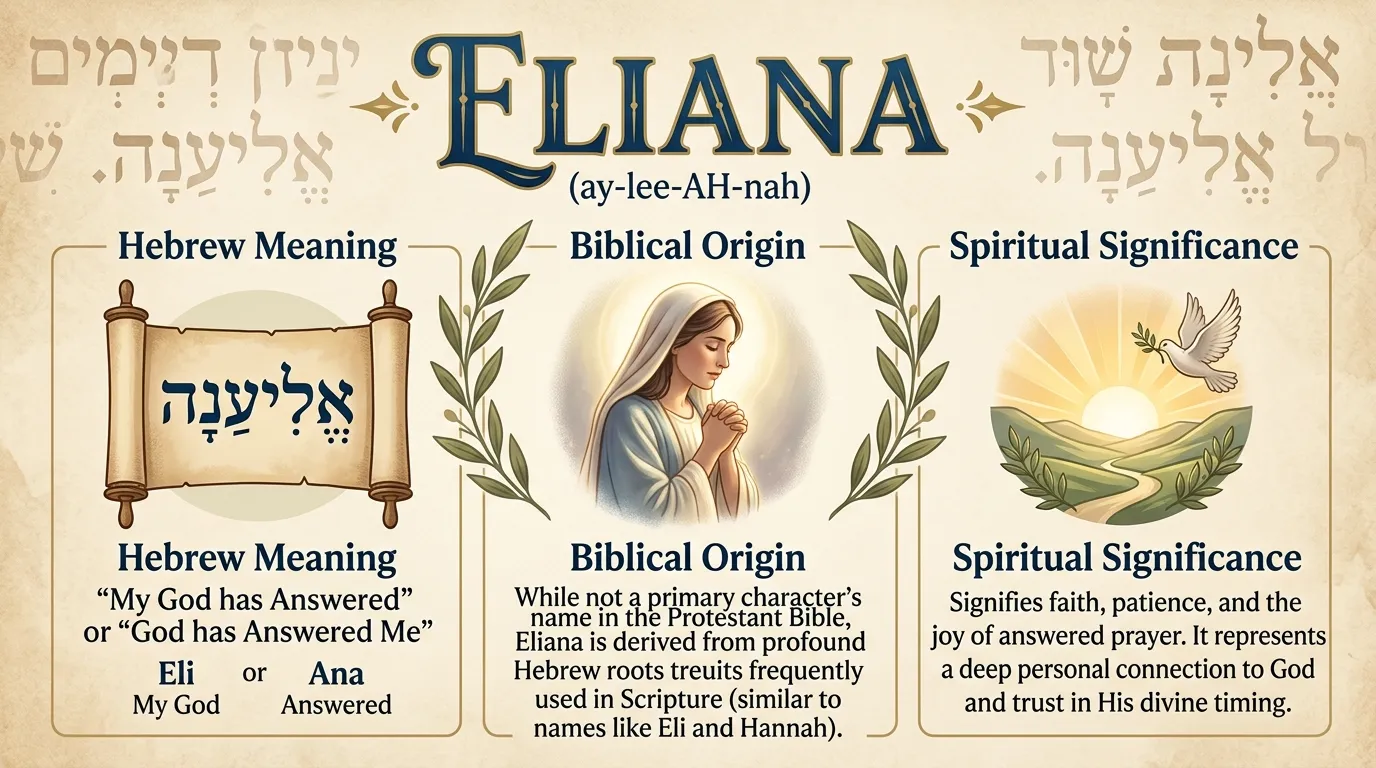
Eliana is not the name of anyone in the Bible. You will not find her in a genealogy or a narrative. But unlike names that merely sound biblical, Eliana is built from genuine Hebrew parts, and those parts tell a story that runs through the whole of Scripture. The name combines El, one of the Bible’s great names for God, with a form of anah, “to answer.” Eliana means, in essence, “God has answered” or “my God has answered me.”
That is not a definition to memorize. It is a testimony to live in. The Bible is full of people who could have worn this name — men and women who prayed, waited, and finally saw God answer. To understand Eliana biblically is to walk through their stories and to ask what it means to live as an answered prayer. This article takes that approach: less dictionary, more discipleship.
The Two Halves of the Name
El is among the oldest names for God in Scripture. It appears in Genesis, in the compound names El Elyon (God Most High), El Shaddai (God Almighty), and El Olam (the Everlasting God). When Hebrew names contain El — Daniel (“God is my judge”), Emmanuel (“God with us”), Elijah (“my God is Yahweh”) — they are making a claim: this person’s life is bound up with God’s character and action. The El in Eliana anchors the name in the God who is, not in vague spirituality.
Anah, the second element, means to answer, to respond, to pay attention. It is the verb of the Psalms’ great prayer language: “In my distress I called to the Lord, and he answered me.” Over and over, the psalmists testify that God answers — not always as expected, not always on schedule, but truly. A name built on anah is a name built on the conviction that prayer is not a monologue. Someone is listening, and the listening leads to action.
Put them together and the name becomes a sentence: God has answered. Every time the name is spoken, it preaches a tiny sermon about a God who hears.
Hannah: The Woman Who Lived This Name
If Eliana had a patron saint in Scripture, it would be Hannah. Her story in 1 Samuel 1 is the Bible’s great portrait of unanswered prayer turning into answered prayer. Hannah is barren in a culture where barrenness feels like a curse. Her husband’s other wife provokes her. Year after year she goes to the tabernacle and weeps. Then, in one of the most moving scenes in the Old Testament, she prays silently — only her lips moving — and the priest Eli mistakes her for a drunk.
Hannah’s response to the accusation is gentle and dignified: she is not drunk, she is pouring out her soul before the Lord. And Eli, perhaps shamed, speaks a blessing: “Go in peace, and the God of Israel grant your petition.” The narrative’s next line is quiet and devastating in its simplicity: Hannah goes away, eats, “and her face was no longer sad.” She has not yet conceived. Nothing has changed — except that she has handed the burden to God, and the handing-over has changed her.
Then God remembers her, and Samuel is born. His name, given by Hannah herself, means “heard of God” or “asked of God” — the masculine counterpart to everything Eliana means. Hannah’s song of thanksgiving in 1 Samuel 2 becomes the template for Mary’s Magnificat a thousand years later: the barren woman and the virgin, singing the same theology. God lifts the humble. God answers prayer. The pattern holds across the centuries.
Living as an Answered Prayer
Here is where the name moves from etymology to application. Many people named Eliana were, quite literally, answers to prayer — long-awaited children, prayed-for daughters, surprises after years of waiting. Their parents chose the name as a memorial, the way the Israelites stacked stones by the Jordan: so that future generations would ask, “What do these stones mean?” and the story would be told again.
But the application runs deeper than origin stories. To carry a name meaning “God has answered” is to carry a vocation. It means living as evidence. When others wonder whether prayer works, whether God notices, whether waiting is worth it, the life of an Eliana is meant to be part of the answer. That is a high calling, and it has a flip side: the name also comforts the bearer in her own seasons of unanswered prayer. The God who answered before is the God who will answer again. His track record is the basis of hope.
There is a subtlety worth noting. “God has answered” does not mean God always says yes. The Bible’s answered prayers include some startling “no”s — Paul’s thorn in the flesh, Jesus in Gethsemane. An answer is not the same as agreement. God answers Hannah with a son; He answers Paul with grace sufficient for weakness. Both are answers. The name testifies to a God who responds, not to a God who can be managed.
The God Who Answers in the Psalms
The Psalms are the church’s prayer book, and they return to God’s answering the way a chorus returns to its refrain. “I sought the Lord, and he answered me.” “In my distress I called upon the Lord; to my God I cried for help. From his temple he heard my voice.” “He has not despised the affliction of the afflicted… but has heard, when he cried to him.”
Notice the pattern in these testimonies: distress first, then crying out, then hearing, then telling. The psalmists do not keep God’s answers to themselves. They publish them. “Come and hear, all you who fear God, and I will tell what he has done for my soul.” A name meaning “God has answered” belongs to this tradition of testimony. It is not private spirituality. It is a public claim, spoken every time the name is used, that God is the kind of God who answers.
This is why the name resonates so deeply with Christian parents. In a world of unanswered emails, unreturned calls, and prayers that seem to vanish into silence, Eliana is a counter-testimony. It says: I know a God who picks up. I have the evidence. Her name is my daughter.
Elizabeth: The Answer in Old Age
Hannah is not the only woman whose story the name could tell. In Luke 1, Zechariah and Elizabeth are righteous, blameless — and childless, “advanced in years.” They have prayed so long that the angel’s announcement startles Zechariah into disbelief: “Your prayer has been heard, and your wife Elizabeth will bear you a son.” The prayer had been prayed for decades. Heaven’s filing system had not lost it.
Elizabeth’s response, when the child finally comes, is pure testimony: “Thus the Lord has done for me in the days when he looked on me, to take away my reproach among people.” She names the shame she carried and the God who removed it. Her son, John the Baptist, becomes the forerunner of the Messiah — which means Elizabeth’s answered prayer was not only personal. It was a link in the chain of redemption. Answered prayers often turn out to be bigger than the people who prayed them.
Between Hannah and Elizabeth, the Bible brackets the whole Old Testament with answered-prayer stories — one at the beginning of the monarchy, one at the dawn of the gospel. The name Eliana stands in that long line, a reminder that God’s answers are not confined to one era. The same God who remembered Hannah and heard Zechariah is still in the business of answering.
When the Answer Is Still Coming
Honesty requires one more note. Some who love this name are still waiting — for a child, for healing, for a prodigal’s return, for a breakthrough that has not come. To them, the name can feel less like a celebration and more like a promise held at arm’s length. The Bible understands this tension. The psalmist who wrote “he answered me” also wrote “How long, O Lord?” — sometimes in the same psalm.
The name does not mock the waiting. It dignifies it. Hannah waited years with a sad face before the year her face changed. Abraham waited decades for Isaac. Israel waited centuries for the Messiah. In every case, the waiting was not wasted; it was the workshop where faith was made. Eliana, as a name, does not claim the wait is over. It claims the wait is meaningful, because the God at the end of it is the God who answers.
So whether the name marks a prayer already answered or a hope still held, its message is the same: pray to the God who hears, wait on the God who acts, and testify to the God who has never failed to answer in the end — even when the answer looks like a cross before it looks like an empty tomb.
The name’s linguistic background is documented in the overview of Eliana as a given name, which traces its Hebrew, Greek, and Latin forms across the languages that carried it into the modern world.










