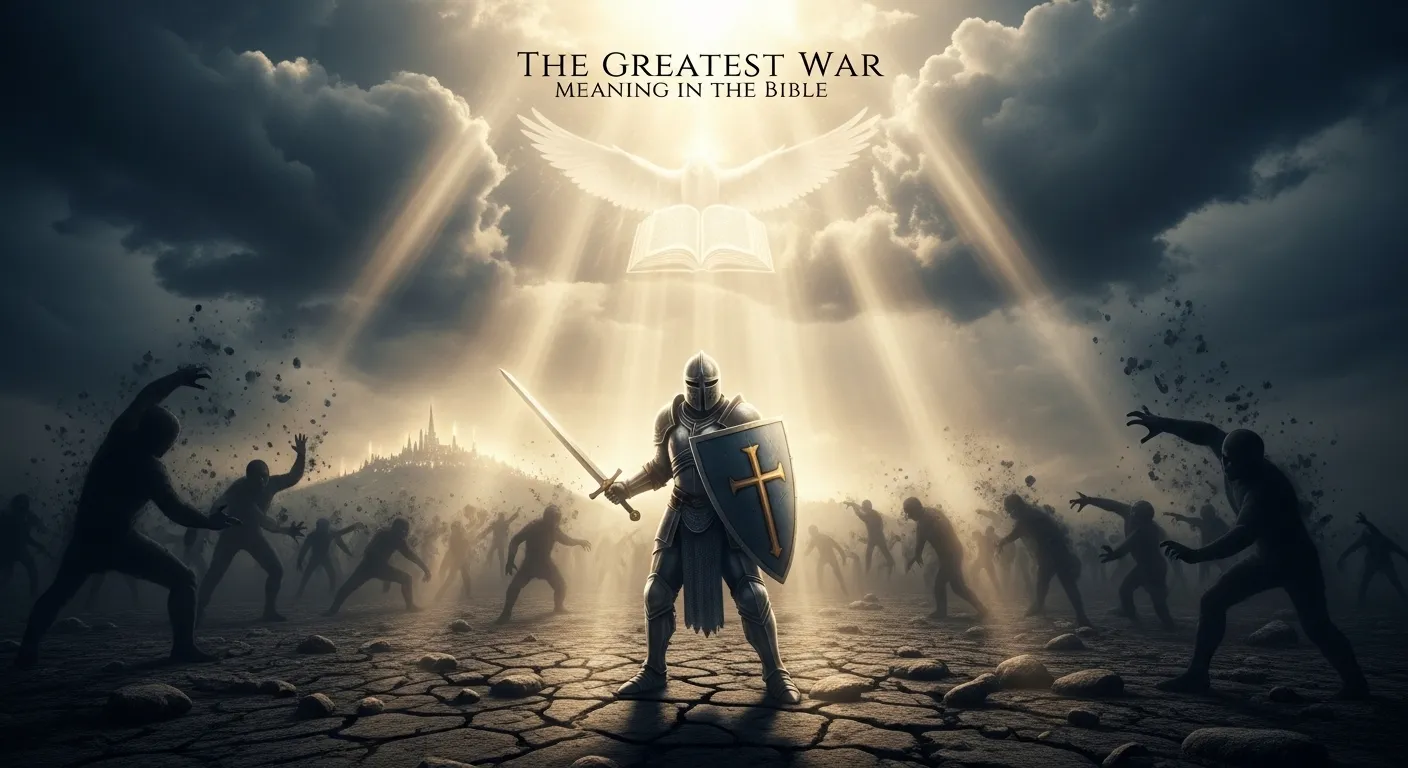
The strangest battle plan in Scripture was issued to King Jehoshaphat. Facing a coalition army “beyond the sea” that vastly outnumbered his forces, with the whole nation fasting and terrified, God sent word through a Levite: “You will not need to fight in this battle. Stand firm, hold your position, and see the salvation of the Lord” (2 Chronicles 20:17). Then Jehoshaphat did the unthinkable — “he appointed those who were to sing to the Lord and praise him in holy attire, as they went before the army” (2 Chronicles 20:21). The choir marched in front of the soldiers. Singers ahead of swordsmen. And “when they began to sing and praise, the Lord set an ambush,” and the enemy armies destroyed each other (2 Chronicles 20:22).
This is the Bible’s signature war story, and it establishes the pattern for understanding every “greatest war” in Scripture: the wars that matter most are the ones God fights, the weapons that matter most are not weapons, and the victory that matters most was never in doubt. The greatest war in the Bible is not decided by the biggest army. It is decided by the only Commander who cannot lose.
The War God Fights Himself
The pattern starts at the Red Sea. Israel is trapped — sea ahead, Egypt’s army behind — and Moses tells a nation of former slaves: “The Lord will fight for you, and you have only to be silent” (Exodus 14:14). Then the sea opens, the army drowns, and Israel’s contribution to the victory is watching. The song of Moses celebrates the result: “The Lord is a man of war; the Lord is his name” (Exodus 15:3).
David and Goliath run the same playbook at personal scale. The giant has the armor, the experience, the height. David has five stones and a sentence: “The battle is the Lord’s, and he will give you into our hand” (1 Samuel 17:47). One stone later, the theology is proven. Jehoshaphat’s choir is the same truth at national scale. In every case the human role shrinks to almost nothing — silence, a sling, a song — and God’s role expands to everything. Scripture’s greatest wars are great precisely because the combatants are so mismatched: omnipotence versus everything else.
The Final Gathering
The prophets project this pattern to the end of history. Ezekiel sees a coalition — “Gog, of the land of Magog” — descending on restored Israel “like a cloud covering the land” (Ezekiel 38:9, 16), and God’s response needs no human army: “I will rain upon him… torrential rains and hailstones, fire and sulfur” (Ezekiel 38:22). John picks up the same imagery for the last rebellion: Satan gathers “Gog and Magog,” numbering “like the sand of the sea,” surrounding the saints — “but fire came down from heaven and consumed them” (Revelation 20:8–9).
Revelation’s other name for the final muster is Armageddon: demonic spirits gather “the kings of the whole world… for battle on the great day of God the Almighty” at “the place that in Hebrew is called Armageddon” (Revelation 16:14, 16). Megiddo was a real plain where real ancient battles were fought — but John’s point is not military analysis. It is theological certainty. The final war is gathered by God’s permission, on God’s schedule, for God’s verdict. The enemy assembles itself for judgment, mistaking the courtroom for a battlefield.
The War Nobody Sees
But the Bible insists the greatest war is not only future and not only physical. Paul relocates the front line: “For we do not wrestle against flesh and blood, but against the rulers, against the authorities, against the cosmic powers over this present darkness, against the spiritual forces of evil in the heavenly places” (Ephesians 6:12). The wrestling is present tense, personal, and daily. Temptation, accusation, despair, deception — these are the skirmishes of the great war fought in individual hearts.
Paul knew this war from the inside. “For I do not do what I want, but I do the very thing I hate,” he confesses (Romans 7:15) — the civil war of the believer, the old nature against the new. This interior conflict is part of the same cosmic struggle: every soul is contested territory. And the weapons for it “are not of the flesh but have divine power to destroy strongholds” (2 Corinthians 10:4). Strongholds — entrenched lies, habitual sins, fortified fears — fall to spiritual weaponry or not at all.
Weapons That Are Not Weapons
So what does the arsenal look like? Jehoshaphat’s choir gives the first item: praise. Singing went before the army, and the battle was won while the song was sung. Paul and Silas confirmed it in a Philippian jail: “about midnight Paul and Silas were praying and singing hymns to God… and suddenly there was a great earthquake, so that the foundations of the prison were shaken” (Acts 16:25–26). Praise in chains is not denial of the battle. It is the battle, fought on the frequency heaven answers.
The second is prayer — the standing order for anxious soldiers: “do not be anxious about anything, but in everything by prayer and supplication with thanksgiving let your requests be made known to God” (Philippians 4:6). The third is the Word: Jesus met every wilderness temptation with “it is written” (Matthew 4:4, 7, 10), and Paul lists “the sword of the Spirit, which is the word of God” as the one offensive weapon in the armor (Ephesians 6:17). The fourth is watchfulness: “stay awake, for you do not know on what day your Lord is coming” (Matthew 24:42) — vigilance as a weapon, alertness as armor.
Notice what is absent: no human cleverness, no political power, no physical force. “Not by might, nor by power, but by my Spirit, says the Lord of hosts” (Zechariah 4:6). The war is the Lord’s; the weapons are the Lord’s; the victory is the Lord’s. The believer’s entire job description is stand: “having done all, to stand firm” (Ephesians 6:13).
More Than Conquerors
The war’s final word for the believer is not survival but triumph: “No, in all these things we are more than conquerors through him who loved us” (Romans 8:37). More than conquerors — the Greek hypernikao suggests overwhelming, superabundant victory. Not barely escaping, but triumphing so completely that the battle itself becomes a trophy.
And Paul closes every loophole of fear: “neither death nor life, nor angels nor rulers, nor things present nor things to come, nor powers, nor height nor depth, nor anything else in all creation, will be able to separate us from the love of God in Christ Jesus our Lord” (Romans 8:38–39). The greatest war in the Bible ends with the greatest assurance in the Bible. The choir can sing in front of the army because the Commander has never lost — at the Red Sea, in the valley of Elah, outside Jerusalem’s walls, at the cross, and at the end of all things.
Gideon’s Three Hundred
No war story makes God’s arithmetic clearer than Gideon’s. Israel faced the Midianites with 32,000 soldiers — and God said that was too many. “The people with you are too many for me to give the Midianites into their hand, lest Israel boast over me, saying, ‘My own hand has saved me’” (Judges 7:2). So God whittled the army down: first to 10,000, then — by the famous water-drinking test — to 300. Three hundred men against a host “like locusts in abundance” (Judges 7:12).
The battle plan was pure theater of divine power: trumpets, torches hidden in clay jars, and a shout — “For the Lord and for Gideon!” (Judges 7:18). No swords mentioned. The jars shattered, the torches blazed, the trumpets blared, and the Midianite army panicked and destroyed itself (Judges 7:21–22). Three hundred unarmed men routed a nation because the war was never theirs to fight. Gideon’s story is the standing rebuke to every believer who sizes up a spiritual battle by counting their own resources. God’s question is never “how many do you have?” It is always “will you trust Me with how few?” The greatest wars in Scripture are won with the smallest armies — because the point was never the army. “The sword of the Lord and of Gideon” — in that order, always.
The question is never whether God wins the war. The question is whether you will stand in His ranks — singing, praying, watching — while He does. The Christian doctrine of spiritual warfare has been formulated many ways across the centuries, but its core never changes: the battle belongs to the Lord, the weapons are spiritual, and the outcome was settled before the first shot was fired.










