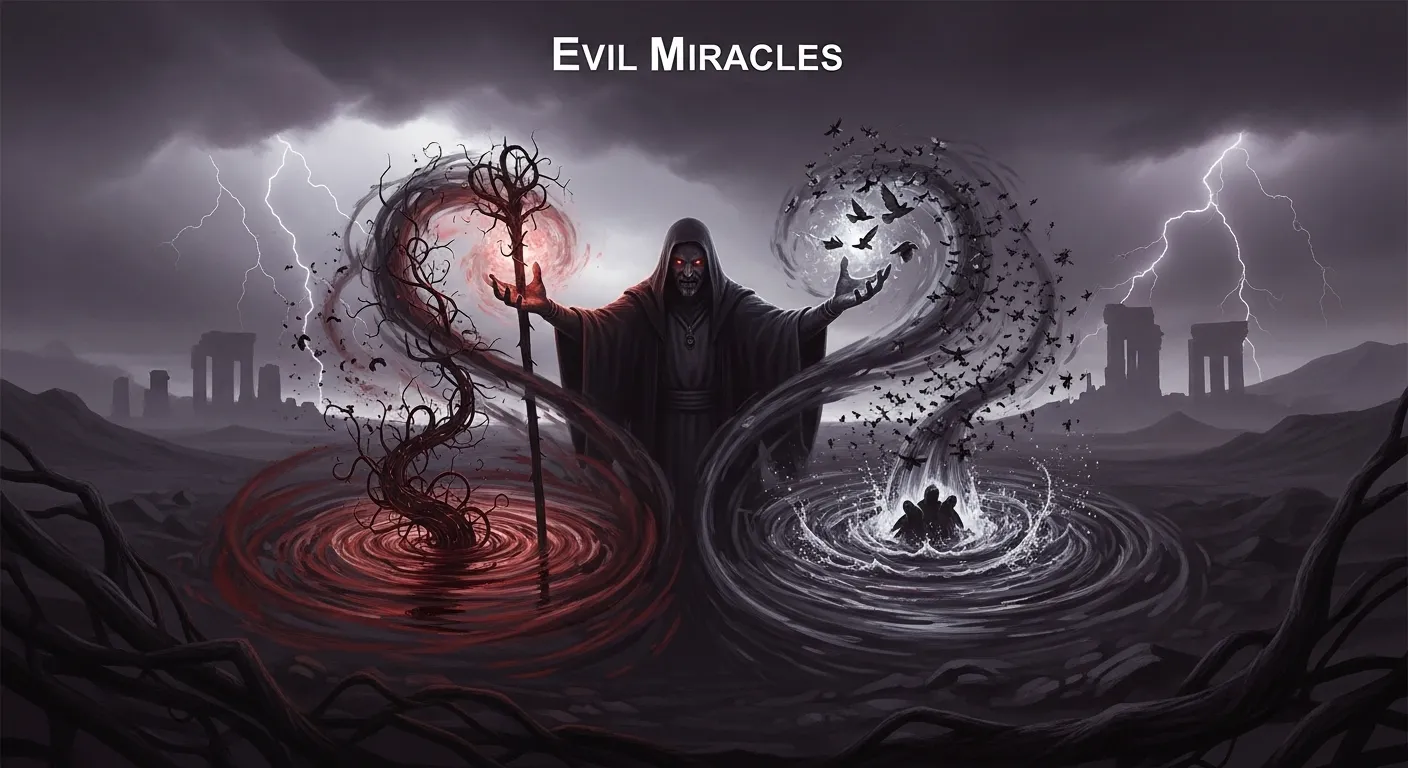
Moses threw down his staff and it became a serpent. Pharaoh’s magicians threw down their staffs — and theirs became serpents too. Then, in the detail that decides everything, “Aaron’s staff swallowed up their staffs” (Exodus 7:12). The Egyptian court had just witnessed something genuinely supernatural that was not from God. It was real power, really displayed, really not divine. And one sentence later the superior power ate the inferior one.
That scene is the Bible’s foundational lesson on evil miracles, and it contains the whole doctrine in miniature: false wonders can be real wonders; they can impress a court; they can even duplicate God’s signs for a while — and they are still defeated, still limited, and still lying about their source. Scripture never says all supernatural power is God’s. It says some of it is the enemy’s, and it teaches God’s people how to tell the difference.
The Court Magicians
Stay in Pharaoh’s court, because the magicians’ performance repays study. They matched Moses twice: the staff-serpent (Exodus 7:11–12) and the water-to-blood (Exodus 7:22). For two rounds, the contest looked like a tie — the supernatural equivalent of a stalemate. Then came the gnats: “the magicians tried by their secret arts to produce gnats, but they could not” (Exodus 8:18). Their power had a ceiling, and they hit it at the third plague. The magicians themselves confessed it: “This is the finger of God” (Exodus 8:19).
The pattern never changes. Evil’s imitations are real but bounded — impressive at first, exhausted quickly. Paul names the magicians centuries later — “Jannes and Jambres opposed Moses” (2 Timothy 3:8) — and uses them as the type of end-times deceivers: “they will not get very far, for their folly will be plain to all, as was that of those two men” (2 Timothy 3:9). The promise is not that deception will never look convincing. It is that it will never stay convincing. Time exposes what discernment should catch early.
The Test Moses Gave Later
Here is the harder lesson, the one that unsettles comfortable believers. Moses later warned Israel: “If a prophet or a dreamer of dreams arises among you and gives you a sign or a wonder, and the sign or wonder that he tells you comes to pass, and if he says, ‘Let us go after other gods,’… you shall not listen” (Deuteronomy 13:1–3). Read that carefully: the sign comes true — and it is still false. Accuracy is not authenticity. A fulfilled prediction, a genuine wonder, a real supernatural event can still be a lie if it leads away from God.
Why would God permit this? Moses gives the reason in the same passage: “for the Lord your God is testing you, to know whether you love the Lord your God with all your heart and with all your soul” (Deuteronomy 13:3). The test is not of God’s power but of God’s people’s loyalty. Will you follow the wonder, or will you follow the Word? The sign is the exam; allegiance is the subject. This single passage demolishes the most common modern error about miracles — that the supernatural, by itself, proves the divine. It does not. It never did.
Carmel: How God Answers
If Pharaoh’s court shows false wonders imitating true ones, Mount Carmel shows the reverse: the true God answering in a way no imitation could match. Elijah’s challenge to the prophets of Baal was deliberately unfair to everyone but God: two altars, two bulls, no fire allowed — “the god who answers by fire, he is God” (1 Kings 18:24). The Baal prophets performed for hours — shouting, dancing, cutting themselves — and “there was no voice, and no one answered” (1 Kings 18:29).
Then Elijah soaked his altar with water. Three times. Twelve jars, until the trench overflowed. And prayed one short prayer — sixty-three words — and “the fire of the Lord fell and consumed the burnt offering and the wood and the stones and the dust, and licked up the water that was in the trench” (1 Kings 18:38). The difference between Carmel and Pharaoh’s court is instructive: false wonders need favorable conditions and still fail at the ceiling; God’s power creates its own conditions and has no ceiling. The water made the miracle harder, and the fire came anyway. When God acts, He does not need the setup. He is the setup.
Jesus’ Own Warning
Jesus takes the doctrine personally and eschatologically: “For false christs and false prophets will arise and perform great signs and wonders, so as to lead astray, if possible, even the elect” (Matthew 24:24). Note the adjectives: great signs, great wonders. The end-times deception will not be clumsy. It will be spectacular enough to threaten “even the elect” — the qualifier “if possible” being the only comfort, and a real one: it is not possible, because the elect are kept.
Paul describes the engine behind it: “The coming of the lawless one is by the activity of Satan with all power and false signs and wonders” (2 Thessalonians 2:9). All power — the full arsenal. And Revelation shows the second beast “performing great signs, even making fire come down from heaven to earth in front of people, and by the signs that it is allowed to work… it deceives those who dwell on earth” (Revelation 13:13–14). Fire from heaven — the Carmel miracle, counterfeited. The imitation is deliberate: Satan’s end-times strategy is to forge God’s signature. Which is exactly why God’s people need better authentication than amazement.
The Practice of Testing
So how does a believer authenticate? John gives the standing order: “Beloved, do not believe every spirit, but test the spirits to see whether they are from God, for many false prophets have gone out into the world” (1 John 4:1). Test — the word is metallurgical, the assayer’s verb. Faith is not gullibility; in Scripture, it is the opposite. The Bereans were called “more noble” precisely because they “examined the Scriptures every day to see if these things were so” (Acts 17:11) — they fact-checked an apostle and were praised for it.
The tests Scripture supplies are concrete. The confession test: “every spirit that confesses that Jesus Christ has come in the flesh is from God” (1 John 4:2). Doctrine first — does the wonder-worker preach the real Christ? The fruit test: “You will recognize them by their fruits” (Matthew 7:16). Does the ministry produce holiness, humility, and love — or pride, greed, and control? The direction test: does the sign lead toward the God of Scripture or away (Deuteronomy 13)? The character test: Satan himself “disguises himself as an angel of light” (2 Corinthians 11:14) — so brightness proves nothing; check the substance behind the shine.
And the emotional signature matters. God’s wonders, even His frightening ones, ultimately produce “love, joy, peace” (Galatians 5:22) — the Spirit’s fruit. Evil wonders produce confusion, fear, bondage, and dependence on the wonder-worker. If a “miracle” leaves you more afraid, more confused, or more controlled, you have your answer regardless of how spectacular it looked. The magicians’ serpents were real. They were also lunch.
Simon the Sorcerer
The New Testament’s own case study in deceptive wonder-working is Simon of Samaria. Before Philip arrived, Simon “had practiced magic in the city and amazed the people of Samaria, saying that he himself was somebody great. They all paid attention to him… saying, ‘This man is the power of God that is called Great'” (Acts 8:9–10). Real amazement. Real following. A whole city convinced this was divine power — and it was sorcery.
What happened next is instructive. Simon believed Philip’s preaching, was baptized, and “continued with Philip. And seeing signs and great miracles performed, he was amazed” (Acts 8:13) — the amazement-merchant, amazed. But his heart had not changed categories: when he saw the Spirit given through the apostles’ hands, he offered money — “Give me this power also” (Acts 8:19). Peter’s rebuke was thunder: “May your silver perish with you, because you thought you could obtain the gift of God with money!… Repent, therefore, of this wickedness of yours” (Acts 8:20, 22).
Simon’s story exposes the anatomy of the false wonder-worker: amazement as a business model, power as a commodity, ministry as self-exaltation. He wanted the Spirit’s effects without the Spirit’s lordship — the classic signature of every evil miracle since. True power from God cannot be bought, controlled, or performed on demand; it is given to the surrendered, not sold to the ambitious. And Peter’s remedy was not a better technique but repentance — because the problem was never the methodology. It was the heart.
Evil miracles, then, are Scripture’s warning label on the supernatural: power is not proof, accuracy is not authenticity, and brightness is not holiness. The court of Pharaoh, the test of Deuteronomy, the fire of Carmel, and the warnings of Christ all converge on one practice — test everything, hold to the Word, and remember that the serpent-eating staff belongs to God. The history of false prophets and deceptive signs shows how often this warning has been needed; the Bible’s answer has never changed: the wonder must bow to the Word, never the reverse.










