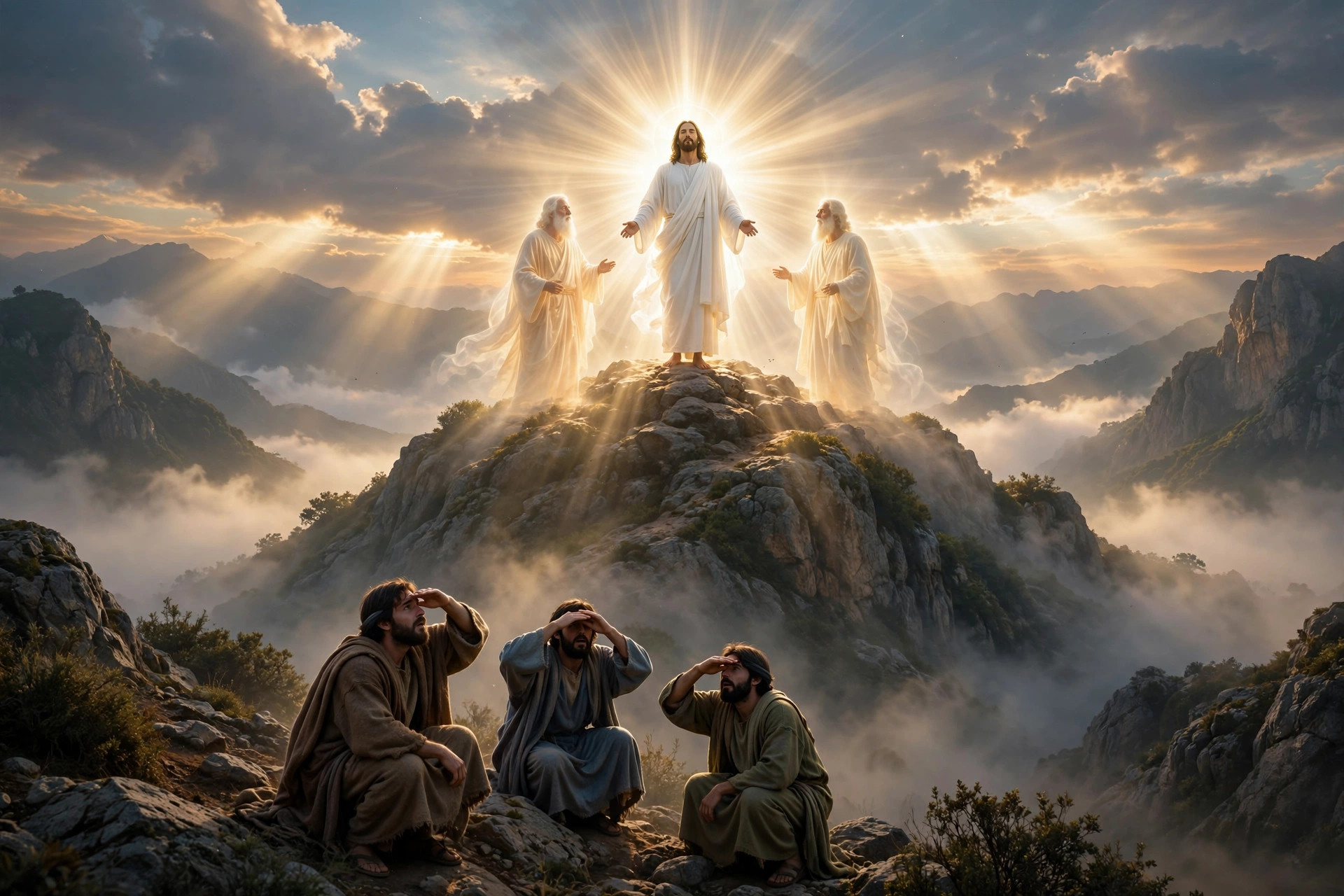
High on a quiet mountain, three disciples watched their world change forever. Jesus — the teacher they ate with, traveled with, and knew as a man — suddenly shone with the brightness of heaven itself. The Transfiguration of Jesus is one of the most stunning moments in all of Scripture, and its meaning reaches into the very heart of who Christ is.
Recorded in Matthew 17:1-13, Mark 9:2-13, and Luke 9:28-36, this event was God’s way of pulling back the curtain. For a brief, blazing moment, the disciples saw Jesus as he truly is: the eternal Son of God, radiant with divine glory. Everything that happened afterward — the cross, the tomb, the resurrection — must be read in the light of that mountain.
The Ascent: Six Days After a Confession
The Transfiguration did not happen in isolation. It happened “after six days” (Matthew 17:1) — about a week after Peter’s great confession at Caesarea Philippi: “You are the Messiah, the Son of the living God” (Matthew 16:16, in substance). It was also immediately after Jesus’ first prediction of his suffering: “The Son of Man must suffer many things and be rejected… and he must be killed and on the third day be raised to life” (Matthew 16:21, in substance).
That timing is everything. The disciples had just learned two truths that seemed impossible to hold together: Jesus is the glorious Messiah — and Jesus is going to die. The Transfiguration was God’s answer to the tension. The glory and the suffering belong to the same person. The cross is not the contradiction of the glory; it is the road to it.
Jesus took three disciples up the mountain: Peter, James, and John. These were the same three he would later take into Gethsemane (Matthew 26:37). They were his inner circle — witnesses to his glory on the mountain and witnesses to his agony in the garden. The same eyes that saw him shine saw him sweat drops of blood. God gave them both visions, because faith needs both: the glory to sustain us, and the suffering to save us.
The Moment: Glory Breaking Through
Luke tells us Jesus went up “to pray” (Luke 9:28). “As he was praying, the appearance of his face changed, and his clothes became as bright as a flash of lightning” (Luke 9:29). Matthew says, “His face shone like the sun, and his clothes became as white as the light” (Matthew 17:2). Mark adds that his clothes became “dazzling white, whiter than anyone in the world could bleach them” (Mark 9:3).
What was happening? The Transfiguration was not Jesus putting glory on from the outside. It was glory breaking through from the inside. The word Matthew uses is metamorphoō — the root of our word “metamorphosis.” The same word Paul uses when he says believers are “being transformed into his image with ever-increasing glory” (2 Corinthians 3:18). What happened to Jesus on the mountain is what will one day happen to us: the inner glory of a child of God, revealed.
For a moment, the veil of his humanity became transparent. The disciples saw what John would later describe: “We have seen his glory, the glory of the one and only Son, who came from the Father, full of grace and truth” (John 1:14). The carpenter from Nazareth was, and always had been, the eternal Son.
Moses and Elijah: The Law and the Prophets
Then two figures appeared, “talking with Jesus” (Matthew 17:3). Moses and Elijah — the Law and the Prophets, the two pillars of the Old Testament. Luke tells us what they discussed: “They spoke about his departure, which he was about to bring to fulfillment at Jerusalem” (Luke 9:31). The Greek word for “departure” is exodus — the same word for Israel’s escape from Egypt. Moses led the first exodus; Jesus would lead the greater one, out of sin and death.
Their presence was a living testimony. Moses had met God on Mount Sinai, his face shining afterward so brightly he wore a veil (Exodus 34:29). Elijah had been taken to heaven in a whirlwind, never tasting death. Now both stood beside Jesus — Moses, who died and was buried by God, and Elijah, who never died — and both pointed to him. The Law and the Prophets were not replaced by Jesus. They were fulfilled in him. Everything they wrote, everything they represented, found its completion on that mountain.
Peter, overwhelmed, blurted out a suggestion: “Lord, it is good for us to be here. Let us put up three shelters — one for you, one for Moses and one for Elijah” (Matthew 17:4). It was a well-meaning mistake. Peter wanted to make the three equal — three tents, three heroes. God would correct him in the next moment.
The Voice: “Listen to Him”
“While he was still speaking, a bright cloud covered them, and a voice from the cloud said, ‘This is my Son, whom I love; with him I am well pleased. Listen to him!'” (Matthew 17:5). The cloud was the same glory-cloud that had filled the tabernacle (Exodus 40:34) and the temple (1 Kings 8:11). The voice was the Father’s — the same voice that had spoken at Jesus’ baptism: “This is my Son, whom I love” (Matthew 3:17).
But this time the Father added two words that change everything: “Listen to him.” At the baptism, the emphasis was on identity — “This is my Son.” At the Transfiguration, the emphasis was on authority — “Listen to him.” Moses had promised a prophet like himself: “The Lord your God will raise up for you a prophet like me from among you… You must listen to him” (Deuteronomy 18:15). The Father was declaring that the Prophet had come — and that his words carry the weight of God’s own voice.
“When the disciples heard this, they fell facedown to the ground, terrified” (Matthew 17:6). And then the most tender detail in the whole story: “Jesus came and touched them. ‘Get up,’ he said. ‘Don’t be afraid.’ When they looked up, they saw no one except Jesus” (Matthew 17:7-8). Moses was gone. Elijah was gone. The cloud was gone. Only Jesus remained. That is the whole gospel in one sentence: when everything else fades, Jesus alone remains — and he is enough.
Why Did It Happen?
The Transfiguration happened for at least four reasons. First, to confirm Jesus’ identity. Peter had confessed him as Messiah; the Father confirmed it with glory and a voice. Second, to strengthen the disciples for the cross. They needed the mountain before they could face the valley. Third, to preview the kingdom. Jesus had said some standing there would “not taste death before they see the Son of Man coming in his kingdom” (Matthew 16:28) — and the Transfiguration was that preview. Fourth, to foreshadow our own transformation. “Our citizenship is in heaven,” Paul writes, “and we eagerly await a Savior from there, the Lord Jesus Christ, who… will transform our lowly bodies so that they will be like his glorious body” (Philippians 3:20-21, in substance).
Notice what Jesus did next: he ordered them to tell no one until after the resurrection (Matthew 17:9, in substance). The glory could not be properly understood until the cross had given it meaning. A Messiah without a cross is a misunderstanding. The disciples had to see the suffering before they could proclaim the glory.
What the Transfiguration Means for You
First, it means Jesus is who he claimed to be. The Transfiguration is not a myth or a metaphor. Peter, who was there, insisted on it decades later: “We did not follow cleverly devised stories… but we were eyewitnesses of his majesty” (2 Peter 1:16). “We ourselves heard this voice that came from heaven when we were with him on the sacred mountain” (2 Peter 1:18). The glory was real, the witnesses were real, and the testimony stands.
Second, it means glory and suffering belong together. If you are in a season of suffering, the Transfiguration does not promise you will escape it. It promises that suffering is not the end of the story. The same Jesus who shone on the mountain also bled in the garden — and rose from the tomb. Your suffering is real, but it is not final. Glory is coming.
Third, it means transformation is your destiny. The same word used for Jesus’ transfiguration is used for yours: “Do not conform to the pattern of this world, but be transformed by the renewing of your mind” (Romans 12:2, in substance). And Paul promises that as we contemplate the Lord’s glory, “we are being transformed into his image with ever-increasing glory” (2 Corinthians 3:18). One day, the glory that shone through Jesus on the mountain will shine through you.
Finally, it means the Father’s command still stands: “Listen to him.” In a world of a thousand voices — influencers, experts, anxieties, accusations — the Father’s voice cuts through: listen to Jesus. His words are the final word. His way is the true way. When everything else fades, only Jesus remains — and he is enough.
Questions Readers Often Ask
Which mountain was it? The Bible does not name it. Tradition points to Mount Tabor, but Mount Hermon, near Caesarea Philippi where the confession happened, is geographically more likely. The text’s silence is telling: the mountain’s identity does not matter. The glory does.
Why did Jesus take only three disciples? Peter, James, and John were his inner circle — witnesses to the raising of Jairus’s daughter, the Transfiguration, and Gethsemane. God often gives the deepest revelations to a few, so that they can strengthen the many.
Behold Him and Be Changed
The disciples went up the mountain knowing Jesus as a man. They came down knowing him as the Son of God in glory. They would still fail him, deny him, and flee from him — but they would never forget what they saw. And neither should we. The Transfiguration is God’s invitation to behold Jesus as he truly is — and to be changed by the sight. For further historical and theological background, the Wikipedia article on the Transfiguration of Jesus offers a helpful overview.










